


The first operators of miniature nuclear reactors described their job as “tickling the tail of a sleeping dragon” because of the danger involved with unlocking the energy in atoms.
Those units built more than a halfcentury ago in the US and Europe generated bursts of heat within fractions of a second so that scientists could gauge nuclear reactions, sometimes with deadly consequences.
Bearing names like Godiva, Viper and Super Kukla, the reactors never fed electricity grids. Instead, they produced research useful to nuclear weapons programs and eventually utilities. Modern reactors are gigantic by comparison, able to power more than 1.5 million homes each.
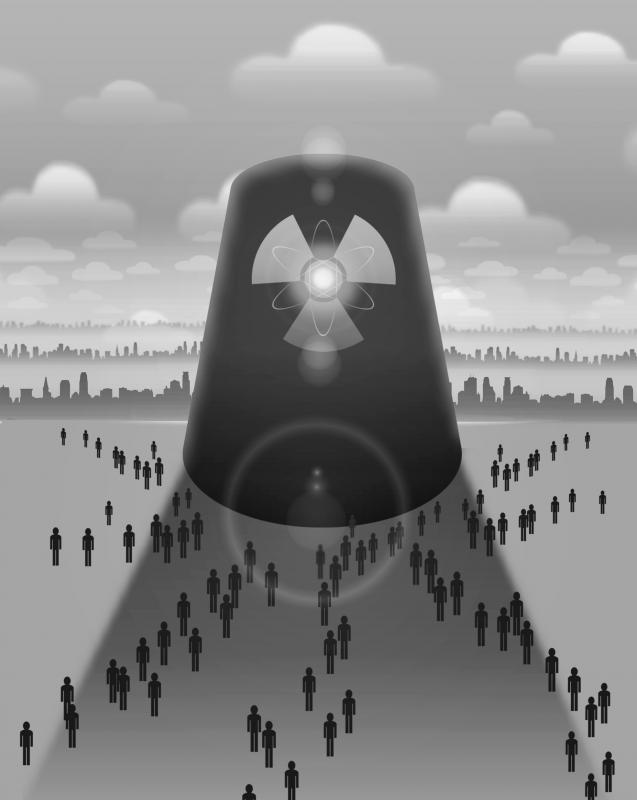
Illustration: Yusha
Today, the nuclear industry once again is thinking small, spurred on by politicians including US president-elect Joe Biden and British Prime Minister Boris Johnson. They are looking to solve the next climate change challenge: how to feed pollution-free heat to industries that make steel, cement, glass and chemicals.
Half of the world’s energy goes into making heat, and that produces two-fifths of the world’s carbon dioxide emissions, the International Energy Agency said.
Those industries sometimes need temperatures higher than 1,000°C and more often than not burn fossil fuels to get there.
“They just need heat,” said Steve Threlfall, an executive at the nuclear fuel maker Urenco Ltd.
He said that there is a £52 billion (US$69.88 billion) industrial market in the UK alone for reactors that can generate temperatures high enough to make ceramics, petrochemicals and steel.
“It’s a particular niche market, but a very large niche,” he said.
Small modular reactors (SMR) are drawing the attention of policymakers across the US and Europe because of their versatility. They can deliver a steady flow of energy in the form of heat and electricity.
‘DECADE OF SMR’
The power helps balance intermittent supplies coming from wind and solar farms. The heat can help decarbonize some of the world’s dirtiest industries.
Johnson last month set aside £500 million for SMR design in a green economy program, and Biden says they are one of the keys to long-term energy policy in the US.
Some of the biggest investors and industrial companies have backed the technology, with reactor designs emerging from Rolls-Royce Holdings, Fluor-backed NuScale Power and Terrestrial Energy USA, which has drawn investment from Bill Gates.
In all, there are 67 unique SMR technologies in various stages of development worldwide, the International Atomic Energy Agency said.
That is about a third more than just two years ago.
“This is the decade of SMR demonstrations, which could potentially determine front-runners for the expected economy of series production,” said Henri Paillere, head of planning and economic studies at the International Atomic Energy Agency in Vienna. “There is high level of innovation.”
Only a single SMR unit is in commercial operation, installed on a barge off Russia’s Arctic coast. NuScale expects approval for one of its designs as early as next month.
While the technology is advancing quickly, the economics of SMRs remain unproven. The challenge is earning enough money from a small plant to pay for the regulatory burden that comes with any nuclear venture.
The industry also must overcome perceptions that its technology is too costly and complex, which has largely left it behind in the clean-energy revolution.
Ballooning expenses and decade-long construction plans needed to build traditional reactors are pricing nuclear power off the grid as the price of wind and solar farms fall.
In places like the UK, which has spent more than a decade working to replace its aging fleet of nuclear reactors, sponsors like Electricite de France are finding it difficult to receive approval for new atomic generation plants.
While modern utility-scale reactors generate 1,500 megawatts (MW) or more, SMRs have capacities of 300MW or less and are designed to be mass-manufactured. The idea is that standardizing units drives down the overall cost of deployment, making the technology quicker and cheaper to set up than traditional nuclear reactors.
Each of the SMR designers offers different pathways to generating heat from nuclear reactions. Some companies such as Urenco, the British-Dutch-German consortium that is the world’s second-biggest nuclear-fuel maker, want to make SMRs that are cooled by gas instead of water.
Others, such as Moltex Energy and Terrestrial, use molten salt to conduct atomic fission. NuScale and Rolls-Royce aim simply to shrink traditional pressurized-water reactors down to a smaller size.
Industrial heat requirements have helped turn Canada into a global hub for SMR developers, said Simon Newton, the director of development at Moltex, a British company working on a 300MW SMR for New Brunswick Power.
NICHE MARKET
Temperatures exceeding 300°C are needed to turn oil sands into liquid petroleum for use in refined products ranging from fertilizers to pharmaceuticals. SMR developers are already evaluating how to displace fossil fuel producers in supply chains.
“This is a business where companies are not going to succeed just a little bit,” Newton said. “The winners will be worth billions and the losers left with nothing.”
Engineers also say that SMRs can efficiently produce hydrogen, another fuel emerging as a preferred way to supply heat for industry.
Around-the-clock availability of nuclear plants pairs well with methods that split gas from water, Urenco CEO Boris Schucht said in September.
“There are definitely niches that SMRs can fill, but there is uncertainty over whether the market will ever be large enough,” said M.V. Ramana, a nuclear physicist who wrote about the history of SMRs at Princeton University. “There are going to be a few reactors that are built. The question is whether there will be the next customer after they see the cost and time it has taken to get the first unit online.”
Experience suggests that the SMR producers could face the same cost overruns and delays that have plagued makers of utility-scale reactors.
An even bigger challenge could be convincing industries and utilities to forgo cheap natural gas. While US industries could provide sufficient demand for as many as 4,000 SMRs, they are unlikely to be able to afford the large up-front investments needed to pay it without support, according to a study by the US-based National Academy of Sciences.
“Using this market to justify the development of a program of factory SMR production appears to be a particularly implausible strategy,” the authors wrote.
Hundreds of billions of dollars in direct subsidies, along with carbon dioxide pollution at US$100 a ton — almost triple the cost of today’s prices in Europe — are required to develop the industry, they wrote.
Without reviving demand for nuclear energy, the academy warned, the US risks losing expertise in building reactors, leaving behind all the hard lessons scientists learned from tickling dragon tails seven decades ago.

Because much of what former US president Donald Trump says is unhinged and histrionic, it is tempting to dismiss all of it as bunk. Yet the potential future president has a populist knack for sounding alarums that resonate with the zeitgeist — for example, with growing anxiety about World War III and nuclear Armageddon. “We’re a failing nation,” Trump ranted during his US presidential debate against US Vice President Kamala Harris in one particularly meandering answer (the one that also recycled urban myths about immigrants eating cats). “And what, what’s going on here, you’re going to end up in World War
Earlier this month in Newsweek, President William Lai (賴清德) challenged the People’s Republic of China (PRC) to retake the territories lost to Russia in the 19th century rather than invade Taiwan. He stated: “If it is for the sake of territorial integrity, why doesn’t [the PRC] take back the lands occupied by Russia that were signed over in the treaty of Aigun?” This was a brilliant political move to finally state openly what many Chinese in both China and Taiwan have long been thinking about the lost territories in the Russian far east: The Russian far east should be “theirs.” Granted, Lai issued
On Tuesday, President William Lai (賴清德) met with a delegation from the Hoover Institution, a think tank based at Stanford University in California, to discuss strengthening US-Taiwan relations and enhancing peace and stability in the region. The delegation was led by James Ellis Jr, co-chair of the institution’s Taiwan in the Indo-Pacific Region project and former commander of the US Strategic Command. It also included former Australian minister for foreign affairs Marise Payne, influential US academics and other former policymakers. Think tank diplomacy is an important component of Taiwan’s efforts to maintain high-level dialogue with other nations with which it does

On Sept. 2, Elbridge Colby, former deputy assistant secretary of defense for strategy and force development, wrote an article for the Wall Street Journal called “The US and Taiwan Must Change Course” that defends his position that the US and Taiwan are not doing enough to deter the People’s Republic of China (PRC) from taking Taiwan. Colby is correct, of course: the US and Taiwan need to do a lot more or the PRC will invade Taiwan like Russia did against Ukraine. The US and Taiwan have failed to prepare properly to deter war. The blame must fall on politicians and policymakers


 RSS
RSS