


More regulations should be introduced to make the legal system regulating activities in the nation’s waters more complete, Taiwan People’s Party (TPP) lawmakers said yesterday, citing increased dredging operations by Chinese vessels off Matsu.
TPP caucus whip Jang Chyi-lu (張其祿) told a news conference on raising awareness about illegal dredging that Taiwan, as an island nation, should have a complete set of laws to address its wide array of maritime affairs.
The TPP made the appeal a day after the Executive Yuan passed amendments to Article 18 of the Act on the Exclusive Economic Zone and the Continental Shelf of the Republic of China (中華民國專屬經濟海域及大陸礁層法), and Article 36 of the Sand and Gravel Excavation Act (土石採取法), increasing the penalties for illegal dredging to a maximum of seven years in prison or a fine of up to NT$80 million (US$2.77 million).
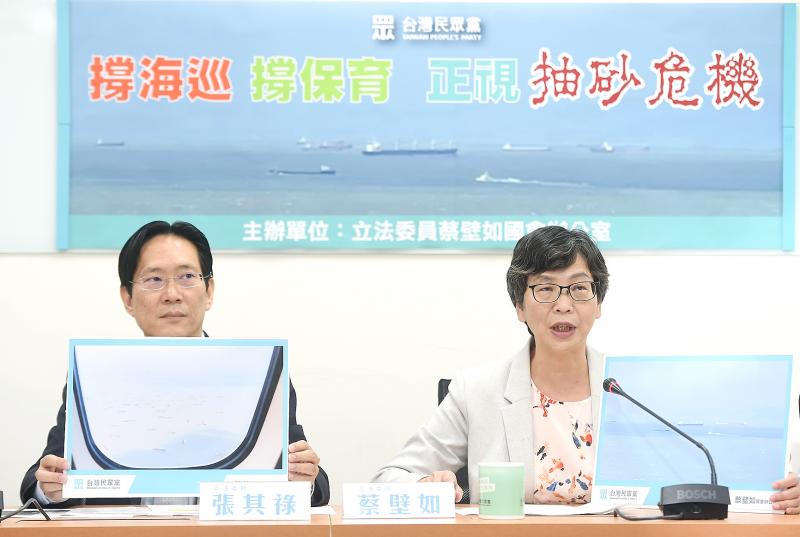
Photo: Chien Jung-fong, Taipei Times
The amendments are subject to further review by the Legislative Yuan.
Waters within 6km of Matsu are restricted and although legislation states that sand dredgers operating in that area would be punished, many Chinese operators were found to only be in “nearby” areas, Jang said.
These gray areas are not technically Taiwan’s exclusive economic zone, as Taiwan and China have not agreed on where the boundaries are, Jang said, calling for cross-strait negotiations on the issue.
Although the Executive Yuan passed the amendments, they are not enough, as regulations for maritime affairs are drafted by separate government agencies and have to be cited from many sources, he said.
The fundamental problem is the lack of legislation from one source that covers everything, he said.
TPP Legislator Tsai Pi-ru (蔡壁如) said that more than 100 Chinese dredgers have been found illegally mining sand off Matsu in the past few weeks, disturbing the lives of local residents with noise and light pollution.
Efforts by the Coast Guard Administration to intercept the vessels were futile, as the vessels would simply move a short distance and continue their operations, Tsai said.
It is good that the amendments passed by the Executive Yuan state that confiscated dredging vessels can be blown up at sea to become artificial fish shelters, which can benefit marine ecology, she said.
The practice also ensures that the vessels would not fall into the hands of illegal sand-mining rings at auctions, as has happened before, she said.
Lin Chin-kuan (林金官), a member of a Matsu folk association, said that media reports showed that China’s increasing mining activities are related to land reclamation projects and the widening of airport runways in Fuzhou in China’s Fujian Province.
Many Chinese vessels seem to not know that waters near Matsu are off-limits to dredging, Lin said.
Areas designated for sand mining by China’s Xiamen City are 15km from Kinmen, Lin said, adding that hopefully the same distance would be applied to Matsu and Fuzhou.
The Executive Yuan and the Ocean Affairs Council should clarify whether Matsu’s waters have been officially defined by China as designated areas for legal sand dredging, he said.

The Centers for Disease Control (CDC) yesterday reported the first case of a new COVID-19 subvariant — BA.3.2 — in a 10-year-old Singaporean girl who had a fever upon arrival in Taiwan and tested positive for the disease. The girl left Taiwan on March 20 and the case did not have a direct impact on the local community, it said. The WHO added the BA.3.2 strain to its list of Variants Under Monitoring in December last year, but this was the first imported case of the COVID-19 variant in Taiwan, CDC Deputy Director-General Lin Ming-cheng (林明誠) said. The girl arrived in Taiwan on

South Korea is planning to revise its controversial electronic arrival card, a step Taiwanese officials said prompted them to hold off on planned retaliatory measures, a South Korean media report said yesterday. A Yonhap News Agency report said that the South Korean Ministry of Foreign Affairs is planning to remove the “previous departure place” and “next destination” fields from its e-arrival card system. The plan, reached after interagency consultations, is under review and aims to simplify entry procedures and align the electronic form with the paper version, a South Korean ministry official said. The fields — which appeared only on the electronic form

The Ministry of Foreign Affairs (MOFA) is suspending retaliation measures against South Korea that were set to take effect tomorrow, after Seoul said it is updating its e-arrival system, MOFA said today. The measures were to be a new round of retaliation after Taiwan on March 1 changed South Korea's designation on government-issued alien resident certificates held by South Korean nationals to "South Korea” from the "Republic of Korea," the country’s official name. The move came after months of protests to Seoul over its listing of Taiwan as "China (Taiwan)" in dropdown menus on its new online immigration entry system. MOFA last week

A bipartisan group of US senators has introduced a bill to enhance cooperation with Taiwan on drone development and to reduce reliance on supply chains linked to China. The proposed Blue Skies for Taiwan Act of 2026 was introduced by Republican US senators Ted Cruz and John Curtis, and Democratic US senators Jeff Merkley and Andy Kim. The legislation seeks to ease constraints on Taiwan-US cooperation in uncrewed aerial systems (UAS), including dependence on China-sourced components, limited access to capital and regulatory barriers under US export controls, a news release issued by Cruz on Wednesday said. The bill would establish a "Blue UAS


 RSS
RSS