


Soon after President Tsai Ing-wen (蔡英文) announced that Taiwan would ease import restrictions on US beef and pork products from Jan. 1 next year, the US promptly responded with an announcement by Assistant Secretary of State for East Asian and Pacific Affairs David Stilwell of a “new senior-level annual economic dialogue” to comprehensively deepen Taiwan-US economic ties.
The American Institute in Taiwan immediately followed up by releasing a statement, announcing that “the United States and Taiwan will be launching an Economic and Commercial Dialogue, led by the Department of State’s Under Secretary for Economic Growth, Energy, and Environment Keith Krach.”
Krach — who ranks just below the deputy secretary and the secretary in the US Department of State — arrived in Taiwan on Sept. 17 for a three-day visit. Given his position, Krach would not have come to Taiwan for a bilateral trade agreement or minor matters. The main purpose of the visit was probably to establish a senior-level Taiwan-US economic strategic partnership.
Krach is promoting an initiative, called the “Economic Prosperity Network” (EPN), which aims to encourage countries to economically decouple from China and form an economic alliance against Beijing.
On July 23, US Secretary of State Mike Pompeo delivered a groundbreaking speech titled “Communist China and the Free World’s Future.” This was tantamount to announcing that the US and China have entered an era of comprehensive confrontation and conflict.
It seems that the US is serious about launching the senior-level economic dialogue against Beijing. Given this rare opportunity, Taiwan should not hesitate to move toward the formation of an economic alliance with the US.
There are three aspects to which Taiwan should pay particular attention.
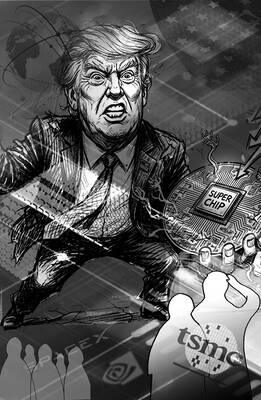
First, the nation should collaborate with the US’ semiconductor sector to build up a semiconductor industry hub. While Taiwan boasts the leading semiconductor industry in the world, the US still controls the sector’s most advanced technologies.
However, China has pledged an estimated US$1.4 trillion to support so-called third-generation semiconductors as part of its 14th five-year plan, hoping to catch up with the US by 2025.
In face of this tremendous challenge, which almost exhausts China’s economic power, the US might be in dire need of strategic partners in Taiwan and Japan, particularly the Taiwanese government and Taiwan Semiconductor Manufacturing Co (TSMC).
During Krach’s visit, he and TSMC founder Morris Chang (張忠謀) were invited to a dinner hosted by Tsai. This shows that the US attaches great importance to the Taiwan-US semiconductor alliance.
Second, after the competition between the US and China for global hegemony became clear, a new global economic model under the banner of “Desinicization,” or “one world, two groups” is emerging.
By proposing the EPN to democratic nations, the US hopes that supply chains would get taken out of the hands of the Chinese Communist Party, limiting Beijing’s influence to China and parts of Africa, about one-third of the world, to protect US national security.
Being an indispensable part of the US’ Indo-Pacific Strategy, Taiwan is influential enough to help shape the future of the high-tech industry’s supply chain, and it should take part in the US-led EPN.
However, Taiwan must pay attention to the obligations that come with it. The nation should strive to be a reliable ally. The government must make an all-out effort to curb the pro-China forces inside Taiwan, by imposing stronger regulations against Beijing’s infiltration.
A technological investigation bill drafted by the Ministry of Justice, for instance, must be enacted and implemented as soon as possible, despite opposition by pro-China members of the public who want to fawn on Beijing and sell out Taiwan under the disguise of defending human rights.
If the regulations fail to catch up with technological progress, the government must draft new laws to protect Taiwanese industries and prevent technology from being plagiarized. Otherwise, outdated laws might create loopholes in the Taiwan-US economic alliance and bring harm to the interests of both countries. Taiwan should make use of this opportunity and bravely strive for a Taiwan-US economic alliance.
Huang Tien-lin is a former advisory member of the National Security Council.
Translated by Chang Ho-ming
The White House’s decision to take a 9.9 percent stake in Intel Corp is looking like very shrewd business indeed. Since the government bought in at US$20.47 a share last August, the US chipmaker’s surging stock price has delivered the US a US$43 billion return. One of the reasons the investment has so far proved so sound is that the White House has made sure of it. According to The Wall Street Journal, Howard personally pushed deals on Intel’s behalf with some of the most lucrative clients imaginable. They include Nvidia Corp, the company at the heart of the AI
In a Taiwanese university classroom, a lecturer asks in English: “Can anyone give me an example from Taiwan?” Students look down. No one answers. After class, one student writes on the course platform in Mandarin: “I understood the concept, but I didn’t know how to answer in English.” That moment highlights a key issue in Taiwan’s English-medium instruction (EMI) reform: It is not just about more English-taught courses, but whether students can learn, participate and belong. EMI expansion is part of the Bilingual 2030 policy and the Ministry of Education’s BEST Program, aiming to improve English ability, support EMI teaching
A single photograph can cut through a lot of noise, but it can also be used to misrepresent the truth. At the very least, it can concentrate the mind on something that requires further investigation. On Monday last week, Ma Ying-jeou Foundation CEO Tai Hsia-ling (戴遐齡) and former National Security Council secretary-general King Pu-tsung (金溥聰) held a news conference in which they showed a photograph of former foundation CEO Hsiao Hsu-tsen (蕭旭岑), now Chinese Nationalist Party (KMT) deputy chairman. In the image Hsiao is seated next to Xiamen Taiwan Businessmen Association chairman Han Ying-huan (韓螢煥). The two men were holding
The Ministry of the Interior, working with the navy and coast guard, is organizing Taiwan’s first joint exercise simulating escort tankers carrying liquefied natural gas (LNG) and oil through a Chinese blockade. The drills simulate fuel transport along three maritime corridors leading toward Japan, the Philippines and the US. Deputy Minister of the Interior Sawyer Mars (馬士元) said that a blockade of the Taiwan Strait would amount to “almost a 100 percent blockade of the regional energy supply.” Minister of National Defense Wellington Koo said planning to counter a blockade is standard practice in Taipei. While the exercise is limited in


 RSS
RSS