


An outrageous dismissal of the exemplary Taiwanese fight against COVID-19 has been perpetrated by the EU. There is no excuse.
I presume that everyone who reads the Taipei Times knows that the EU has excluded Taiwan from its so-called “safe list,” which permits citizens unhindered travel to and from the countries of the EU.
As the EU does not feel that it needs to explain the character of this exclusive list, perhaps we should examine it ourselves in some detail.
There are 14 nations on the list that have been chosen as safe countries of origin and safe countries of destination for the EU. We must presume that they have proven better records than the excluded nations on matters such as new COVID-19 cases, total cases over time and lesser mortality rates. This distinction should be clear and unproblematic.
However, the evidence from the chosen 14 nations shows this presumption to be false.
We go further, for we would claim that not only is Taiwan far above the nations on the list in its COVID-19 record, Taiwan’s other characteristics — such as the maturity and stability of its civil society, its education and health systems, and its level of good governance — are all well above that of the nations on the selected list.
First, Taiwan has had no domestic COVID-19 cases for more than 80 days, and only 449 cases registered since its first infection on Jan. 21. The nation has a level of COVID-19 cases of 19 per 1 million residents and 0.3 per 1 million for COVID-19 deaths.
It is true that nine nations on the list can match Taiwan in having no deaths in the 24 hours before confirmation of the list, but, considering the overall death toll, Morocco had 148, Australia had 107 and South Korea had 63. This could be viewed as bad luck, but further facts suggest bad judgement. Looking at cases per million in the nations on the list, the average of the 14 nations is 578, ranging from 46 for Thailand to 2,784 for Canada.
Compared with Taiwan’s figures, its present exclusion from the list becomes ludicrous. With mortality measured as registered deaths per million — a much better indicator of official management of COVID-19 over time — Taiwan’s figure of 0.3 can be set against a 14-nation list average of 26.5, ranging from 0.8 for Thailand to 230 for Canada.
Surely these figures speak for themselves. Among other countries, Taiwan has been very badly treated by the EU.
However, the matter is especially annoying and unfair for Taiwan for two reasons:
First, Taiwan is a nation of exemplary COVID-19 management performance at a global level. Excluding very small and isolated nations, Taiwan can be rated as No. 1 globally.
Second, there are no other reasons that can be arrayed against Taiwan that would rationally excuse the EU.
Let me briefly expand on this:Many commentators — including myself — have long identified a superior kind of governance of COVID-19 in East Asian nations, but also, for example, in Germany and some of the smaller Western economies.
My model combined speedy interventions, early work in identifying infected incomers, tracing contact networks, isolating, practical supply responses, medical effectiveness and low costs.
Western nations tended to act late and to depend too much on lockdowns without paying sufficient attention to hospital supplies and personnel protection, locating the major sites of the especially vulnerable — older folks and those with deficient immune systems — or locking down contact nets, localities and particular sites rather than imposing wholesale national lockdowns.
However, some holes have appeared in the “East Asia model” over time, with Singapore clearly having depended very much on a huge proportion of foreign workers in industrial production and domestic services who were neglected in national estimates, but have since shown the flaws in the management system there.
Hong Kong has kept an excellent record of low cases and mortality, but it seems that this is far more due to the inventive responses of civil society than to good governance, and the territory now fears a third wave.
In South Korea, the earlier, very good record has been eroded by the later rise in cases and mortality.
Yet, as I have noted above, South Korea with its 63 new cases and its 254 cases per million appears within the EU list of safe nations.
In brief, Taiwan remains first among nations in demonstrating a form of COVID-19 response and management that is presently unmatched in the world. It is impossible for the EU to not have known this.
So, are there any reasons at all that could be called rational? When thinking of the EU accepting or rejecting tourists, businesspeople, students and relatives from other nations on COVID-19 grounds, the only possible factor beyond the statistics themselves must relate to the capacity for government and civil society to work together to dampen and eventually eliminate the dangers of the virus.
There is no single measure for this, but there is reasonable evidence I can suggest. Probably the best is the Global Competitiveness Index for last year and this year, constructed by the World Economic Forum in Geneva, Switzerland, the city at the heart of European diplomacy and foreign policy. This has worked for many years, is of great influence and generates mega-data from a host of institutions, surveys and its own extensive network of European-dominated partner institutions.
The index ranks Taiwan as No. 12 in the world, that is, in the top dozen of the world’s nations in its levels of education, civil society, security, stability of governance and good health.
However, the EU list of safe nations includes Rwanda at 100, Algeria at 89, Georgia at 74 and Uruguay at 54.
This is no critique of any nation, but it is a strong indictment of the EU. Its decision cannot be allowed to stand. Other countries might now be arguing their cases, but none are in as strong a position as Taiwan.
There are two other basic considerations:
First, this symbolic EU decision hits Taiwan especially hard because it is a small nation, but a big economy whose activities across a range of areas is seldom recognized by the international community. Taiwan’s offers of material and logistics aid to other nations have been generous, but are generally overlooked in the Western press. Its diplomatic life outside of the WTO or the WHO means that Taiwan repeatedly suffers from a lack of strategic alliances and powerful network influences.
The COVID-19 world should surely recognize the true excellence of the way in which Taiwan has fought the disease and attempted to help others. It is clear that Taiwan’s success has arisen from a mix of good governance and a responsive civil society. What more could be asked for?
Second, Taiwan is a thorn in the side of China, but there is no reason to argue that China could possibly object to the inclusion of Taiwan in the EU’s “safe list.” China has so many other things aimed at Taiwan. Any resolution of the Taiwan-China relationship might not come soon and might certainly not be helped either way by the decisions of the EU.
If pressure from China, or even the EU’s fear of such pressure, is the most active factor at work, then this is, in the end, irrational. Europe can have no real reason to exclude Taiwan from the list, and it could easily argue that any Chinese objection that arises is immaterial and of no great moment.
Whatever the tempest of criticism that shall arise with the EU listing, whatever the number of nations that is to object for so many reasons, the case of Taiwan is especially serious, for it identifies the many flaws that now exist in the global culture of our present world.
Ian Inkster is professorial research associate at the Center of Taiwan Studies, SOAS, University of London, a global historian and political economist, who has taught and researched at universities in Britain, Australia, Taiwan and Japan.
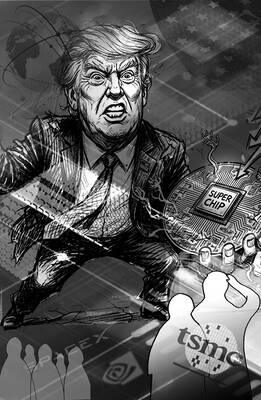
The White House’s decision to take a 9.9 percent stake in Intel Corp is looking like very shrewd business indeed. Since the government bought in at US$20.47 a share last August, the US chipmaker’s surging stock price has delivered the US a US$43 billion return. One of the reasons the investment has so far proved so sound is that the White House has made sure of it. According to The Wall Street Journal, Howard personally pushed deals on Intel’s behalf with some of the most lucrative clients imaginable. They include Nvidia Corp, the company at the heart of the AI
In a Taiwanese university classroom, a lecturer asks in English: “Can anyone give me an example from Taiwan?” Students look down. No one answers. After class, one student writes on the course platform in Mandarin: “I understood the concept, but I didn’t know how to answer in English.” That moment highlights a key issue in Taiwan’s English-medium instruction (EMI) reform: It is not just about more English-taught courses, but whether students can learn, participate and belong. EMI expansion is part of the Bilingual 2030 policy and the Ministry of Education’s BEST Program, aiming to improve English ability, support EMI teaching
The Ministry of the Interior, working with the navy and coast guard, is organizing Taiwan’s first joint exercise simulating escort tankers carrying liquefied natural gas (LNG) and oil through a Chinese blockade. The drills simulate fuel transport along three maritime corridors leading toward Japan, the Philippines and the US. Deputy Minister of the Interior Sawyer Mars (馬士元) said that a blockade of the Taiwan Strait would amount to “almost a 100 percent blockade of the regional energy supply.” Minister of National Defense Wellington Koo said planning to counter a blockade is standard practice in Taipei. While the exercise is limited in
A single photograph can cut through a lot of noise, but it can also be used to misrepresent the truth. At the very least, it can concentrate the mind on something that requires further investigation. On Monday last week, Ma Ying-jeou Foundation CEO Tai Hsia-ling (戴遐齡) and former National Security Council secretary-general King Pu-tsung (金溥聰) held a news conference in which they showed a photograph of former foundation CEO Hsiao Hsu-tsen (蕭旭岑), now Chinese Nationalist Party (KMT) deputy chairman. In the image Hsiao is seated next to Xiamen Taiwan Businessmen Association chairman Han Ying-huan (韓螢煥). The two men were holding


 RSS
RSS