


In some ways Taiwan’s situation at the beginning of this year seems grim. Global economic disruption from the COVID-19 pandemic will disproportionately harm the nation because of its heavy dependence on exports. Chinese military activity near Taiwan, as well as verbal threats emanating from the Chinese government, have increased.
This has fueled speculation in Taiwan that Beijing has decided to politically incorporate Taiwan by military force and sees a window of opportunity while the US is temporarily preoccupied with the pandemic.
However, amid these immediate problems, four longer-term trends can be seen that have positive implications for Taiwan.
First, Taiwan is on track to remain prosperous after the pandemic blows over. Taiwan’s economy was growing at a pace of about 3 percent last year, and that was projected to continue this year before the onset of the pandemic.
The New Southbound Policy is bearing fruit, helping drive a healthy diversification away from economic overreliance on China.
A significant number of Taiwanese companies are returning home, while others are redirecting their foreign direct investment away from China and into countries such as Vietnam. Increased tourism from other countries has helped offset the Chinese government’s efforts to starve Taiwan of visitors from China.
The chances of a US-Taiwan bilateral trade agreement in the near future are perhaps at their best ever, enhanced by the US government worrying less about actions that might offend Beijing.
Second, the pandemic has increased world respect and sympathy for Taiwan, which will pay long-term dividends.
Taiwan and China made administrative and procedural adjustments based on their experiences with the SARS epidemic in 2003.
In China, a dysfunctional political culture impeded the efficient operation of the healthcare system in the crucial early weeks of the COVID-19 outbreak, squandering the advance notice provided by doctors such as ophthalmologist Li Wenliang (李文亮), and worsening the crisis for China and the rest of the world.
China was in the news for trying to spin the virus narrative to heroize Chinese President Xi Jinping (習近平) and the Chinese Communist Party (CCP); for dubiously declaring an early victory over the virus, despite widespread suspicion that Beijing was underreporting new cases; and for transferring faulty medical supplies to other countries.
By contrast, Taiwan has been a model of how to fight a pandemic. Taipei moved quickly to impose travel bans, which despite early controversy soon proved wise and essential.
Taiwan marshaled the latest technology and social media to track people possibly exposed to the virus. Authorities implemented a strict quarantine system combined with measures to ensure food delivery to the people quarantined.
They also established a system to ensure equitable rationing rather than hoarding of masks. By the beginning of this month, Taiwan had produced a surplus of masks and was donating millions of them to countries still gripped by shortages.
The nation’s approach featured a highly active outreach by government officials to keep citizens informed about the virus and what steps are necessary to combat it, with credible experts taking the lead.
The exposure of Chinese influence over the WHO has shamed both, increasing international support for the idea that Beijing’s opposition to Taiwan’s membership in the global health regime is not only immoral and irresponsible, but also dangerous. This will increase pressure on China to relent.
A third positive trend is increased US support for Taiwan.
US President Donald Trump has exhibited little inherent interest in Asia-Pacific strategic issues beyond a dislike for multilateral trade deals and for the US’ alliance commitments. He devoted considerable attention to the North Korea nuclear missile crisis only because it was thrust upon him, and he has now seemingly disengaged, content to rest on his false claim of victory.
Based on what Trump had said before taking office, it would not have been surprising to see his administration downgrade US relations with Taiwan as part of a larger agreement with China, which he could have sold domestically as an economic victory for Americans.
However, the Trump administration has upgraded Taiwan-US relations.
While his two predecessors refused to provide Taiwan with new F-16 jets, Trump approved a sale in August last year. Washington also moved toward a more routine rather than “bundled” process of selling arms to Taiwan.
Reported transits of US Navy warships through the Taiwan Strait have become more frequent. Restrictions on high-level visits loosened. US deputy assistant secretaries of state and defense have traveled to Taipei, while National Security Council Secretary-General David Lee (李大維) and former premier William Lai (賴清德) — now vice president-elect — visited Washington, and President Tsai Ing-wen (蔡英文) visited a US government facility, NASA headquarters in Houston, Texas.
The wellspring of this rejuvenation in Taiwan-US relations is Xi. Americans saw the opening of the Xi regime as marking a reversal of previously positive trends in Beijing’s domestic and foreign-policy behavior.
Under Xi, the Chinese state reasserted its power at the expense of Chinese civil society, seen in the contraction of civil and political rights, a new emphasis on loyalty to the CCP and to Xi, and strong new campaigns to suppress religious communities, particularly Muslims.
Externally, Beijing seemed more interested in imposing its preferences upon the region than in assuaging fears of Chinese domination, exemplified by China’s construction of military bases in disputed territory in the middle of the South China Sea.
A result of this Chinese turn toward increased authoritarianism and bullying was a new consensus in the US, that playing nice with China was not working and a tougher policy was warranted.
As part of this shift, Taiwan’s political and strategic value to the US was increased because of Taiwan’s support for the US-sponsored liberal regional order. At the same time, the US government felt less restrained from taking actions that offend China, such as cooperation and coordination with Taipei.
This is not limited to the Trump White House. The two top contenders to be the Democratic Party’s presidential candidate in November both expressed continuing support for Taiwan.
US Senator Bernie Sanders, who has since bowed out of the race, in February said that as president he would order the US military to intervene to prevent a Chinese “invasion” of Taiwan, while former US vice president Joe Biden in January said that he favored Americans “strengthening our ties with Taiwan.”
Two laws calling for closer Taipei-US relations — The Taiwan Travel Act and the Taiwan Allies International Protection and Enhancement Initiative — passed unanimously in both houses of the US Congress in 2018 and this year respectively.
It is remarkable that even with the fading of the US generation that had sentimental attachment to the Republic of China (ROC) as a World War II ally and as the “free China” of the Cold War, and despite the expressed reticence of the US public to send US troops to die in defense of Taiwan and the increased costs of US intervention because of improved Chinese military capabilities, US policymakers still see a rationale for upholding Taiwan’s autonomy.
The fourth positive trend is the routinization of Taiwan’s autonomy from China. Taiwan is not only a de facto independent country, it is a successful and internationally respected one.
The argument between the CCP government and the ROC government about sovereignty over Taiwan involves complicated legal and historical factors, but at a basic human level what stands out to everyone is that Taiwan has been occupied and effectively administered for decades by people who do not consider themselves subjects of the regime in Beijing.
By the end of Tsai’s second term in 2024, Democratic Progressive Party (DPP) politicians would have held the presidency for 16 out of 24 years. During that period, the DPP’s stated position has been that “Taiwan is an independent, sovereign country,” even if it does not codify this status in key documents such as the ROC Constitution.
The world, including people in China, are increasingly accustomed to a de facto independent Taiwan. This situation is so natural that it is now hard to imagine what the CCP would do with Taiwan if unification actually occurred — especially in light of Beijing’s mismanagement of politics in Hong Kong.
The passage of time erodes two important pieces of CCP propaganda. The first is that only a small number of “separatists” on Taiwan oppose unification with China. The millions of Chinese who have visited Taiwan have learned firsthand that this is false.
As for the rest of the Chinese population, it is becoming obvious to all but the least informed that a great majority of Taiwanese do not want to be ruled by the CCP.
The second unsustainable CCP falsehood is that China cannot “rise” or achieve “rejuvenation” without regaining the “Chinese” territory of Taiwan. It is abundantly clear that China can be a secure and prosperous country without Taiwan being one of its provinces.
A critical rethinking of this anachronistic CCP mantra is warranted, even if the party is itself too insecure to raise the question. In the meantime, every year further consolidates the “status quo,” making the idea of a Chinese military attack more radical and outrageous.
The sounds of war from across the Strait likely do not indicate Chinese confidence, but rather the opposite. Beijing worries about foreigners taking advantage of China at a time when it is beset by internal weakness, in this case the virus, and its economic and political damage.
Xi needs to signal that China could still defend a challenge to its interests, but the nation’s posture is defensive rather than offensive.
Significantly, Chinese media outlets, such as the Global Times, have accused the US government of playing up tensions with China as a means of “inciting nationalist sentiment” to distract Americans from the sluggish response of their government to the pandemic.
Regardless of whether or not this accusation is correct, this might be a case of mirror-imaging in which Chinese elites are quick to interpret Washington’s actions according to a game plan that Beijing itself often employs.
Denny Roy is a senior fellow at the East-West Center in Honolulu.

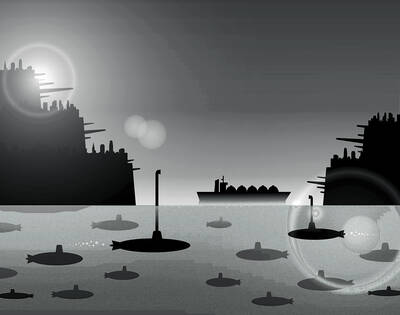
In the event of a war with China, Taiwan has some surprisingly tough defenses that could make it as difficult to tackle as a porcupine: A shoreline dotted with swamps, rocks and concrete barriers; conscription for all adult men; highways and airports that are built to double as hardened combat facilities. This porcupine has a soft underbelly, though, and the war in Iran is exposing it: energy. About 39,000 ships dock at Taiwan’s ports each year, more than the 30,000 that transit the Strait of Hormuz. About one-fifth of their inbound tonnage is coal, oil, refined fuels and liquefied natural gas (LNG),
On Monday, the day before Chinese Nationalist Party (KMT) Chairwoman Cheng Li-wun (鄭麗文) departed on her visit to China, the party released a promotional video titled “Only with peace can we ‘lie flat’” to highlight its desire to have peace across the Taiwan Strait. However, its use of the expression “lie flat” (tang ping, 躺平) drew sarcastic comments, with critics saying it sounded as if the party was “bowing down” to the Chinese Communist Party (CCP). Amid the controversy over the opposition parties blocking proposed defense budgets, Cheng departed for China after receiving an invitation from the CCP, with a meeting with
Chinese Nationalist Party (KMT) Chairwoman Cheng Li-wun (鄭麗文) is leading a delegation to China through Sunday. She is expected to meet with Chinese President Xi Jinping (習近平) in Beijing tomorrow. That date coincides with the anniversary of the signing of the Taiwan Relations Act (TRA), which marked a cornerstone of Taiwan-US relations. Staging their meeting on this date makes it clear that the Chinese Communist Party (CCP) intends to challenge the US and demonstrate its “authority” over Taiwan. Since the US severed official diplomatic relations with Taiwan in 1979, it has relied on the TRA as a legal basis for all
To counter the CCP’s escalating threats, Taiwan must build a national consensus and demonstrate the capability and the will to fight. The Chinese Communist Party (CCP) often leans on a seductive mantra to soften its threats, such as “Chinese do not kill Chinese.” The slogan is designed to frame territorial conquest (annexation) as a domestic family matter. A look at the historical ledger reveals a different truth. For the CCP, being labeled “family” has never been a guarantee of safety; it has been the primary prerequisite for state-sanctioned slaughter. From the forced starvation of 150,000 civilians at the Siege of Changchun


 RSS
RSS