


TRA-like law welcome
In an article published on Sunday by the Taipei Times (“Academic urges TRA-like Japan law,” page 1), Japanese lawmaker Jikido Aeba urged the Japanese government to “establish a Taiwan-Japan relations bill,” based on the US’ Taiwan Relations Act (TRA).
To be sure, the TRA has long been an important US law. It has enabled constructive relations between the US and Taiwan, and not insignificantly created a stronger security partnership between the two countries.
Were Japan to do the same, it could very well open up a new methodology and construct in international law vis a vis Taiwan and the international community.
My point here is that the establishment of actual legalized relations between Japan and Taiwan could introduce a new internationalized legal order — outside of given “memoranda of understanding,” agency agreements, bilateral accords, or generalized economic agreements (which this article concedes has been the primary focus of Japan-Taiwan relations for many years).
Rather than any halfway measure, such an act would be a legislated, fully lawful covenant, in which national and international collaboration and cooperation are emplaced in statute, precedent and covenant. It would thus be more than a given “agreement,” “compromise” or even concord, and instead a fixed mandate of law itself.
It would be an international legal understanding — and virtually every country in the world today claims it “adheres to the rule of law,” and this phrasing has become a code word and concrete element of just what it means to be a free international associate and accessory (not all nations can actually claim this, but they can always try).
To be sure, there would be complexities in such an act, in terms of military relations between Taiwan and Japan.
Aeba states that Japan should amend its constitution “to enable the Japan Self-Defense Forces to defend its Asian partners.” This is probably unlikely, but given that the TRA addresses just these factors, there is probably no reason that Japan and Taiwan could not do something similar.
In a word, Japan legislating such an act would further legalize Taiwan as an international adjunct in the world, with what that means in terms of the rule of law and the role of free, constitutional nations in the world. This would all codify and further authorize the states of Japan and Taiwan (Republic of China) in international law, and from there cement relations with their alliances, and their association with other nations. China might not fully comply with these principles, but it could not deny that a new international legal order was in effect.
Who said it best? Austin O’Malley (American professor, 1858-1932) said that “Law is the rudder of the ship of state.” The rudders of two ships of state, Japan and Taiwan, may be in the spotlight soon. Or US Supreme Court Justice Thurgood Marshall, who said: “Do what you think is right, and let the law catch up.” Let us let the law move ahead and strike new chords of agreement and kindred spirit with Taiwan and its partners around the world.
David Pendery
Taipei
A gap appears to be emerging between Washington’s foreign policy elites and the broader American public on how the United States should respond to China’s rise. From my vantage working at a think tank in Washington, DC, and through regular travel around the United States, I increasingly experience two distinct discussions. This divergence — between America’s elite hawkishness and public caution — may become one of the least appreciated and most consequential external factors influencing Taiwan’s security environment in the years ahead. Within the American policy community, the dominant view of China has grown unmistakably tough. Many members of Congress, as
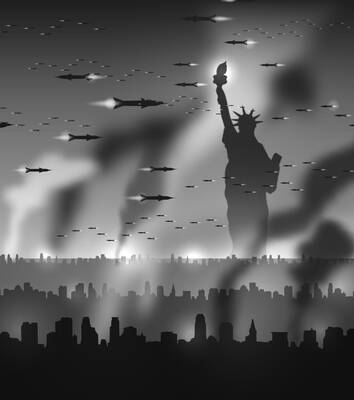
After declaring Iran’s military “gone,” US President Donald Trump appealed to the UK, France, Japan and South Korea — as well as China, Iran’s strategic partner — to send minesweepers and naval forces to reopen the Strait of Hormuz. When allies balked, the request turned into a warning: NATO would face “a very bad” future if it refused. The prevailing wisdom is that Trump faces a credibility problem: having spent years insulting allies, he finds they would not rally when he needs them. That is true, but superficial, as though a structural collapse could be caused by wounded feelings. Something
Former Taipei mayor and Taiwan People’s Party (TPP) founding chairman Ko Wen-je (柯文哲) was sentenced to 17 years in prison on Thursday, making headlines across major media. However, another case linked to the TPP — the indictment of Chinese immigrant Xu Chunying (徐春鶯) for alleged violations of the Anti-Infiltration Act (反滲透法) on Tuesday — has also stirred up heated discussions. Born in Shanghai, Xu became a resident of Taiwan through marriage in 1993. Currently the director of the Taiwan New Immigrant Development Association, she was elected to serve as legislator-at-large for the TPP in 2023, but was later charged with involvement
Out of 64 participating universities in this year’s Stars Program — through which schools directly recommend their top students to universities for admission — only 19 filled their admissions quotas. There were 922 vacancies, down more than 200 from last year; top universities had 37 unfilled places, 40 fewer than last year. The original purpose of the Stars Program was to expand admissions to a wider range of students. However, certain departments at elite universities that failed to meet their admissions quotas are not improving. Vacancies at top universities are linked to students’ program preferences on their applications, but inappropriate admission


 RSS
RSS