


This is a big year for anniversaries in China. On Saturday, the People’s Republic of China (PRC) commemorated the centennial of the May Fourth Movement, the student-led protests in front of Beijing’s Tiananmen Square in 1919 that marked the birth of Chinese nationalism.
Then, one month later, on June 4, will come the 30th anniversary of the violent suppression of pro-democracy student protests at the same site.
This milestone, by contrast, will not be officially acknowledged, much less commemorated, in China.
The 1919 demonstrations are immortalized in stone on the Monument to the People’s Heroes in Tiananmen Square. Referring to the same ideals of science and democracy, the protesters in 1989 also presented themselves as loyal to the nation.
However, the 1989 movement ended in what is known outside China as the Tiananmen Square Massacre, and within China as the “Tiananmen incident.” The events of three decades ago are a taboo subject in China, scrubbed by the authorities from the Internet and largely unknown to the country’s younger generation.
It is a persistent contradiction that the Chinese state claims the mantle of May 4 while repressing the memory of June 4.
The students of 1919 are celebrated as outspoken patriots, in keeping with a long Chinese tradition that places the intellectual in a role of social responsibility. The ideal student of imperial times took great risks to speak truth to power, to expose official corruption and spur reform.
University students in the early 20th century inherited this legacy. The Chinese Communist Party (CCP) actually has its roots in the May Fourth Movement: Student periodicals spread Marxist ideas, a Marxist study group was founded at Peking University and Mao Zedong (毛澤東) himself embraced Marxism-Leninism as a student worker in the library.
As the May Fourth Movement has broad and popular resonance in China, the student protesters of 1989 — sporting long hair and blue jeans, rather than long gowns and pleated skirts — consciously referred to it.
As their predecessors did, they emphasized their patriotism, pointing out official corruption and the economic inequalities that had resulted from the post-Mao economic reforms.
Yet the Chinese state branded the 1989 Tiananmen Square protest a “counterrevolutionary riot,” and blamed a handful of conspirators for misleading the people.
Despite the world’s attention, the movement ended in a crackdown, followed by official silence and a public amnesia that worsens by the year.
The June 4 anniversary nonetheless remains politically sensitive, and the Chinese state always goes into high alert in the lead-up to it. In what has become an annual ritual, foreign journalists in China are blocked from covering the anniversary — as Louisa Lim (林慕蓮), a former BBC and National Public Radio Beijing correspondent, has said.
Since 1989, the CCP has made every effort to bind young people to the Chinese state and its priorities. Children take lessons in “patriotic education,” fidelity is cultivated through the Young Pioneers of China and the Communist Youth League, and universities have developed elaborate systems to guard against political deviance and reward political loyalty with jobs.
To a large extent, such efforts have made Chinese youth apolitical. The May Fourth legacy has effectively been divided, with patriotism cleaved apart from protest.
Yet the state has not entirely succeeded in co-opting China’s students. Last year, students who support the CCP’s own Marxist ideology became the latest generation of protesters to run afoul of the authorities.
Last summer, groups began organizing factory workers in southern China, calling attention to abuses and helping workers to form an independent labor union. Presenting themselves as loyal to Chinese President Xi Jinping (習近平), the students launched campaigns in the field and on their university campuses.
The state has detained dozens of them. Videos show Peking University officials attempting to block student organizations, and witnesses have confirmed the disappearance of Marxist student leaders at the hands of plainclothes police.
The irony is that China is repressing leftist students whose words and deeds embody the CCP’s original ideals. Just like the party’s earliest leaders, including Mao, they champion exploited workers and seek to organize them, sometimes even engaging in factory work themselves.
As their classes in Marxism and Mao’s writings have taught them to do, they investigate social conditions and question China’s deep inequalities. Like their May Fourth forebears, today’s young Marxists see themselves as loyal students speaking truth to power.
This year’s anniversaries of the 1919 and 1989 movements therefore carry particular weight.
The May Fourth legacy is one of patriotism and enlightenment. Born of those claims, the Tiananmen Square Massacre in 1989 ended in violence and silence.
Foreign observers will doubtless point to the Chinese authorities’ contradictory attitudes toward May 4 and June 4, and conclude that China now has the power to shape its own historical narrative.
However, the case of the Marxist students last year highlighted the continued potential for a loyal opposition. As the PRC looks ahead to the 70th anniversary of its founding this October, it must continue to reckon with its own history.
Denise Y. Ho is a professor of history at Yale University.
Copyright: Project Syndicate
A gap appears to be emerging between Washington’s foreign policy elites and the broader American public on how the United States should respond to China’s rise. From my vantage working at a think tank in Washington, DC, and through regular travel around the United States, I increasingly experience two distinct discussions. This divergence — between America’s elite hawkishness and public caution — may become one of the least appreciated and most consequential external factors influencing Taiwan’s security environment in the years ahead. Within the American policy community, the dominant view of China has grown unmistakably tough. Many members of Congress, as
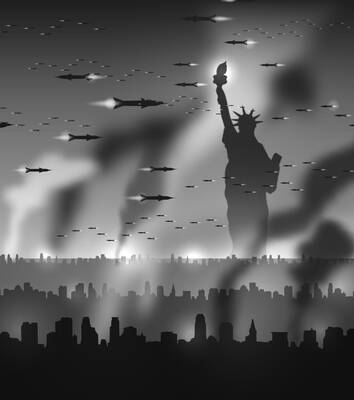
After declaring Iran’s military “gone,” US President Donald Trump appealed to the UK, France, Japan and South Korea — as well as China, Iran’s strategic partner — to send minesweepers and naval forces to reopen the Strait of Hormuz. When allies balked, the request turned into a warning: NATO would face “a very bad” future if it refused. The prevailing wisdom is that Trump faces a credibility problem: having spent years insulting allies, he finds they would not rally when he needs them. That is true, but superficial, as though a structural collapse could be caused by wounded feelings. Something
Former Taipei mayor and Taiwan People’s Party (TPP) founding chairman Ko Wen-je (柯文哲) was sentenced to 17 years in prison on Thursday, making headlines across major media. However, another case linked to the TPP — the indictment of Chinese immigrant Xu Chunying (徐春鶯) for alleged violations of the Anti-Infiltration Act (反滲透法) on Tuesday — has also stirred up heated discussions. Born in Shanghai, Xu became a resident of Taiwan through marriage in 1993. Currently the director of the Taiwan New Immigrant Development Association, she was elected to serve as legislator-at-large for the TPP in 2023, but was later charged with involvement
Out of 64 participating universities in this year’s Stars Program — through which schools directly recommend their top students to universities for admission — only 19 filled their admissions quotas. There were 922 vacancies, down more than 200 from last year; top universities had 37 unfilled places, 40 fewer than last year. The original purpose of the Stars Program was to expand admissions to a wider range of students. However, certain departments at elite universities that failed to meet their admissions quotas are not improving. Vacancies at top universities are linked to students’ program preferences on their applications, but inappropriate admission


 RSS
RSS