


Taiwan strong
The new year is scarcely three weeks old and already we have seen the national sovereignty of Taiwan and the wishes of its 23 million people attacked by China in every imaginable way.
Recently this was carried out in Chinese President Xi Jinping’s (習近平) rather direct and brutal public warning to Taiwan that any assemblage of independence or democracy for Taiwan is completely out of the question as far as the communist authoritarian regime is concerned.
President Tsai Ing-wen (蔡英文) rather bravely stood up to these aggressive comments by stating that the wishes of the Taiwanese people must be respected within their own homeland without illegal compromise or foreign aggression.
Many international voices have also spoken up in support of Tsai recently, especially from within the US Congress.
Taiwan and the world cannot control the irresponsible and aggressive behavior of neighboring China, nor should it seek to try.
Rather, Taiwan would do well to take the moral and strong defensive high-ground in response to Chinese attacks against its very right to existence.
Where China offers hatred and war, Taiwan should respond with careful, but strong, resolute defense for its own people in the face of imminent military threat. Peace can only be had in the face of tyranny by showing the aggressor that the nation will not collapse when bullied, but will rather stand stronger and more prepared.
Given this year’s aggressive behavior on the part of the Chinese Communist Party against Taiwan, it feels only irresponsible and foolhardy to continue to allow direct flights and shipping of any kind coming to Taiwan from China and/or any territory under its control or vice versa.
In response to China’s military and international aggression against the sovereignty of Taiwan, the routes should all be immediately severed and forced to rather travel via a third, neutral nation such as Japan, South Korea or Vietnam.
There needs to be a responsible defensive response from the government of Taiwan to China’s aggressive behavior.
Taiwan needs to remain committed to peace and non-aggression, but very much does need to take the basic actions to help ensure the continuation of its democracy and liberty. Severing all direct flights and navigation is a logical and reasonable commonsense response.
These could all be resumed when China publicly and in writing renounces any and all acts and threats of war against Taiwan.
In this way the choice would be completely up to China to do the right thing and in the meantime Taiwan would be more secure.
Howard Fass
Massachusetts
A gap appears to be emerging between Washington’s foreign policy elites and the broader American public on how the United States should respond to China’s rise. From my vantage working at a think tank in Washington, DC, and through regular travel around the United States, I increasingly experience two distinct discussions. This divergence — between America’s elite hawkishness and public caution — may become one of the least appreciated and most consequential external factors influencing Taiwan’s security environment in the years ahead. Within the American policy community, the dominant view of China has grown unmistakably tough. Many members of Congress, as
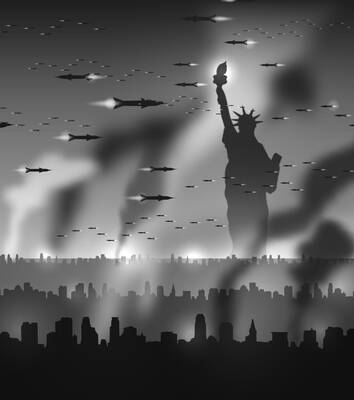
After declaring Iran’s military “gone,” US President Donald Trump appealed to the UK, France, Japan and South Korea — as well as China, Iran’s strategic partner — to send minesweepers and naval forces to reopen the Strait of Hormuz. When allies balked, the request turned into a warning: NATO would face “a very bad” future if it refused. The prevailing wisdom is that Trump faces a credibility problem: having spent years insulting allies, he finds they would not rally when he needs them. That is true, but superficial, as though a structural collapse could be caused by wounded feelings. Something
Former Taipei mayor and Taiwan People’s Party (TPP) founding chairman Ko Wen-je (柯文哲) was sentenced to 17 years in prison on Thursday, making headlines across major media. However, another case linked to the TPP — the indictment of Chinese immigrant Xu Chunying (徐春鶯) for alleged violations of the Anti-Infiltration Act (反滲透法) on Tuesday — has also stirred up heated discussions. Born in Shanghai, Xu became a resident of Taiwan through marriage in 1993. Currently the director of the Taiwan New Immigrant Development Association, she was elected to serve as legislator-at-large for the TPP in 2023, but was later charged with involvement
Out of 64 participating universities in this year’s Stars Program — through which schools directly recommend their top students to universities for admission — only 19 filled their admissions quotas. There were 922 vacancies, down more than 200 from last year; top universities had 37 unfilled places, 40 fewer than last year. The original purpose of the Stars Program was to expand admissions to a wider range of students. However, certain departments at elite universities that failed to meet their admissions quotas are not improving. Vacancies at top universities are linked to students’ program preferences on their applications, but inappropriate admission


 RSS
RSS