


Despite his seemingly limitless capacity for vindictiveness, it would be a mistake to interpret US President Donald Trump’s decision to withdraw the security clearance of former CIA director John Brennan as only his latest vendetta for lese-majeste.
True, Brennan has all but labeled Trump and his behavior, including his Russian connections, a national security threat.
However, Trump’s move is more than personal payback.
As the most recent blow in his two-year-long attack on the intelligence community, his slap at Brennan is a harbinger of more to come as Trump tries to bring his espionage agencies to heel.
More ominously for the health of the democracies of the West, other populists are following Trump’s example.
In Europe, a variety of right-wing parties, having now found themselves in power, are taking on former government antagonists, who have monitored and policed their extremism for decades.
In Austria, the country’s populist leaders have been intimidating, muzzling and purging the nation’s intelligence services. In February, on orders from the populist interior minister, Austrian police raided the country’s main intelligence agency — the very organization charged with monitoring right-wing extremism.
It should be recalled that the Freedom Party, the coalition partner in Austrian Chancellor Sebastian Kurz’s government, was founded by former SS officers.
What was the pretext for the raid and subsequent demotion of senior Austrian intelligence officials? That the agency was running an operation aimed at harming North Korea.
No doubt, Trump wishes that he could pull off such a stunt and both halt the investigation of him led by Robert Mueller and bring to heel all of the US intelligence agencies.
A fan of strongman leaders who “get it done,” Trump admires diktats and brazen contempt for legal processes. He almost certainly will pay even closer attention as the intelligence-fueled investigations into his presidential campaign’s possible collusion with Moscow in 2016 close in on him.
It is this combination of self-interest and contempt for law that makes Trump’s revocation of the Brennan’s security clearance so troubling. The regulations governing clearances are straightforward: The president has the power to deny access to official secrets if someone is found to have compromised classified information or is at risk of doing so.
By all accounts, Brennan has done nothing of the sort. In fact, Trump admits that.
Buried in the explanatory word salad that accompanied the revocation of Brennan’s security clearance, the White House claimed that Brennan’s “erratic” behavior was the cause.
That accusation would be laughable if it was not so serious.
Trump has simply ignored the laws — including laws governing the US intelligence services — that he swore faithfully to execute. Eleven former CIA directors and deputy directors, as well as 70 former senior CIA officers — including me — said as much last week, criticizing the unprecedented revocation as political coercion and accusing Trump of misusing presidential powers, damaging national security, and threatening current and former officials’ right of free speech.
As if to underscore the point, White House spokespeople say that Trump intends to order more revocations, including a former national security adviser and deputy attorney general, as well as former directors of national intelligence, the CIA and the US National Security Agency.
The hit list is no coincidence. Those in the crosshairs have overseen intelligence collection and analysis that informed the intelligence community’s conclusion that Russia interfered in the 2016 election, including possible collusion with Trump’s presidential campaign.
With attacks on the intelligence and law enforcement communities playing well among his supporters, Trump could well double down on this demagoguery.
However, his willingness to use his presidential powers as a blatantly partisan political weapon breaks ground that no American should want him to tread.
The damage that has resulted from the raid in Austria shows why.
While Austrian courts ultimately will determine the raid’s legality, the effects are already clear. By stripping Austria’s spies of their files, the raid has essentially put the intelligence service out of operation and raised doubts among allied intelligence services about the Austrians’ reliability. Internal operations are dead in the water, as is intelligence sharing with European counterparts.
Washington is not Vienna, but the parallels deserve close attention nonetheless.
Trump’s attacks on the intelligence community and its former leaders are unprecedented and it would be naive not to consider their impact, not only on the current intelligence leadership, but also on the rank-and-file officers who do the difficult and often dangerous work of intelligence gathering and analysis.
That is why it is so important to adhere to the laws that empower and constrain intelligence agencies, and that underpin the political independence and integrity of their officers.
Events in Austria should be a warning. For democracies to thrive, government must be transparent as well as publicly accountable. When it comes to overseeing intelligence agencies pledged to protect their sources and methods, the challenges are obvious.
However, so, too, are the threats, including to the democratic process itself, when politicians violate rather than respect the rules that govern their intelligence services’ integrity.
In the final analysis, Brennan is not the only victim of Trump’s unwarranted and vindictive action. So are all Americans when national leaders put their own interests above those of the country and corrupt the political system they are sworn to defend.
Kent Harrington, a former senior CIA analyst, served as US national intelligence officer for East Asia, chief of station in Asia, and the CIA’s director of public affairs.
Copyright: Project Syndicate
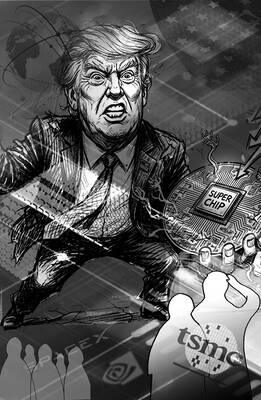
The White House’s decision to take a 9.9 percent stake in Intel Corp is looking like very shrewd business indeed. Since the government bought in at US$20.47 a share last August, the US chipmaker’s surging stock price has delivered the US a US$43 billion return. One of the reasons the investment has so far proved so sound is that the White House has made sure of it. According to The Wall Street Journal, Howard personally pushed deals on Intel’s behalf with some of the most lucrative clients imaginable. They include Nvidia Corp, the company at the heart of the AI
A single photograph can cut through a lot of noise, but it can also be used to misrepresent the truth. At the very least, it can concentrate the mind on something that requires further investigation. On Monday last week, Ma Ying-jeou Foundation CEO Tai Hsia-ling (戴遐齡) and former National Security Council secretary-general King Pu-tsung (金溥聰) held a news conference in which they showed a photograph of former foundation CEO Hsiao Hsu-tsen (蕭旭岑), now Chinese Nationalist Party (KMT) deputy chairman. In the image Hsiao is seated next to Xiamen Taiwan Businessmen Association chairman Han Ying-huan (韓螢煥). The two men were holding
I first met Professor Ray Jiing (井迎瑞) as a film and documentary student at Shih Hsin University’s (SHU) Department of Radio Television and Film in 1988. The following year, he went on to become the director of the Chinese Taipei Film Archive — forerunner of the Taiwan Film and Audiovisual Institute (TFAI). Over his eight-year tenure, Jiing rescued and restored over 200 classic Taiwanese films. In 1997, he established the Graduate Institute of Studies in Documentary and Film Archiving at Tainan National University of the Arts (TNNUA), and I joined the program in his third cohort of students. Beyond a
President William Lai Ching-te’s (賴清德) May 20 second-anniversary address was not just a routine policy review; it was damage control. US President Donald Trump’s remarks — that he did not want to see anyone move toward independence and that the delivery of a major Taiwan arms package could depend on the progress of US-China relations — unsettled Taiwan’s public and created an opening for opposition parties to question whether Taiwan was being treated as a bargaining chip in Washington’s dealings with Beijing. Lai’s speech was designed to close that opening. The address covered the expected ground: sovereignty, cross-strait relations, defense spending,


 RSS
RSS