


Imagine a city at 50°C. The pavements are empty, the parks quiet, entire neighborhoods appear uninhabited. Nobody with a choice ventures outside during daylight hours. Only at night do the denizens emerge, H.G. Wells-style, into the streets — though, in temperatures that high, even darkness no longer provides relief.
Uncooled air is treated like effluent: to be flushed as quickly as possible. School playgrounds are silent as pupils shelter inside. In the hottest hours of the day, working outdoors is banned. The only people in sight are those who do not have access to air conditioning, who have no escape from the blanket of heat: the poor, the homeless and undocumented laborers.
Society is divided into the cool haves and the hot have-nots. Those without the option of sheltering indoors can rely only on shade, or perhaps a water-soaked sheet hung in front of a fan. Construction workers, motor-rickshaw drivers and street hawkers cover up head to toe to stay cool.
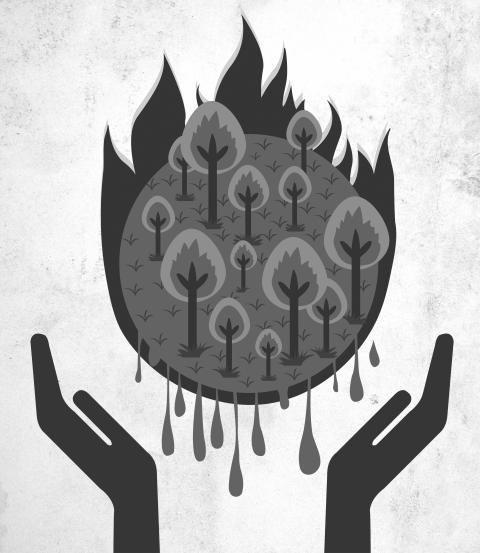
Illustration: Lance Liu
The wealthy, meanwhile, go from one climate-conditioned environment to another: homes, cars, offices, gymnasiums and malls. Asphalt heats up 10° to 20°C higher than the air. You really could fry an egg on the pavement. A dog’s paws would blister on a short walk, so pets are kept behind closed doors.
There are fewer animals overall; many species of mammals and birds have migrated to cooler environments, perhaps at a higher altitude — or perished. Reptiles, unable to regulate their body temperatures or dramatically expand their range, are worst placed to adapt. Even insects suffer.
Maybe in the beginning, when it was just a hot spell, there was a boom in spending as delighted consumers snapped up sunglasses, bathing suits, barbecues, garden furniture and beer, but the novelty quickly faded when relentless sunshine became the norm. Consumers became more selective.
Power grids are overloaded by cooling units. The heat is now a problem. The temperature is recalibrating behavior. Appetites tend to fade as the body avoids the thermal effect of food and tempers are quicker to flare — along, perhaps, with crime and social unrest. However, eventually lethargy sets in as the body shuts down and any prolonged period spent outdoors becomes dangerous.
Hospitals see a surge in admissions for heat stress, respiratory problems and other illnesses exacerbated by high temperatures. Some set up specialist wards. The elderly, the obese and the sick are most at risk. Deaths rise.
At 50°C —1 halfway to water’s boiling point and more than 10°C above a healthy body temperature — heat becomes toxic. Human cells start to cook, blood thickens, muscles lock around the lungs and the brain is choked of oxygen. In dry conditions, sweat — the body’s in-built cooling system — can lessen the impact, but this protection weakens if there is already moisture in the air.
A so-called wet-bulb temperature — which factors in humidity — of just 35°C can be fatal after a few hours to even the fittest person, and scientists have said that climate change could make such conditions increasingly common in India, Pakistan, Southeast Asia and parts of China.
Even under the most optimistic predictions for emissions reductions, experts have said that almost half the world’s population could be exposed to potentially deadly heat for 20 days a year.
Not long ago, 50°C was considered an anomaly, but it is increasingly widespread. Earlier this year, the 1.1 million residents of Nawabshah, Pakistan, endured the hottest April ever recorded on Earth, as temperatures hit 50.2°C.
In neighboring India two years earlier, the town of Phalodi sweltered in 51°C — the country’s hottest day ever.
Dev Niyogi, chair of the Urban Environment department at the American Meteorological Society, witnessed how cities were affected by extreme heat on a research trip to New Delhi and Pune during that 2015 heatwave in India, which killed more than 2,000 people.
“You could see the physical change. Road surfaces started to melt, neighborhoods went quiet because people didn’t go out and water vapor rose off the ground like a desert mirage,” he said.
“We must hope that we don’t see 50°C. That would be uncharted territory. Infrastructure would be crippled and ecosystem services would start to break down, with long-term consequences,” he added.
Several cities in the Persian Gulf are getting increasingly accustomed to such heat. Basra, Iraq, — population 2.1 million — registered 53.9°C two years ago. Kuwait City and Doha have experienced 50°C or more in the past decade. At Quriyat, on the coast of Oman, overnight temperatures earlier this summer remained above 42.6°C, which is believed to be the highest “low” temperature ever recorded in the world.
At Mecca, Saudi Arabia, the 2 million hajj pilgrims who visit each year need ever more sophisticated support to beat the heat. On current trends, it is only a matter of time before temperatures exceed the record 51.3°C reached in 2012.
Last year, traditionalists were irked by plans to install what are reportedly the world’s biggest retractable umbrellas to provide shade on the courtyards and roof of the Great Mosque. Air conditioners weighing 25 tonnes have been brought in to ventilate four of the biggest tents. Thousands of fans already cool the marble floors and carpets, while police on horseback spray the crowds with water.
Soccer supporters probably cannot expect such treatment at the Qatar World Cup in 2022, and many could add to the risks of hyperthermia and dehydration by taking off their shirts and drinking alcohol. FIFA is so concerned about conditions that it has moved the final from summer to a week before Christmas.
Heat is also why Japanese politicians are now debating whether to introduce daylight saving time for the 2020 Tokyo Summer Olympics, so that marathon and racewalk athletes can start at what is currently 5am and avoid mid-afternoon temperatures that have started to pass 40°C with humidity of more than 80 percent.
At the Australian open in Melbourne this year — when ambient temperatures reached 40°C — players were staggering around like “punch-drunk boxers” due to heatstroke.
Even walking outside can feel oppressive at higher temperatures. “The blast of furnace-like heat ... literally feels life-threatening and apocalyptic,” Nigel Tapper, a professor of environmental science at Melbourne’s Monash University, said of the 48°C recorded in parts of the city. “You cannot move outside for more than a few minutes.”
The feeling of foreboding is amplified by the increased threat of bush and forest fires, he added.
“You cannot help but ask, ‘How can this city operate under these conditions? What can we do to ensure that the city continues to provide important services for these conditions? What can we do to reduce temperatures in the city?’” Tapper said.
Those places already struggling with extreme heat are doing what they can. In Ahmedabad, in Gujarat, hospitals have opened specialist heat wards. Australian cities have made swimming pools accessible to the homeless when the heat creeps above 4o° and instructed schools to cancel playground time. In Kuwait, outside work is forbidden between noon and 4pm when temperatures soar.
However, many regulations are ignored, and companies and individuals underestimate the risks. In almost all countries, hospital admissions and death rates tend to rise when temperatures pass 35°C — which is happening more often, in more places.
Currently, 354 major cities experience average summer temperatures in excess of 35°C; by 2050, climate change will push this to 970, the recent “Future We Don’t Want” study by the C40 alliance of the world’s biggest metropolises said.
In the same period, it predicted that the number of urban dwellers exposed to this level of extreme heat would increase eightfold to 1.6 billion.
As baselines shift across the globe, 50°C is also uncomfortably near for tens of millions more people. This year, Chino, California, 50km from Los Angeles, hit a record of 48.9°C, Sydney saw 47°C, and Madrid and Lisbon also experienced temperatures in the mid-40s.
New studies suggest that France “could easily exceed” 50°C by the end of the century, while Australian cities are forecast to reach this point even earlier. Kuwait, meanwhile, could sizzle toward an uninhabitable 60°C.
How to cool dense populations is now high on the political and academic agenda, said Niyogi, who last week cochaired an urban climate symposium in New York.
Cities can be modified to deplete heat through measures to conserve water, create shade and deflect heat. In many places around the world, these steps are already under way.
The city at 50°C could be more tolerable with lush green spaces on and around buildings; towers with smart shades that follow the movement of the sun; roofs and pavements painted with high-albedo surfaces; fog capture and renewable energy fields to provide cooling power without adding to the greenhouse effect.
However, with extremes creeping up faster than baselines, Niyogi said that such adaptation would require changes not just to the design of cities, but how they are organized and how we live in them.
However, first have to see what is coming — which might not hit with the fury of a flood or typhoon, but can be even more destructive.
“Heat is different,” Niyogi said. “You don’t see the temperature creep up to 50°C. It can take people unawares.”

The White House’s decision to take a 9.9 percent stake in Intel Corp is looking like very shrewd business indeed. Since the government bought in at US$20.47 a share last August, the US chipmaker’s surging stock price has delivered the US a US$43 billion return. One of the reasons the investment has so far proved so sound is that the White House has made sure of it. According to The Wall Street Journal, Howard personally pushed deals on Intel’s behalf with some of the most lucrative clients imaginable. They include Nvidia Corp, the company at the heart of the AI
The Ministry of the Interior, working with the navy and coast guard, is organizing Taiwan’s first joint exercise simulating escort tankers carrying liquefied natural gas (LNG) and oil through a Chinese blockade. The drills simulate fuel transport along three maritime corridors leading toward Japan, the Philippines and the US. Deputy Minister of the Interior Sawyer Mars (馬士元) said that a blockade of the Taiwan Strait would amount to “almost a 100 percent blockade of the regional energy supply.” Minister of National Defense Wellington Koo said planning to counter a blockade is standard practice in Taipei. While the exercise is limited in
A single photograph can cut through a lot of noise, but it can also be used to misrepresent the truth. At the very least, it can concentrate the mind on something that requires further investigation. On Monday last week, Ma Ying-jeou Foundation CEO Tai Hsia-ling (戴遐齡) and former National Security Council secretary-general King Pu-tsung (金溥聰) held a news conference in which they showed a photograph of former foundation CEO Hsiao Hsu-tsen (蕭旭岑), now Chinese Nationalist Party (KMT) deputy chairman. In the image Hsiao is seated next to Xiamen Taiwan Businessmen Association chairman Han Ying-huan (韓螢煥). The two men were holding
I first met Professor Ray Jiing (井迎瑞) as a film and documentary student at Shih Hsin University’s (SHU) Department of Radio Television and Film in 1988. The following year, he went on to become the director of the Chinese Taipei Film Archive — forerunner of the Taiwan Film and Audiovisual Institute (TFAI). Over his eight-year tenure, Jiing rescued and restored over 200 classic Taiwanese films. In 1997, he established the Graduate Institute of Studies in Documentary and Film Archiving at Tainan National University of the Arts (TNNUA), and I joined the program in his third cohort of students. Beyond a


 RSS
RSS