


Premier William Lai (賴清德) last week reiterated his position that the 1981 Lausanne Agreement between the Chinese Taipei Olympic Committee and the International Olympic Committee (IOC) means that Taiwanese athletes are required to use the title “Chinese Taipei” when competing at the Olympics.
It is important that Taiwan’s athletes are able to compete at the Olympics, he said, adding that their rights must be protected.
Lai’s remarks raise two important questions:
First, does this mean that the campaign by an alliance of civic groups for a referendum to rename the national sports team “Taiwan” would affect the ability of Taiwanese athletes to take part at the 2020 Tokyo Olympics?
Second, if the referendum is successful and the government submits a name-change request to the IOC, would this contravene the terms of the Lausanne Agreement?
The answer to both of these questions is no.
Beijing would undoubtedly be driven into paroxysms of fury, but it is important to note that the agreement contains no clause that prevents the government or Taiwanese from freely expressing themselves.
The idea that the IOC would revoke Taiwan’s right to complete if it changed the name of its team does not stand up to scrutiny.
While one can empathize with Lai’s predicament, he and others must understand that China’s bark is worse than its bite. The government has nothing to fear.
As Beijing’s behavior becomes ever more loutish and unreasonable, the world’s attention is drawn with increasing intensity to the absurdity of the name “Chinese Taipei” under which Taiwanese athletes are forced to complete.
Lai also said: “We all support and respect the civic force that is driving” the referendum campaign.
However, at such an important juncture as this, when society is pushing for a referendum to rectify the name, Lai should refrain from making any comments that might confuse the public and hurt the campaign.
Furthermore, Lai also said: “When the majority of Taiwanese refer to their country, for instance at certain academic events, they use the name ‘Republic of China’ [ROC]. However, most people generally refer to their country simply as ‘Taiwan.’”
“While both [names] represent our nation, ‘Republic of China’ is used only when specifically required,” he said.
The point is that the name “Chinese Taipei” does not represent Taiwan or the ROC. “Chinese Taipei” certainly does not denote “ROC Taipei.” If it did contain so much as a whiff of this meaning, the People’s Republic of China (PRC) would certainly not have tolerated its use.
Besides, the international community believes that there is only “one China” and that this means the PRC.
As such, when Taiwan calls itself “Chinese Taipei” at the Olympics, it is easy for people from other nations to mistakenly assume that Taiwanese athletes are PRC athletes. This is obviously extremely detrimental to the nation’s interests.
While it is extremely important that Taiwan’s athletes have the chance to complete at the Olympics, it is equally important — a matter of urgency even — that the international community understands the reality that Taiwan is a sovereign and independent nation.
For this reason, the public must get behind the referendum campaign so that Taiwan can spread the truth to the world.
Hideki Nagayama is chairman of the Taiwan Research Forum.
Translated by Edward Jones
A gap appears to be emerging between Washington’s foreign policy elites and the broader American public on how the United States should respond to China’s rise. From my vantage working at a think tank in Washington, DC, and through regular travel around the United States, I increasingly experience two distinct discussions. This divergence — between America’s elite hawkishness and public caution — may become one of the least appreciated and most consequential external factors influencing Taiwan’s security environment in the years ahead. Within the American policy community, the dominant view of China has grown unmistakably tough. Many members of Congress, as
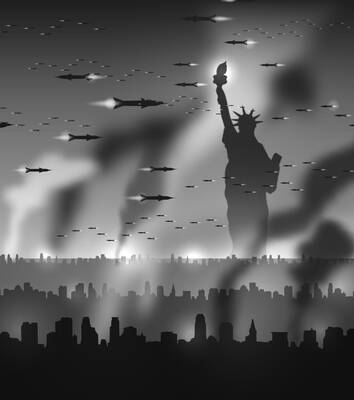
After declaring Iran’s military “gone,” US President Donald Trump appealed to the UK, France, Japan and South Korea — as well as China, Iran’s strategic partner — to send minesweepers and naval forces to reopen the Strait of Hormuz. When allies balked, the request turned into a warning: NATO would face “a very bad” future if it refused. The prevailing wisdom is that Trump faces a credibility problem: having spent years insulting allies, he finds they would not rally when he needs them. That is true, but superficial, as though a structural collapse could be caused by wounded feelings. Something
Former Taipei mayor and Taiwan People’s Party (TPP) founding chairman Ko Wen-je (柯文哲) was sentenced to 17 years in prison on Thursday, making headlines across major media. However, another case linked to the TPP — the indictment of Chinese immigrant Xu Chunying (徐春鶯) for alleged violations of the Anti-Infiltration Act (反滲透法) on Tuesday — has also stirred up heated discussions. Born in Shanghai, Xu became a resident of Taiwan through marriage in 1993. Currently the director of the Taiwan New Immigrant Development Association, she was elected to serve as legislator-at-large for the TPP in 2023, but was later charged with involvement
Out of 64 participating universities in this year’s Stars Program — through which schools directly recommend their top students to universities for admission — only 19 filled their admissions quotas. There were 922 vacancies, down more than 200 from last year; top universities had 37 unfilled places, 40 fewer than last year. The original purpose of the Stars Program was to expand admissions to a wider range of students. However, certain departments at elite universities that failed to meet their admissions quotas are not improving. Vacancies at top universities are linked to students’ program preferences on their applications, but inappropriate admission


 RSS
RSS