


The third plenary session of the Chinese Communist Party’s (CCP) Central Committee approved a list of recommended leaders for national institutions, which it passed on for approval by this month’s sessions of the National People’s Congress and the National Committee of the Chinese People’s Political Consultative Conference, along with constitutional amendments that allow President Xi Jinping (習近平) to become an “emperor.”
Xi mimics Mao Zedong (毛澤東), but lacks his confidence, because he cannot match Mao’s cultural foundation or his political achievements, still less his military ones.
Where Mao employed people from throughout China, Xi sticks to old friends and subordinates: He has placed people such as Wang Qishan (王岐山), Zhao Leji (趙樂際), Zhang Youxia (張又俠) and Li Zhanshu (栗戰書) in high positions, along with former subordinates from his days in Fujian and Zhejiang provinces, especially those from Zhejiang, where, as first secretary of the party’s provincial committee, he made all the key appointments.
In the wake of the 1989 Tiananmen Square Massacre, CCP elder Peng Zhen (彭真) said: “We are all in one rickety boat, so we need to row together.”
A so-called “collective leadership” was instituted that involved the fair sharing of benefits and mutual compromises. Xi has upset this equilibrium.
Even Liu Yuan (劉源), son of former president Liu Shaoqi (劉少奇), and Liu Yazhou (劉亞洲), son-in-law of former president Li Xiannian (李先念), have been pressured into retiring from the military. Xi’s practice of putting his own clique in charge is bound to narrow the foundation of his rule, so it is no surprise that we often hear speculation about a military coup.
Xi’s future team will not be headed by himself and Premier Li Keqiang (李克強) or Li Zhanshu, who rank second and third in the Politburo Standing Committee. Rather, news emanating from Beijing suggests that it will be a triumvirate consisting of “Xi, Zhang and Zhao.”
“Zhang” means politburo member General Zhang Youxia (張又俠), vice chairman of the Central Military Commission, who took part in the 1979 Sino-Vietnamese War. He is a native of Shaanxi Province, where Xi’s father, Xi Zhongxun (習仲勳), came from.
Zhang’s father was Zhang Zongxun (張宗遜), one of the People’s Republic of China’s founding generals, who was first vice commander of the party’s Northwest Field Army when Xi Zhongxun was a political commissar in the same army.
“Zhao” is Zhao Leji, who is a member of the Standing Committee of the 19th Politburo and secretary of the Central Commission for Disciplinary Inspection. Zhao is also a Shaanxi native. It is said that he and Xi met when they were sent to do farmwork in Shaanxi.
Zhao’s grandfather and Xi Zhongxun were fellow members of the Northwest Military-Adminstrative Commission. When Zhao was secretary of the CCP’s Shaanxi Provincial Committee, he demonstrated his loyalty by renovating “relics” related to Xi.
So, Xi stands at the center, flanked by these two men who have power over two of the controlling factors of the dictatorship: The military and judiciary. What this triumvirate lacks is anyone with expertise in economics. Economist Zhang Weiying (張維迎) is a native of Shaanxi Province, but his reformist ideas are too radical for Xi. Perhaps economist and politburo member Liu He (劉鶴) will be brought in to form a quadrumvirate.
Membership in Xi’s closest circle requires coming from Shaanxi. While Xi’s king-like status might be splendid, it is lonely and might not be an easy ride. Meanwhile, many new variables are emerging in China and around the world that call for a more collective approach.
Paul Lin is a political commentator.
Translated by Julian Clegg
A gap appears to be emerging between Washington’s foreign policy elites and the broader American public on how the United States should respond to China’s rise. From my vantage working at a think tank in Washington, DC, and through regular travel around the United States, I increasingly experience two distinct discussions. This divergence — between America’s elite hawkishness and public caution — may become one of the least appreciated and most consequential external factors influencing Taiwan’s security environment in the years ahead. Within the American policy community, the dominant view of China has grown unmistakably tough. Many members of Congress, as
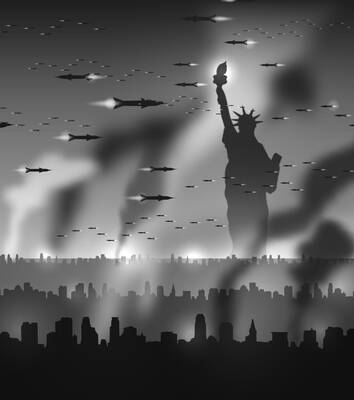
After declaring Iran’s military “gone,” US President Donald Trump appealed to the UK, France, Japan and South Korea — as well as China, Iran’s strategic partner — to send minesweepers and naval forces to reopen the Strait of Hormuz. When allies balked, the request turned into a warning: NATO would face “a very bad” future if it refused. The prevailing wisdom is that Trump faces a credibility problem: having spent years insulting allies, he finds they would not rally when he needs them. That is true, but superficial, as though a structural collapse could be caused by wounded feelings. Something
Former Taipei mayor and Taiwan People’s Party (TPP) founding chairman Ko Wen-je (柯文哲) was sentenced to 17 years in prison on Thursday, making headlines across major media. However, another case linked to the TPP — the indictment of Chinese immigrant Xu Chunying (徐春鶯) for alleged violations of the Anti-Infiltration Act (反滲透法) on Tuesday — has also stirred up heated discussions. Born in Shanghai, Xu became a resident of Taiwan through marriage in 1993. Currently the director of the Taiwan New Immigrant Development Association, she was elected to serve as legislator-at-large for the TPP in 2023, but was later charged with involvement
Out of 64 participating universities in this year’s Stars Program — through which schools directly recommend their top students to universities for admission — only 19 filled their admissions quotas. There were 922 vacancies, down more than 200 from last year; top universities had 37 unfilled places, 40 fewer than last year. The original purpose of the Stars Program was to expand admissions to a wider range of students. However, certain departments at elite universities that failed to meet their admissions quotas are not improving. Vacancies at top universities are linked to students’ program preferences on their applications, but inappropriate admission


 RSS
RSS