


Subhraag Singh’s house is down a hill from a bakery in a quiet suburb of Stuttgart, where everyone’s garden is neatly kept. If someone turned their music up too loud, you would imagine that the neighborhood watch would give them a ticking off. It does not look like the home of the future of music, but propped up in Singh’s study is an instrument he says will “change the way music functions.” He made it in his basement and it is called the Infinitone.
On his Web site, he is even more enthusiastic. The Infinitone is “the saxophone of the future” — the first instrument capable of opening “infinite musical universes. The status quo in music from this point forward shall be obliterated.” Music will “never be the same again,” he writes.
Singh kneels behind the Infinitone, puts his lips around its mouthpiece and blows. The sound is nothing special at first, but then he starts playing a keyboard by his side, hitting the odd button on an iPad, and something magical happens: five arms start rushing up and down, motors whirring, as if they are trying to leap onto his face.
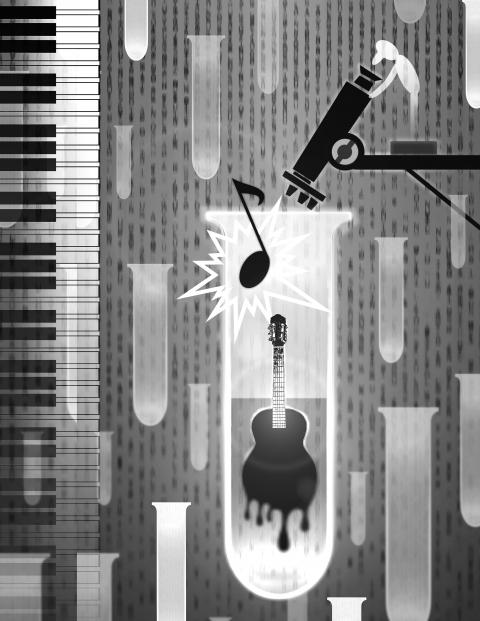
Illustration: Yusha
“It’s alive,” he jokes.
The arms are opening holes to precise points so that Singh can play any note imaginable — ones that, perhaps, no one has heard before.
“Now we’re traveling to the pyramids,” he says at one point, then makes a noise like John Coltrane blaring his way across the Middle East.
“And now the Himalayas,” he says.
Within seconds we have traveled there too. The music keeps changing location with each breath, although at times it simply sounds like an out-of-tune sax.
You would be forgiven for thinking that
instrument-making reached its end point long ago. The orchestra has largely been fixed since Belgian Adolphe Sax patented his eponymous instrument in the 1840s. Besides, these days, a standard laptop can make so many sounds, why would we need anything new?
However, there are hundreds, even thousands, of instrument inventors beavering away.
There is Jan Heinke, a German who has decided the world needs a set of steel rings that you play like a cello, and Yuto Hasebe, a Japanese artist trying to make a new instrument out of deer antlers. There is Ly Yang, who has stuck two zithers together and called it a Lyharp, so she can play heavy metal covers at the same time as Chinese music. There is also Caleb Byerly, a missionary who invented the Salimbaa — a 36-stringed East-Asian instrument, because God sent it to him in a vision.
Most of these are only ever played by their inventor. Researchers at Queen Mary University of London looked at 70 examples and, excluding apps, discovered only five had ever sold a unit, but some do reach the public eye. Singh’s Infinitone won this year’s Guthman Musical Instrument Design Competition at Georgia Tech University, Atlanta — the Pulitzer of the new instrument world.
Singh grew up in Arizona playing the saxophone and became increasingly spiritual, moving to India where he adopted his Sikh name, which appropriately means “all music.”
He started having dreams “where the most amazing music would be playing. I’d wake up and be, like: ‘Woah, I want to make that.’”
He would try playing the tunes on his sax, but says: “I’d never find the right notes, the right feelings.”
In frustration, he sold his instruments.
Then, one day in 2014, he stumbled across the concept of micro-tonality — the idea that notes exist between those you find on a piano — and realized that might hold an answer to his search. He taught himself how to bend metal, to control motors, to program computers, and after many, many false starts, the Infinitone was born.
He is busy explaining all this when his wife calls. What does she think of it?
“She’s really supportive, but sometimes she says: ‘Even I don’t know what you’re doing,’” he says.
The barriers to creating a successful new instrument are immense, say experts.
For a start, any invention must “do something other instruments won’t do — and make a nice, new, interesting sound,” says Jeremy Montagu, author of numerous books on the history of instruments.
If it does not manage that, composers and musicians will not give it a second glance, he says.
Any instrument also needs a “low floor and high ceiling,” adds Gil Weinberg, coordinator of the Guthman prize and an inventor himself, most recently of a robotic drum arm.
That means it is easy enough for a child to play, Weinberg says, but “so rich in what it can do — the subtleties, the expression — that it allows for life-long learning, for people to become virtuosos.”
It also needs to be cheap, Montagu adds, so that people can afford to buy it and it spreads widely.
There is no guarantee you will be a success even if you achieve all that. Take the piano, invented by Bartolomeo Cristofori in around 1700. Its advantages over the harpsichord were obvious — it could play dynamically, getting as loud or quiet as the player wanted — but he sold just a handful. Bach got his hands on an early copy and rubbished it. It did not take off until Mozart started using one in the 1770s — more than four decades after Cristofori’s death.
Given that, most instrument-makers must be “bloody lunatics,” Montagu says.
One inventor who definitely is not is Roland Lamb, founder of Roli — widely seen as the most successful new instrument firm, with 140 employees and £7 million (US$9.3 million) in venture capital behind it. It is so trendy that its offices are a former carpet factory in east London and Pharrell Williams has signed up to be its chief creative officer.
Roli’s main product is the Seaboard. It looks like a rubber piano — the keys rising out of it like waves — but when you move your hands across it, the notes glide with you, and when you wobble a key, the note wobbles too, like a violinist adding vibrato. The harder you press, the louder the music gets, while notes last until you lift your fingers off.
It is a synth too, so it can make any sound you want. It has sold tens of thousands.
Lamb came up with the idea while he was a student at the Royal College of Art.
He was playing the college’s honky-tonk piano in the cafe, eyes closed, singing along to himself, when he hit a note and added a gesture as if trying to add the vibrato in his voice.
A thought struck him: “It’s 2009. There’s no reason why I can’t make that happen for real.”
Within a year, he had made a prototype.
The reason the Seaboard has taken off is that it is an evolution of existing instruments, rather than something bizarre, Lamb says.
“It’s part of the keyboard family, but if you look at the distance from organ to harpsichord, harpsichord to piano — each one of those is a small jump. But we’re a huge, huge evolutionary step,” he says.
There are other “expressive” and gestural electronic instruments competing with it, such as the Eigenharp — a cross between a keytar and a bassoon — and the LinnStrument , a light-filled board designed by Roger Linn, a pioneer of the digital drum machine. Lamb loves them both, but they are clearly more out there than his products.
Lamb sounds more like a Facebook executive than an inventor when he talks about his firm.
Roli is operating at a loss, but he says that is because: “We have had to [invest to] reach a critical mass and build something that could scale to a global platform.”
Existing instruments are “too difficult to learn” and most people’s experience of playing them “is one of frustration,” he adds.
Could he see a Seaboard replacing, say, grand pianos at the Proms then?
Maybe, in 25 to 50 years, he says, but who cares?
“Musically and culturally, I don’t think the Proms matter. The sign of success for me is more like: ‘Is this being used in the home? Is this used in schools as part of education?’ We’re already hitting those points,” he says.
Weinberg is not willing to declare Seaboard the instrument of the future quite yet.
“Remember all those instruments we have now are a product of hundreds, sometimes thousands of years’ development,” he says.
Roli’s instruments are probably just a beginning.
“If we have one new instrument per century that sticks, that’s good enough,” he says.
Back in Stuttgart, I ask Singh how long it will take for people to realize the Infinitone’s worth.
He needs to improve it first, he says, pointing out that some of the joint work is not the best — he is sometimes worried that it will fall apart — and it may be good to put the controllers on the instrument itself, but he is spending most of his time inventing micro-tonal software for computers at the moment.
An investor would help, too — he has ploughed his life savings into it — and it would be brilliant if someone like Bjork took it up, but really, he needs one thing: a tune.
“Just 30 seconds. The idea is when people hear that, they’ll be like: ‘Oh, wow. What is this? I like this.’ It’ll answer everyone’s questions,” he says.
There is just one hurdle he has to jump: It turns out that writing mind-blowing music is as hard as inventing an instrument.
From the Iran war and nuclear weapons to tariffs and artificial intelligence, the agenda for this week’s Beijing summit between US President Donald Trump and Chinese President Xi Jinping (習近平) is packed. Xi would almost certainly bring up Taiwan, if only to demonstrate his inflexibility on the matter. However, no one needs to meet with Xi face-to-face to understand his stance. A visit to the National Museum of China in Beijing — in particular, the “Road to Rejuvenation” exhibition, which chronicles the rise and rule of the Chinese Communist Party — might be even more revealing. Xi took the members
After Chinese Nationalist Party (KMT) Chairwoman Cheng Li-wun (鄭麗文) met Chinese President Xi Jinping (習近平) in Beijing, most headlines referred to her as the leader of the opposition in Taiwan. Is she really, though? Being the chairwoman of the KMT does not automatically translate into being the leader of the opposition in the sense that most foreign readers would understand it. “Leader of the opposition” is a very British term. It applies to the Westminster system of parliamentary democracy, and to some extent, to other democracies. If you look at the UK right now, Conservative Party head Kemi Badenoch is
A Pale View of Hills, a movie released last year, follows the story of a Japanese woman from Nagasaki who moved to Britain in the 1950s with her British husband and daughter from a previous marriage. The daughter was born at a time when memories of the US atomic bombing of Nagasaki during World War II and anxiety over the effects of nuclear radiation still haunted the community. It is a reflection on the legacy of the local and national trauma of the bombing that ended the period of Japanese militarism. A central theme of the movie is the need, at
The Chinese Nationalist Party (KMT) and the Taiwan People’s Party (TPP) on Friday used their legislative majority to push their version of a special defense budget bill to fund the purchase of US military equipment, with the combined spending capped at NT$780 billion (US$24.78 billion). The bill, which fell short of the Executive Yuan’s NT$1.25 trillion request, was passed by a 59-0 margin with 48 abstentions in the 113-seat legislature. KMT Chairwoman Cheng Li-wun (鄭麗文), who reportedly met with TPP Chairman Huang Kuo-chang (黃國昌) for a private meeting before holding a joint post-vote news conference, was said to have mobilized her


 RSS
RSS