


China’s latest push to revive its bloated state-owned sector is set to pick up pace this year, with bankers and investors expecting possible spin-offs and asset sales to follow a key Chinese Communist Party Congress next month, but the effort is likely to only involve a limited role for private money, even as Beijing has been promoting it as crucial for reforming state-owned enterprises (SOEs), according to people familiar with China’s plans.
Beijing would likely lean on cash-rich SOEs such as China Life Insurance Co and CITIC Group to bail out the largest of the struggling companies, the people said.
They cited China Life stepping in to help China Unicom Ltd raise US$12 billion last month.
Illustration: Mountain people
A limited role for private capital would raise questions about the depth of any overhaul of the SOEs.
China hopes to speed up the reforms to meet ambitious economic growth targets and manage its corporate debt burden.
“The current model allows winners, companies doing better, to partially own those doing worse,” Natixis chief Asia-Pacific economist Alicia Garcia-Herrero said. “In other words, this is a reshuffling of profit, loss among SOEs to a large extent.”
China Life is in talks with China Three Gorges New Energy, a unit of the nation’s top hydropower developer, according to sources familiar with the matter.
They said it could also be critical to others in line for so-called mixed ownership, the injection of private capital into state enterprises.
Those companies include China Southern Power Grid Co, China State Shipbuilding Corp and China Nuclear Engineering & Construction Corp.
China Life and Citic Group did not respond to requests for comment.
China’s SOEs dominate the nation’s key industries, from banking to insurance, energy and telecoms.
They retain an edge over their private rivals in investing both locally and overseas, in part thanks to easier financing, but they also produce lower returns than their private counterparts and account for the biggest proportion of the bad loans on the books of the nation’s banks.
The fund raising by Unicom, a state-owned telecom, had sparked hopes for the mixed ownership effort, as outlined in a 2015 government plan.
The partial privatization of Unicom in August, involving 14 investors, including the technology giants Alibaba Group Holding Ltd and Tencent Holdings Ltd, was welcomed by markets, but as Beijing balanced the need for cash with the need for control, China Life ended up with a 10.6 percent stake in the company, nearly a third of the total sold.
New investors, including China Life, were given three of 15 seats on the board.
“For the SOE reforms to really take off, the ownership of these companies should be truly diversified both in terms of equity holding as well as governance,” said a Beijing-based lawyer, who works with the Chinese National Development and Reform Commission, the top economic planning body, and private companies.
“That will be difficult to achieve — there is no incentive for private enterprises to invest in most of these state-owned firms,” said the lawyer, who declined to be named due to the sensitivity of the issue. “So it will be basically a case of using one SOE’s cash balance to try and revive another.”
Private capital is still expected to play an increasing role.
Responding to stagnating foreign direct investment and even a possible decline this year, China said last month that it would become more open to international investors — its latest statement about opening up to foreign cash.
That includes areas such as banking, insurance and securities, where foreign ownership limitations have long grated on overseas companies trying to penetrate the Chinese market.
Bankers — with one eye on next month’s Chinese Communist Party Congress — expect the next wave of state enterprise reform to be more than just tie-ups. It could, some said, extend to smaller sales of unwanted, undervalued assets that might be more attractive to private investors, if they are allowed control.
The Chinese Communist Party Congress “will be a very important inflection point,” Morgan Stanley China chief executive and Asia-Pacific co-chief executive Wei Sun Christianson (孫瑋) said at a conference this month, referring to possible sales or spin-offs in the aftermath.
“All of that creates opportunities for investors,” he said
For now, the playing field is favoring the likes of China Life.
China Three Gorges New Energy, its next likely investment, according to the people familiar with the matter, is planning to raise about US$1.5 billion from new investors.
Other potential investors in China Three Gorges, the next enterprise to receive outside cash, are also state-backed — and there is tepid interest from private investors, said one of the people who has knowledge of the process.
We “will actively participate in the next round of mixed-ownership reforms,” China Life chairman Yang Mingsheng (楊明生) said at an earnings news conference last month.
However, while some mixed-ownership candidates hold little appeal for private cash, some private players will be considering more than just returns when they weigh their role in China’s reform push.
“In China, you can’t always think about how to make money,” said one private investor, who joined Unicom’s fundraising drive. “You also need to take part in such reforms to show your support for the government’s policy.”
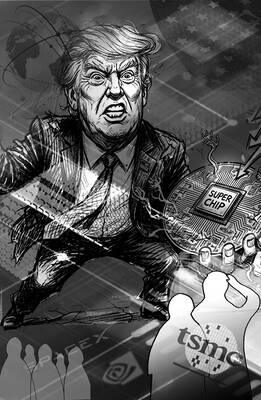
The White House’s decision to take a 9.9 percent stake in Intel Corp is looking like very shrewd business indeed. Since the government bought in at US$20.47 a share last August, the US chipmaker’s surging stock price has delivered the US a US$43 billion return. One of the reasons the investment has so far proved so sound is that the White House has made sure of it. According to The Wall Street Journal, Howard personally pushed deals on Intel’s behalf with some of the most lucrative clients imaginable. They include Nvidia Corp, the company at the heart of the AI
In a Taiwanese university classroom, a lecturer asks in English: “Can anyone give me an example from Taiwan?” Students look down. No one answers. After class, one student writes on the course platform in Mandarin: “I understood the concept, but I didn’t know how to answer in English.” That moment highlights a key issue in Taiwan’s English-medium instruction (EMI) reform: It is not just about more English-taught courses, but whether students can learn, participate and belong. EMI expansion is part of the Bilingual 2030 policy and the Ministry of Education’s BEST Program, aiming to improve English ability, support EMI teaching
A single photograph can cut through a lot of noise, but it can also be used to misrepresent the truth. At the very least, it can concentrate the mind on something that requires further investigation. On Monday last week, Ma Ying-jeou Foundation CEO Tai Hsia-ling (戴遐齡) and former National Security Council secretary-general King Pu-tsung (金溥聰) held a news conference in which they showed a photograph of former foundation CEO Hsiao Hsu-tsen (蕭旭岑), now Chinese Nationalist Party (KMT) deputy chairman. In the image Hsiao is seated next to Xiamen Taiwan Businessmen Association chairman Han Ying-huan (韓螢煥). The two men were holding
The Ministry of the Interior, working with the navy and coast guard, is organizing Taiwan’s first joint exercise simulating escort tankers carrying liquefied natural gas (LNG) and oil through a Chinese blockade. The drills simulate fuel transport along three maritime corridors leading toward Japan, the Philippines and the US. Deputy Minister of the Interior Sawyer Mars (馬士元) said that a blockade of the Taiwan Strait would amount to “almost a 100 percent blockade of the regional energy supply.” Minister of National Defense Wellington Koo said planning to counter a blockade is standard practice in Taipei. While the exercise is limited in


 RSS
RSS