


After more than six years experience as a tour guide and tour operator in Taiwan, I think it is wrong to flatter a spoiled business sector.
I have faced burning coaches, bus drivers who drive with a flat tire against orders, smoking in buses, ignorance of tour leaders’ decisions, guides leaving tours for private fun, guides fighting with bus drivers and more.
In cooperation with a Taiwanese tour operator, I have organized tours for Europeans.
Hotel managers in Alishan, Sun Moon Lake (日月潭) or Kending (墾丁) have shown an arrogance and disinterested attitude toward small groups of tourists.
Hotels in those areas have been overbooked and prices increase every year.
Price hikes for Westerners and Taiwanese have subsidized cheap rates for Chinese guests.
However, when Chinese guests are taken to Taroko Gorge they are often forced to visit shops instead of sightseeing.
I do not think they get a good impression of Taiwan.
Guides in Alishan use megaphones, crying out as though somebody is being tortured, without any respect for other visitors.
My requests that they speak quietly are ignored or I am attacked.
In those six years, I have seen a decline in quality combined with a terrible price increases and exchange-rate difficulties which resulted in me nearly giving up the work.
Despite the fact that I was the representative for three of 10 German companies which offer regular tours around Taiwan, the Tourism Bureau is too arrogant to discuss these problems with me.
Some examples of these problems are listed below.
1: Western tours in Taiwan are organized one year in advance.
Offering tours to Yushan (玉山) is near impossible due to the regulations.
A tour operator knows only six weeks in advance if permits are to be issued or not.
When I spoke with the bureau, they said: “Really, you need a permit? If you get one it is not a problem, but if not book another hotel and change the itinerary.”
Do they have any understanding how tours are organized and that hotels in Alishan and Sun-Moon Lake are always overbooked?
2: We want to stay at Songsyue Lodge (松雪樓) at Hehuanshan (合歡山), which is run by the government.
It is only possible to book rooms one month in advance. So, as an example, I have literally one month to the day of writing this article opened the Web site to see when it is possible to book rooms.
There is an opening for Oct. 6 that goes on sale at 6am; I have opened the site at 5:58am.
However, when I refresh the Web site the rooms are already booked at 6am exactly. Overbooked within 0:00:00 seconds?
What happened?
Perhaps some private business by the person in charge?
3: Businesses in Alishan are complaining about the decline in the numbers of Chinese tourists.
It is so sad, I am unable to sleep for days.
How did they survive for the 10 years before any Chinese guests arrived?
Businesses in Alishan have increased their prices every year with reference to a free market. No space for discussion.
Eat or die.
Now that they are facing problems they are still unwilling to give discounts.
Sorry, the free market is a fine thing when you are winning, but when you are losing then you like your government regulations?
Taiwanese and Western guests have paid increased prices because the hotels are doing good business due to Chinese visitors, but now Taiwanese taxpayers should shoulder the burden of their losses?
Losses, or is it only the decline in profits from an immoral, greedy level to a normal level?
4: This year, Taiwan has been hit by many typhoons.
On Sept. 15, the authorities closed some beaches, including some so-called “hotel beaches” (which is incorrect).
Without knowing this, I booked at one of my partner hotels, which I have used regularly for more than three years, one month in advance; this time I needed nine rooms.
They did not tell me about the closure or give a discount, but rather increased the rates.
Five hours before our arrival, they informed me that the beach would shortly be closed.
One month later is not shortly.
On my arrival, I saw at a 4-5 star hotel literally 30 buses full of school children.
The hotel manager took good care of their teacher, who slept on the third floor.
My guests’ rooms were beside the children’s rooms.
So for the teachers it is too uncomfortable sleeping on the same floor as the students — too noisy — but for my guests the hotel manager considered it acceptable. What kind of attitude is that?
The hotel got much negative feedback on travel Web sites.
At 9pm, the children were running and playing outside our rooms and the hotel opened a private night market.
The teacher was sleeping two floors above the children. So happily, the teacher did not suffer any discomfort.
When I complained at 10pm, the manager suggested my guests change rooms. At 10pm? Why not on arrival?
My guests were not too happy about that. For that stress, I was offered a discount of 5 percent per day.
5: As a teacher, I meet many friendly Chinese students and colleagues, and I am not against cooperation with China. Any individual Chinese tourist is welcome.
However, bringing several million Chinese tourists to Taiwan cannot solve the nation’s problems and would solely hurt this small nation.
Taiwanese roads, hotels and points of interest are too small for mass tourism. Every place would be overcrowed, noisy and dirty. A relatively small area such as Alishan can not accommodate 200 coaches with 40 guests on each (which I counted myself in 2014).
Tourism and environmental protection cannot be solely decided by the simple market economics of Harvard academics, it is more a question of logical assessment and practical experience.
Have these academics and politicians who favor cheap mass tourism heard about the problems in mainland Spain, Mallorca or Pattaya?
There are many examples of mass tourism gone wrong and where authorities are facing difficulties overcoming poor political decisions made decades before.
I still consider Taiwan a good destination with friendly people.
Hotels in areas such as Taipei and Tainan are often professional with acceptable prices. However, hotel managers and owners in some areas have to give up this short-term focus on money and learn more about international business, otherwise they will not attract international guests.
The Tourism Bureau must understand more about real tourism, not academic “the free market does it all” theory.
Why does the government request academic advice, but not advice from the tourism sector?
It should forget institutions such as the European Chamber of Commerce, which only represents big companies. The bureau should solicit professional advice from smaller, specialized agencies.
No one in the Taiwanese tourism industry would say privately a friendly word about the bureau or its competence.
On the contrary, local authorities are competent, friendly and helpfully, but they have no real authority to make decisions because they are restricted by the bureau.
Subsidizing the tourism sector will not solve any problems.
The government should regulate prices and service quality. Investors should give up the notion of an endless revenue stream paid for by Taiwanese taxpayers.
Claudius Petzold is an assistant professor of German at Fu Jen Catholic University.
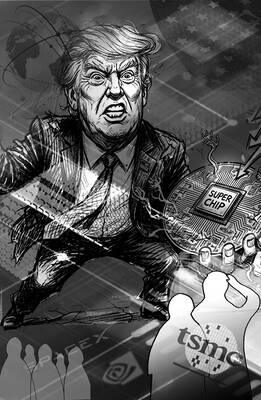
The White House’s decision to take a 9.9 percent stake in Intel Corp is looking like very shrewd business indeed. Since the government bought in at US$20.47 a share last August, the US chipmaker’s surging stock price has delivered the US a US$43 billion return. One of the reasons the investment has so far proved so sound is that the White House has made sure of it. According to The Wall Street Journal, Howard personally pushed deals on Intel’s behalf with some of the most lucrative clients imaginable. They include Nvidia Corp, the company at the heart of the AI
The Ministry of the Interior, working with the navy and coast guard, is organizing Taiwan’s first joint exercise simulating escort tankers carrying liquefied natural gas (LNG) and oil through a Chinese blockade. The drills simulate fuel transport along three maritime corridors leading toward Japan, the Philippines and the US. Deputy Minister of the Interior Sawyer Mars (馬士元) said that a blockade of the Taiwan Strait would amount to “almost a 100 percent blockade of the regional energy supply.” Minister of National Defense Wellington Koo said planning to counter a blockade is standard practice in Taipei. While the exercise is limited in
A single photograph can cut through a lot of noise, but it can also be used to misrepresent the truth. At the very least, it can concentrate the mind on something that requires further investigation. On Monday last week, Ma Ying-jeou Foundation CEO Tai Hsia-ling (戴遐齡) and former National Security Council secretary-general King Pu-tsung (金溥聰) held a news conference in which they showed a photograph of former foundation CEO Hsiao Hsu-tsen (蕭旭岑), now Chinese Nationalist Party (KMT) deputy chairman. In the image Hsiao is seated next to Xiamen Taiwan Businessmen Association chairman Han Ying-huan (韓螢煥). The two men were holding
I first met Professor Ray Jiing (井迎瑞) as a film and documentary student at Shih Hsin University’s (SHU) Department of Radio Television and Film in 1988. The following year, he went on to become the director of the Chinese Taipei Film Archive — forerunner of the Taiwan Film and Audiovisual Institute (TFAI). Over his eight-year tenure, Jiing rescued and restored over 200 classic Taiwanese films. In 1997, he established the Graduate Institute of Studies in Documentary and Film Archiving at Tainan National University of the Arts (TNNUA), and I joined the program in his third cohort of students. Beyond a


 RSS
RSS