


The so-called “Panama Papers” — the leak of 11.5 million files from the Panamanian law firm Mossack Fonseca — have given us a deep look into the many ways offshore shell companies are used to conceal the ownership of art.
Leaked initially to Suddeutsche Zeitung, a German newspaper, the documents have been pored over by a consortium of journalistic outlets, which released a series of articles last week, several about the art market.
The documents reveal the surprising extent of art ownership behind such veils. At this point, though, the papers have not established the degree to which these strategies are being used, as some suspect, to manipulate markets, evade taxes or launder money.
There might well be plenty of further revelations.
At the moment, three cases in particular illustrate just how critical a role secrecy has come to play in the art market today.
The papers reveal that a collection of modernist masterpieces assembled by Victor and Sally Ganz, a Manhattan couple, and auctioned for US$206.5 million at a landmark sale at Christie’s in New York in 1997, was not actually sold by the Ganz family, but by a British financier who had secretly bought the collection months earlier.
According to Mossack Fonseca documents, the British billionaire currency trader Joe Lewis — or rather, one of his shell companies — was the seller at the auction, apparently in some kind of partnership with Christie’s.
It was all a massive “flip,” a quick resale that was early, if undisclosed, evidence of just how much art was being treated like a commodity.
The event set a high for any single-owner collection at auction, ushering in a new era of blockbuster prices for trophy art. The question is whether people would have paid as much if they had known that the art was not fresh from the estate of two connoisseurs who had spent half a century scouring galleries for gems by artists such as Picasso, Jasper Johns and Frank Stella.
“To ‘flip’ an entire collection of that quality is unprecedented,” said art adviser Wendy Goldsmith, who was Christie’s director of 19th-century European art in London at the time and was unaware of the auction house’s arrangement with Lewis. “It was an icon of estate sales, a milestone in pricing. Bidders were buying the Ganz provenance.”
Picasso’s The Dream, a 1932 painting of a sleeping Marie-Therese Walter, soared to US$48.4 million. His 1955 Women of Algiers (Version ‘O’), advertised with a high estimate of US$12 million, went for US$31.9 million. (Even at that price, it was a sound investment. The work sold at Christie’s last year for US$179.4 million.)
As revealed by the Guardian, more than 100 works from the 118-piece collection, including those two Picassos, had been bought months earlier for US$168 million by Simsbury International Corp, an entity controlled by Lewis. The corporation was in some kind of arrangement with Spink, a subsidiary of Christie’s that is now defunct. At that time, the auction house was publicly listed and Lewis was its biggest shareholder.
The leaked documents state that Simsbury, based on the tiny Pacific island of Niue, and Spink would share the profits if the property sold for more than US$168 million, suggesting that they split, with fees, about US$38.5 million in profits. The Guardian article did not say whether Ganz heirs also benefited additionally from the sale.
Christie’s, which acknowledged its interest in the works at the time of the Ganz sale, has declined to comment on Lewis’ involvement.
“There is no suggestion that the sale arrangements were incorrect or outside of auction standards governed by law. All necessary financial disclosures were made at the time of sale,” the auction house said in a statement on Friday last week.
The International Consortium of Investigative Journalists, citing the documents, reported last week that Russian billionaire collector Dmitry Rybolovlev used an offshore holding entity, created by Mossack Fonseca, to move his collection out of his wife’s reach during divorce proceedings.
Rybolovlev’s lawyers denied that the divorce had anything to do with his decision to transfer ownership of his art to the entity, Xitrans Finance Ltd, which he had established in the British Virgin Islands in 2002.
Rybolovlev’s wife, Elena, filed for divorce in 2008. According to the article, during the legal battle that ensued, correspondence sent to Mossack Fonseca stated that Rybolovlev used Xitrans to move his collection out of Switzerland to Singapore and London.
In a statement last week, the Rybolovlev family trust’s lawyer said the offshore arrangements “were set up completely legitimately for the purposes of asset protection and estate planning,” and had been publicly disclosed in numerous publications worldwide.
Rybolovlev has spent more than US$2 billion on museum-quality works by Leonardo da Vinci and other masters. He bought them with the help of Yves Bouvier, a Swiss art dealer and businessman who runs a storage facility at the Geneva Freeport, a warehouse complex.
Rybolovlev has accused Bouvier of defrauding him in the purchases, a charge that Bouvier has denied.
The documents released last week provided a look at how the use of a shell corporation can confuse a restitution claim. For four years, Philippe Maestracci, a French resident, has been fighting in New York courts to claim a Modigliani painting, Seated Man With a Cane, which he says was taken from his grandfather by the Nazis.
The painting, valued at US$25 million, was bought at auction in 1996 by the International Art Center, a Panama-based entity that many in the art world had long associated with the Nahmad family of art dealers.
Maestracci has struggled to make headway with his suit, partly because the Nahmads have said their galleries had no ownership stake in the offshore entity. The documents released last week established that Nahmad family members have controlled the International Art Center for more than 20 years and that the family’s patriarch, David Nahmad, has been its sole owner since 2014.
On Friday last week, Swiss prosecutors issued a seizure order for the painting, which the Art Center stores at the Geneva Freeport.
The authorities would not discuss their reasoning. A lawyer for the company and the Nahmad family, Aaron Richard Golub, said that the order meant that the painting could not be moved from the freeport and that the company had 10 days to appeal the order.
Golub last week called the ownership question “irrelevant” to the issues of the lawsuit.
He said there was no evidence that Maestracci’s grandfather owned the work in question, a contention the plaintiff has rejected.
Additional reporting by Doreen Carvajal and Graham Bowley
A gap appears to be emerging between Washington’s foreign policy elites and the broader American public on how the United States should respond to China’s rise. From my vantage working at a think tank in Washington, DC, and through regular travel around the United States, I increasingly experience two distinct discussions. This divergence — between America’s elite hawkishness and public caution — may become one of the least appreciated and most consequential external factors influencing Taiwan’s security environment in the years ahead. Within the American policy community, the dominant view of China has grown unmistakably tough. Many members of Congress, as
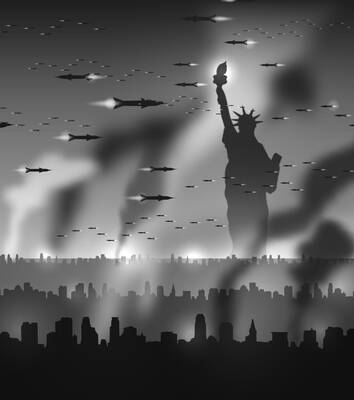
After declaring Iran’s military “gone,” US President Donald Trump appealed to the UK, France, Japan and South Korea — as well as China, Iran’s strategic partner — to send minesweepers and naval forces to reopen the Strait of Hormuz. When allies balked, the request turned into a warning: NATO would face “a very bad” future if it refused. The prevailing wisdom is that Trump faces a credibility problem: having spent years insulting allies, he finds they would not rally when he needs them. That is true, but superficial, as though a structural collapse could be caused by wounded feelings. Something
Former Taipei mayor and Taiwan People’s Party (TPP) founding chairman Ko Wen-je (柯文哲) was sentenced to 17 years in prison on Thursday, making headlines across major media. However, another case linked to the TPP — the indictment of Chinese immigrant Xu Chunying (徐春鶯) for alleged violations of the Anti-Infiltration Act (反滲透法) on Tuesday — has also stirred up heated discussions. Born in Shanghai, Xu became a resident of Taiwan through marriage in 1993. Currently the director of the Taiwan New Immigrant Development Association, she was elected to serve as legislator-at-large for the TPP in 2023, but was later charged with involvement
Out of 64 participating universities in this year’s Stars Program — through which schools directly recommend their top students to universities for admission — only 19 filled their admissions quotas. There were 922 vacancies, down more than 200 from last year; top universities had 37 unfilled places, 40 fewer than last year. The original purpose of the Stars Program was to expand admissions to a wider range of students. However, certain departments at elite universities that failed to meet their admissions quotas are not improving. Vacancies at top universities are linked to students’ program preferences on their applications, but inappropriate admission


 RSS
RSS