


A certain way to help the stock market return to its normal operating procedures is avoiding government intervention. To achieve that, Minister of Finance Chang Sheng-ford (張盛和) is planning an exit of the National Stabilization Fund from the stock market despite worries that the TAIEX might face a new wave of downward pressure.
On Wednesday last week, Chang said that the management committee of the NT$500 billion (US$15.4 billion) fund would hold a routine meeting tomorrow to discuss the fund’s operation.
He said it is time for the fund to pull out of the market after it has poured more than NT$20 billion to shore up local shares since Aug. 25 last year — the longest period the fund has ever been tapped to stabilize Taiwan’s financial markets since 2000.
Previously, Chang said the government would continue to use the state-run fund to support the stock market and boost investor confidence during the transition of political power. However, this rationale does not explain to taxpayers why the National Stabilization Fund would remain functional when there is no sign of market fluctuation or economic turbulence.
The fund’s function, as its name implies, is to stabilize Taiwan’s economy and capital markets in the event of an emergency. Because the fund is an emergency mechanism, it should enter the market swiftly and exit as soon as the market stabilizes. Most importantly, the fund’s purpose is to provide an immediate or short-term remedy, rather than a long-term cure.
Unfortunately, the duration of government intervention through the fund has tended to become longer and more frequent over the past few years. For instance, the fund only stayed idle for five days during the nation’s first transition of political power after the 2000 presidential election; it remained active for 91 days during the 2008 global financial crisis and was activated for 121 days in the wake of the European debt crisis in 2011. However, in the latest intervention the fund has been active for more than seven months after a global stock market rout last year.
Knowing that the fund is entering the market might give investors some sort of psychological support or a sense of guarantee. However, sadly, the fund’s efforts can do only so much to comfort retail investors, while it has gradually been taken as a tool for letting large players or foreign investors off the hook, as they know that the fund would certainly buy on lows.
Moreover, there have been concerns over the fund’s operations ever since the legislature passed the Regulation on the Establishment and Management of the National Stabilization Fund in January 2000.
The regulation stipulates that the fund can use state-owned shares in public or private enterprises to borrow up to NT$200 billion from the banking industry and up to NT$300 billion from four government funds — the Labor Insurance Fund, Labor Pension Fund, Civil Servant Pension Fund and Postal Savings Fund.
However, questions over the fund’s investment goals, decisionmaking process, operational model and management strategy, as well as supervisory mechanisms and organizational regulations, have yet to be answered.
The fund is a double-edged sword that could help or hurt the local market. While it can help restore investor confidence, it also sends a signal to global players that the return on their investments in local equities is guaranteed by the Taiwanese government. That makes pulling the fund out of the market as soon as possible the best way to mitigate public worries about the principle of fairness. It also raises the question whether the fund’s billions of New Taiwan dollars were used wisely.
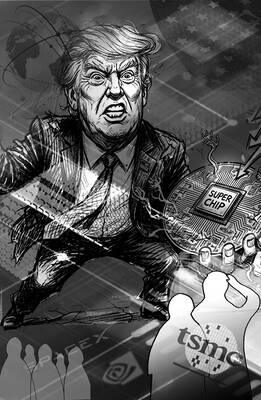
The White House’s decision to take a 9.9 percent stake in Intel Corp is looking like very shrewd business indeed. Since the government bought in at US$20.47 a share last August, the US chipmaker’s surging stock price has delivered the US a US$43 billion return. One of the reasons the investment has so far proved so sound is that the White House has made sure of it. According to The Wall Street Journal, Howard personally pushed deals on Intel’s behalf with some of the most lucrative clients imaginable. They include Nvidia Corp, the company at the heart of the AI
A single photograph can cut through a lot of noise, but it can also be used to misrepresent the truth. At the very least, it can concentrate the mind on something that requires further investigation. On Monday last week, Ma Ying-jeou Foundation CEO Tai Hsia-ling (戴遐齡) and former National Security Council secretary-general King Pu-tsung (金溥聰) held a news conference in which they showed a photograph of former foundation CEO Hsiao Hsu-tsen (蕭旭岑), now Chinese Nationalist Party (KMT) deputy chairman. In the image Hsiao is seated next to Xiamen Taiwan Businessmen Association chairman Han Ying-huan (韓螢煥). The two men were holding
I first met Professor Ray Jiing (井迎瑞) as a film and documentary student at Shih Hsin University’s (SHU) Department of Radio Television and Film in 1988. The following year, he went on to become the director of the Chinese Taipei Film Archive — forerunner of the Taiwan Film and Audiovisual Institute (TFAI). Over his eight-year tenure, Jiing rescued and restored over 200 classic Taiwanese films. In 1997, he established the Graduate Institute of Studies in Documentary and Film Archiving at Tainan National University of the Arts (TNNUA), and I joined the program in his third cohort of students. Beyond a
President William Lai Ching-te’s (賴清德) May 20 second-anniversary address was not just a routine policy review; it was damage control. US President Donald Trump’s remarks — that he did not want to see anyone move toward independence and that the delivery of a major Taiwan arms package could depend on the progress of US-China relations — unsettled Taiwan’s public and created an opening for opposition parties to question whether Taiwan was being treated as a bargaining chip in Washington’s dealings with Beijing. Lai’s speech was designed to close that opening. The address covered the expected ground: sovereignty, cross-strait relations, defense spending,


 RSS
RSS