


In the wake of the Democratic Progressive Party’s (DPP) landslide victory in the Jan. 16 presidential and legislative elections, the Chinese Nationalist Party (KMT) has yet to launch a review into the causes of its defeat.
When president-elect Tsai Ing-wen (蔡英文) lost to President Ma Ying-jeou (馬英九) in the 2012 presidential election, she resigned as DPP chairperson, but also ordered a report into the party’s defeat and, upon her return to the post, rebuilt the DPP from the ground up.
However, the KMT has managed only a scattershot account of why it suffered such a heavy defeat. KMT Secretary-General Lee Shu-chuan (李四川) tried to blame an election-eve incident involving 16-year-old Taiwanese singer Chou Tzu-yu (周子瑜), saying it had even more of an impact than the “two bullet” incident on the eve of the 2004 presidential election.
After KMT chairman Eric Chu (朱立倫) resigned to take responsibility for the party’s losses, it was Deputy Legislative Speaker Hung Hsiu-chu (洪秀柱) and Taipei City Councilor Lee Hsin (李新) — both of whom are ideologically close to the New Party — who were first to throw their names in the hat for the chairpersonship. New Party Chairman Yok Mu-ming (郁慕明) also expressed an interest, with the party by-election shaping up to be a war of restoration for the New Party, not a battlecry for reform.
There are many reasons why the KMT lost power. Apart from Ma’s out-of-touch administration, there was an initial reluctance within the party to field a strong candidate, with Chu replacing the party’s original candidate, Hung, halfway into the campaign. Previously, the KMT had won the electorate with its cross-strait credentials. However, the Jan. 16 elections showed that the electorate has rejected the KMT’s outdated cross-strait policy.
The KMT’s biggest problem is that it has lost contact with Taiwanese. It has long lost the younger generation, who like neither the KMT nor its policies and, despite young people calling on the party to strengthen its localization discourse, urging it to drop the word “Chinese” from its name, the party’s old guard and those wanting to lead the party — Hung, Lee Hsin and KMT Legislator Apollo Chen (陳學聖) — do not like change. Their confidence stems from the fact that one-third of the more than 300,000 KMT members belong to the deep-blue Huang Fu-hsing (黃復興) military veterans branch. If they can secure the votes of this group of retirees and family members, they should have the chairpersonship in the bag.
KMT members tend to be older, with military, civil service or public school teacher backgrounds and vested interests. They have a natural connection with China and tend to favor unification with their perceived motherland. They are at odds with those born and raised in Taiwan, who tend to be middle class, desiring a free, fair and just society and sympathetic to the idea of independence. People directly associated with the KMT are increasingly personae non grata.
Former president Chiang Kai-shek (蔣介石) was defeated in the Chinese Civil War and brought the KMT to Taiwan. His son, former president Chiang Ching-kuo (蔣經國), encouraged Taiwanese to go into government. When his successor, former president Lee Teng-hui (李登輝), became KMT chairman, he encouraged many Taiwanese to enter politics, and this new blood sustained the KMT for two decades. Former vice president and KMT chairman Lien Chan (連戰) and Ma rested on their predecessors’ achievements and failed to cultivate any new talent. Chu was the KMT’s last rising star, but now potential leaders are thin on the ground. This, in a nutshell, is the crisis the KMT now faces.
The party lacks an intergenerational struggle. All it has is a struggle for the way forward: Whether to allow the pro-China New Party to return to the fold, or to cultivate a more youthful, Taiwan-oriented core. The problem is, if the party cannot reform and rise from the pile of ashes it now finds itself in, it is destined to be swept into the dustbin of history.
A gap appears to be emerging between Washington’s foreign policy elites and the broader American public on how the United States should respond to China’s rise. From my vantage working at a think tank in Washington, DC, and through regular travel around the United States, I increasingly experience two distinct discussions. This divergence — between America’s elite hawkishness and public caution — may become one of the least appreciated and most consequential external factors influencing Taiwan’s security environment in the years ahead. Within the American policy community, the dominant view of China has grown unmistakably tough. Many members of Congress, as
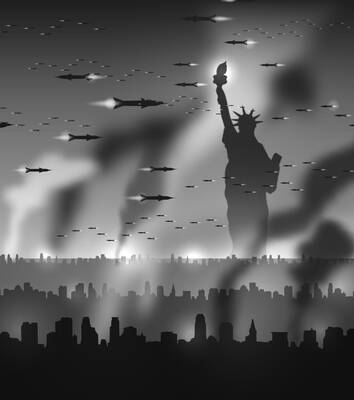
After declaring Iran’s military “gone,” US President Donald Trump appealed to the UK, France, Japan and South Korea — as well as China, Iran’s strategic partner — to send minesweepers and naval forces to reopen the Strait of Hormuz. When allies balked, the request turned into a warning: NATO would face “a very bad” future if it refused. The prevailing wisdom is that Trump faces a credibility problem: having spent years insulting allies, he finds they would not rally when he needs them. That is true, but superficial, as though a structural collapse could be caused by wounded feelings. Something
Former Taipei mayor and Taiwan People’s Party (TPP) founding chairman Ko Wen-je (柯文哲) was sentenced to 17 years in prison on Thursday, making headlines across major media. However, another case linked to the TPP — the indictment of Chinese immigrant Xu Chunying (徐春鶯) for alleged violations of the Anti-Infiltration Act (反滲透法) on Tuesday — has also stirred up heated discussions. Born in Shanghai, Xu became a resident of Taiwan through marriage in 1993. Currently the director of the Taiwan New Immigrant Development Association, she was elected to serve as legislator-at-large for the TPP in 2023, but was later charged with involvement
Out of 64 participating universities in this year’s Stars Program — through which schools directly recommend their top students to universities for admission — only 19 filled their admissions quotas. There were 922 vacancies, down more than 200 from last year; top universities had 37 unfilled places, 40 fewer than last year. The original purpose of the Stars Program was to expand admissions to a wider range of students. However, certain departments at elite universities that failed to meet their admissions quotas are not improving. Vacancies at top universities are linked to students’ program preferences on their applications, but inappropriate admission


 RSS
RSS