


On Nov. 28, Rong San Lin (林榮三), the man who single-handedly founded the Liberty Times group, set out the group’s philosophy and remained steadfast in his beliefs throughout, passed away.
In the days after, we arranged a simple space in the group’s office building in which we could go and pay our respects and offer our condolences to the family of our company’s founder. To this space, too, came people from the wider community, from all walks of life, irrespective of party affiliation or generation, regardless of whether they knew the man well or had never met him. All of these people came to offer their condolences and to pay their respects in person, and for this we are sincerely grateful.
Over the past three weeks, we have received a number of questions from readers of the Liberty Times (sister newspaper of the Taipei Times) concerned about the direction the paper is to take in the wake of its founder’s passing. This level of belief in what our founder was determined to do is quite moving.
Beyond the gratitude we feel for this, we are also well aware of the gravity of the responsibility with which we are charged and feel that there is a need to address this point here, for our readers and for society as a whole.
The guiding principle of the Liberty Times is “Taiwan Foremost, Liberty First” (台灣優先 自由第一). The newspaper’s localization message, with its staunchly Taiwan-centric perspective, places the protection of the freedom of expression at the core of its mission. Its goals are embedded in the democratization process of Taiwan’s recent past, being both a product of, and witness to, this history.
The newspaper was founded after the lifting of the Chinese Nationalist Party (KMT) regime’s ban on the establishment of new newspapers and as a result of a commitment to localization. Through its persistent challenge to the establishment, it has grown stronger.
It has been three decades since our newspaper, founded by a Taiwanese to give ordinary Taiwanese a voice, was launched. The public was initially a bit suspicious, preferring to keep a distance, but gradually the message struck a chord. The newspaper began to stand out from the others in what was a fiercely competitive market, over time growing into the role, and there was a sense that it had found its vocation.
This showed how a section of the news media and the Taiwanese public were on the same page, so to speak, and anticipated the Liberty Times’ development strategy for the new millennium: Liberty for Taiwan is only possible through persistent efforts to put “Taiwan foremost.”
This principle, forged from the newspaper’s experience of its own growing pains, is to continue to guide it. It is something that both benefits others and is a rational choice that is also good for us.
Placing the emphasis on Taiwan and localization is so much more than a narrow concept of independence or regionalism. It is the fusion of the universal values of freedom and democracy, intertwined by two major threads: Taiwan’s future should be decided by the 23 million Taiwanese living here and they must be provided with an absolute guarantee that they have the right to choose their own way of life; and when these two principles are met, Taiwan should seek to promote peace with its neighbors and fulfill its international responsibilities.
The autonomy of a nation is nothing without a foundation of economic autonomy. However, unlike most other entrepreneurs, Lin cared not just about Taiwan’s economic problems, but also believed that the ultimate goal of economic development was the expansion of the number of jobs available for people.
As a result, running contrary to the prevailing wisdom of GDP as a measure of economic success, the Liberty Times has long called on the government to use policy instruments that can sustain traditional industries and small and medium enterprises, as they are capable of creating the greatest number of jobs.
It is because we believe that it is possible to achieve a better life for Taiwanese through hard work, and therefore achieve their dreams, that we object to industry preferring to move overseas wholesale — rather than modernizing and upgrading — simply for the sake of reducing costs, and in the process robbing Taiwan of jobs and tax revenue.
Due to factor price equalization, we have been opposed to the formation of a free-trade economic entity with China, proclaiming the China-leaning policy to be misconceived, and in fact, the main culprit behind sluggish growth in salaries in Taiwan over the past few years. It also accounts for the difficulty we have had competing with China, given the sheer volume of the cheap goods it produces.
There are serious problems with Taiwan’s economy, and not everyone is benefiting from economic development. This creates problems with the allocation of public resources and with inter-generational fairness, consigning us to a vicious cycle.
The government has a responsibility to ensure that it creates the conditions in which the younger generation can reap the benefits of their hard work, and to provide a platform where initiative and opportunity meet.
The current generation — those who grew up in Taiwan’s most prosperous years — should learn from the previous generation, who worked their fingers to the bone to create the world that they did and pass on the fruits of their labor. They should emulate this attitude in working for a better future for their own children.
Our founder was not prone to espousing profound philosophies, but he would often ask: “Do you think we could be content sitting here, enjoying life, while others have nothing to eat and struggle to get by?”
The words are simple, but reflect a wish to make the world a better place. The logic behind them coincides with the aforementioned economic perspective.
In the administration of the newspaper, Lin insisted that the media existed to perform a function for society, and constantly reiterated his belief that the media were absolutely not there merely to satisfy one’s personal ambitions.
For this reason, whenever the newspaper has addressed a major issue, it has been imperative that the information be accurate and the analysis professional. The newspaper has concentrated on the issues and stayed away from ad hominem attacks. This has been the yardstick by which its work has been measured.
Even when the issue at hand involved his personal interests, Lin refrained from using the newspaper’s clout or using it as a club with which to bludgeon or intimidate rivals.
On the contrary, for a long time it has been the newspaper, based on the media’s duty to provide oversight and expose wrongdoing, that has constantly had to deal with cajolery and intimidation from powerful outside forces, and yet we have clung to our editorial line and conscience, and have resisted change and refused to compromise.
There is a red line and we have not crossed it. We have not, and will not.
In this, our founder led through example, emphasizing the idea that “there are standards to be kept when running a newspaper.” The example that he set, the road ahead that he laid down, has given us ample room for discussion on the policies that are to take us forward, although they must always be measured against the yardstick of “Taiwan Foremost, Liberty First.”
We have enumerated the things that our founder has left us. All of these things, from his love of Taiwan, his passion for the place where he was born and his commitment to doing what is right, have long been part of our DNA. And, just as he passed them on to us, we will surely hand them down to future generations.
Translated by Paul Cooper
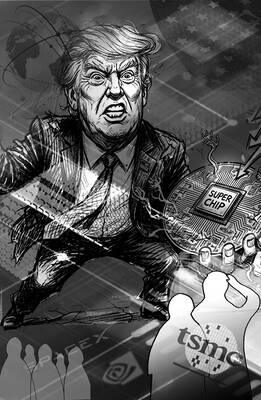
The White House’s decision to take a 9.9 percent stake in Intel Corp is looking like very shrewd business indeed. Since the government bought in at US$20.47 a share last August, the US chipmaker’s surging stock price has delivered the US a US$43 billion return. One of the reasons the investment has so far proved so sound is that the White House has made sure of it. According to The Wall Street Journal, Howard personally pushed deals on Intel’s behalf with some of the most lucrative clients imaginable. They include Nvidia Corp, the company at the heart of the AI
A single photograph can cut through a lot of noise, but it can also be used to misrepresent the truth. At the very least, it can concentrate the mind on something that requires further investigation. On Monday last week, Ma Ying-jeou Foundation CEO Tai Hsia-ling (戴遐齡) and former National Security Council secretary-general King Pu-tsung (金溥聰) held a news conference in which they showed a photograph of former foundation CEO Hsiao Hsu-tsen (蕭旭岑), now Chinese Nationalist Party (KMT) deputy chairman. In the image Hsiao is seated next to Xiamen Taiwan Businessmen Association chairman Han Ying-huan (韓螢煥). The two men were holding
I first met Professor Ray Jiing (井迎瑞) as a film and documentary student at Shih Hsin University’s (SHU) Department of Radio Television and Film in 1988. The following year, he went on to become the director of the Chinese Taipei Film Archive — forerunner of the Taiwan Film and Audiovisual Institute (TFAI). Over his eight-year tenure, Jiing rescued and restored over 200 classic Taiwanese films. In 1997, he established the Graduate Institute of Studies in Documentary and Film Archiving at Tainan National University of the Arts (TNNUA), and I joined the program in his third cohort of students. Beyond a
President William Lai Ching-te’s (賴清德) May 20 second-anniversary address was not just a routine policy review; it was damage control. US President Donald Trump’s remarks — that he did not want to see anyone move toward independence and that the delivery of a major Taiwan arms package could depend on the progress of US-China relations — unsettled Taiwan’s public and created an opening for opposition parties to question whether Taiwan was being treated as a bargaining chip in Washington’s dealings with Beijing. Lai’s speech was designed to close that opening. The address covered the expected ground: sovereignty, cross-strait relations, defense spending,


 RSS
RSS