


About a dozen Catholics wept and sang hymns outside their church as a man climbed to the top of the building and sliced off its steel cross with a cutting torch. It toppled with a thud.
“Aren’t you ashamed of what you have done?” a teary woman yelled at the more than 100 security guards, who along with police and government workers kept the parishioners of Lower Dafei Catholic Church from protecting the symbol of their faith. The guards, who stood with shields and batons in the sun for nearly two hours, looked indifferent.
“Doesn’t the government give us the right to religious freedom? Why are they taking down our symbol without any explanation?” another parishioner said hours earlier, as government workers arrived to build the scaffolding to reach the cross.
“We have violated no law. We do not oppose the government,” the parishioner said, who gave his name only as Chen for fear of retaliation from authorities. “We have been good, law-abiding citizens,” he said.
Authorities in Zhejiang Province are believed to be under a two-month deadline to remove crosses from the spires, vaults, roofs and wall arches of the 4,000 or so churches that dot the landscape of this economically thriving region.
In a rare move, even China’s semiofficial Christian associations — which are supposed to ensure the Chinese Communist Party’s (CCP) control over Protestant and Catholic groups — have denounced the campaign as unconstitutional and humiliating. They have warned that it could risk turning the faithful into enemies of the party.
The campaign is believed to be the doing of Chinese President Xi Jinping (習近平), whose administration has launched the most severe crackdown in decades on social forces that might challenge the monopoly of the party’s rule.
However, Yang Fenggang (楊鳳崗), an expert on China’s religions at Purdue University in Indiana, said the party may have miscalculated and could be creating the very instability it is trying to avoid.
“The crackdown has alienated Christians in China, who are otherwise law-abiding citizens,” Yang said.
He said the campaign to assert state power over officially sanctioned churches has been ordered by the central government and is likely being carried out as a kind of experiment in Zhejiang, where the provincial party chief, Xia Baolong (夏寶龍), is a trusted ally of Xi.
The massive campaign comes one year after the provincial leadership ordered the razing of several churches and hundreds of rooftop crosses deemed to be illegal structures. This summer, Zhejiang banned rooftop crosses altogether. Despite criticism that the new rule violates China’s constitutional right of religious freedom, local enforcers are sending demolition crews to virtually all the province’s churches.
They have met with resistance. Parishioners have kept vigils and tried to block entrances to church grounds with cargo trucks and many churches have re-erected crosses in defiance.
Since Xi came into power in late 2012, Beijing has hushed voices critical of its policies and practices in China’s social media, locked up members of the New Citizens Movement who had called for greater government accountability and most recently, rounded up rights lawyers who insist China’s law must be followed to the letter and applied equally to the people and the state.
“The authorities are especially worried that those with religious beliefs have a strong sense of identity and belonging, which can translate into huge social forces,” independent commentator Zhao Chu (趙楚) said.
In targeting Christians, the party is going after a group possibly larger than itself. Yang said Christians probably number close to 100 million after more than three decades of rapid growth, though official figures are much lower. The CCP has nearly 88 million members.
In a troubling sign for the party, a sizable portion of its nominally atheist membership holds Christian, Buddhist, Muslim or other beliefs. The party is worried that religion — especially versions of Christianity rooted in the West — could subvert its rule.
The party tried to wipe out religion altogether during the ideological fervor of the Cultural Revolution of the 1960s and 1970s, but later restored the right to worship. In ensuing decades, religious participation has grown as people seek to fill a spiritual void.
Still, Beijing retains tight controls over all religious groups, requiring them to register with the state or be labeled illegal. It claims the exclusive right to appoint Catholic bishops within China, instead of the Vatican.
In the western regions of Tibet and Xinjiang, where Buddhist and Islamic beliefs mingle with ethnic identities, the government also has sought to curb some of the visible symbols of faith, including beards and veils and installed surveillance cameras in and around monasteries and mosques.
The rules Zhejiang adopted early last month say crosses should be wholly affixed to a building facade and be no more than one-tenth of the facade’s height. No rationale has been provided and the provincial government did not respond to an Associated Press request for an interview.
The Catholic Patriotic Association of Zhejiang has said it is illegal to remove crosses from properly registered churches. The Christian Association of Zhejiang warned the act has caused animosity toward the CCP. Both groups called for an immediate halt.
Yang said the rare open opposition from the government-sanctioned Christian associations, which serve as liaisons between the authorities and rank-and-file Christians, means the authorities could lose this important conduit.
“Now this bridge has been burned,” he said.
Fear, frustration and fury are probably most palpable in the municipality of Wenzhou, tucked between China’s eastern coastline and rugged mountain ranges. With its 2,000 or so churches, Wenzhou, home to 9 million people, is as well-known as a bastion of Christianity as it is for its gritty entrepreneurship.
Almost every township has its own claim to a line of products — whether it be buttons, shoe soles, pet products or children’s toys. Almost every village has a church or two, joining the landscape of rice paddies, farmhouses and factories.
Zhu Libin, president of the Wenzhou Christian Association, is torn between fellow Christians, who want him to speak on their behalf and local authorities, who want him to persuade churches to comply.
“As a Christian, I want to see the cross lifted as high as possible, but as a citizen of China, I have to follow the rule when asked,” he said in an interview at his downtown Wenzhou office.
When asked to comment on the continuing cross removals, he stood up and walked out. Moments later, he returned but refused to answer.
Officially appointed bishop Zhu Weifang (朱?方) declined to be interviewed, but he and two dozen other Catholic officials and priests signed a strongly worded letter calling the new rules unlawful.
“The more [authorities] suppress the call for justice, the more it shows they are faced with severe social crisis, that they have little confidence in their ability to rule, and that they are incompetent in dealing with issues,” said the letter, which urges parishioners to “fight by law of reason to defend our very basic right to our religion.”
In village churches, Protestants and Catholics are defying orders to remove crosses on their own and keeping around-the-clock vigils in slim hopes of holding off demolition crews. Many have defiantly re-erected the crosses.
Tears welled in the eyes of Tu Shouzhe when he recalled how authorities forcibly removed the cross from his Protestant church in the village of Muyang on a hot, humid summer afternoon.
“It was a surprise attack. We did not let them in, but they broke in by cutting off the lock. We demanded paperwork, but they showed us none. They cordoned us away from the church,” Tu said “They had 60-70 people. We had just about a dozen or so. Everyone was crying. Our hearts ached. We felt powerless to resist, and only prayed and sang hymns.”
In the Zhejiang city of Jinhua, two pastors from the official Jinhua City Christian Church have been detained on suspicion of corruption after the two refused to remove the rooftop cross from a newly built sanctuary, lawyer Liu Weiguo (劉衛國) said on Wednesday.
In Lower Dafei Village, the demolition crew descended one morning two weeks ago, but soon realized it could not scale the spire to get to the cross. They returned in the afternoon with poles for scaffolding and a cutting torch. Officials barred a photographer and videojournalist from the AP from documenting the demolition, but another reporter was present, apparently the first news media to capture images of a cross removal.
One parishioner sat in the narrow entrance to the church grounds, trying to block the intruders, but was ordered to leave. He never spoke a word, but kept his eyes on the cross and prayed silently.
As several men built the scaffolding, parishioners’ tearful singing echoed over the church grounds: “He uses the love of the cross, the cross, to conquer the man.”
A gap appears to be emerging between Washington’s foreign policy elites and the broader American public on how the United States should respond to China’s rise. From my vantage working at a think tank in Washington, DC, and through regular travel around the United States, I increasingly experience two distinct discussions. This divergence — between America’s elite hawkishness and public caution — may become one of the least appreciated and most consequential external factors influencing Taiwan’s security environment in the years ahead. Within the American policy community, the dominant view of China has grown unmistakably tough. Many members of Congress, as
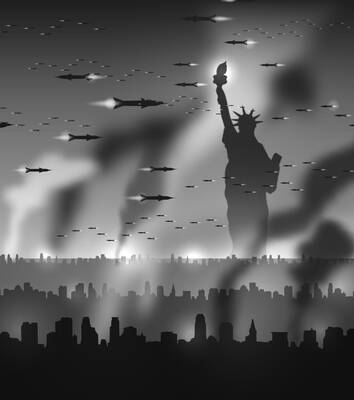
After declaring Iran’s military “gone,” US President Donald Trump appealed to the UK, France, Japan and South Korea — as well as China, Iran’s strategic partner — to send minesweepers and naval forces to reopen the Strait of Hormuz. When allies balked, the request turned into a warning: NATO would face “a very bad” future if it refused. The prevailing wisdom is that Trump faces a credibility problem: having spent years insulting allies, he finds they would not rally when he needs them. That is true, but superficial, as though a structural collapse could be caused by wounded feelings. Something
Former Taipei mayor and Taiwan People’s Party (TPP) founding chairman Ko Wen-je (柯文哲) was sentenced to 17 years in prison on Thursday, making headlines across major media. However, another case linked to the TPP — the indictment of Chinese immigrant Xu Chunying (徐春鶯) for alleged violations of the Anti-Infiltration Act (反滲透法) on Tuesday — has also stirred up heated discussions. Born in Shanghai, Xu became a resident of Taiwan through marriage in 1993. Currently the director of the Taiwan New Immigrant Development Association, she was elected to serve as legislator-at-large for the TPP in 2023, but was later charged with involvement
Out of 64 participating universities in this year’s Stars Program — through which schools directly recommend their top students to universities for admission — only 19 filled their admissions quotas. There were 922 vacancies, down more than 200 from last year; top universities had 37 unfilled places, 40 fewer than last year. The original purpose of the Stars Program was to expand admissions to a wider range of students. However, certain departments at elite universities that failed to meet their admissions quotas are not improving. Vacancies at top universities are linked to students’ program preferences on their applications, but inappropriate admission


 RSS
RSS