


In response to the arrogance of the Ministry of Education, which refuses to withdraw its “micro-adjustments” to the high-school curriculum guidelines, students from nearly 300 high schools as well as members of educational and social groups surrounded the ministry on Wednesday evening in a determined display of their demands. Not only was this a rare sight, it could also be seen as advance notice of a new era.
A publication entitled Taiwan Youth (台灣青年) was founded in Tokyo almost a century ago, on July 16, 1920. Funded by several landlords, such as Tsai Hui-ju (蔡惠如) and Lin Hsien-tang (林獻堂), the magazine was published by a group of Taiwanese studying in Japan, including Tsai Pei-huo (蔡培火), Lin Cheng-lu (林呈祿) and Peng Hua-ying (彭華英).
By using the word “youth” in its name, the magazine showed an affinity with earlier organizations, such as Young Italy and Young China (少年中國) and publications such as the New Youth (新青年).
Later, the magazine was transformed into the publications Taiwan (台灣), Taiwan Minpao (台灣民報) and, finally, the Taiwan New Minpao (台灣新民報), serving as the main channel for publications related to the new literature and cultural movement in Taiwan, and a battlefield for the anti-Japanese culture movement.
In this era, young Taiwanese were outstanding as they shined in both cultural and political domains. Although the governments before and after World War II had a strict and conservative attitude toward national education, “Taiwan awareness” took root and sprouted in the educational domain following Taiwan’s first change in government in 2000. Hence, the high-school curriculum “micro-adjustments” that President Ma Ying-jeou’s (馬英九) government has insisted on in recent years and that have caused a series of disputes, can be seen both as a transformation and continuance of the Chinese colonization of Taiwan’s educational system and as the last attack of a dying beast.
Regardless of how controversy over the “micro-adjustments” to the high-school curriculum ends, the issue has succeeded in motivating people in cultural circles, professors, writers, and high-school history and civil ethics teachers opposed to the adjustments to protest in public. Even senior-high and vocational school students are taking concrete action and joining the campaign to show their determination to safeguard educational autonomy, and that is an unexpected positive result.
What deserves people’s greater attention is that, apart from the past focus on political and economic issues, young Taiwanese have extended their focus of attention to environmental, media, educational and cultural issues. They have displayed a broader intellectual approach and vision than older generations. That being so, perhaps it is possible to optimistically conclude that a new era is undoubtedly coming; the door has already been kicked opened.
Na Su-phoh is a volunteer worker at the Northern Taiwan Society.
Translated by Eddy Chang
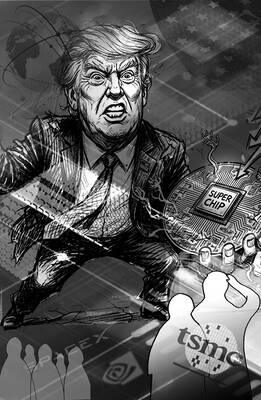
The White House’s decision to take a 9.9 percent stake in Intel Corp is looking like very shrewd business indeed. Since the government bought in at US$20.47 a share last August, the US chipmaker’s surging stock price has delivered the US a US$43 billion return. One of the reasons the investment has so far proved so sound is that the White House has made sure of it. According to The Wall Street Journal, Howard personally pushed deals on Intel’s behalf with some of the most lucrative clients imaginable. They include Nvidia Corp, the company at the heart of the AI
KMT Chairwoman Cheng Li-wun’s (鄭麗文) recent visit to Beijing and her upcoming visit to Washington will serve as a high-level test of her diplomatic mettle. In Beijing, Cheng was received with symbolic gestures, a warm reception, and high-level access. In Washington, she will receive far less pomp and far sharper questions about the KMT’s vision for the future of Taiwan. Her challenge will be to persuade Washington that the KMT’s engagement with China can coexist with strong deterrence. Cheng’s April 7-12 visit to mainland China coincided with an intense period of conflict in Iran. Despite the strategic significance of Cheng’s trip,
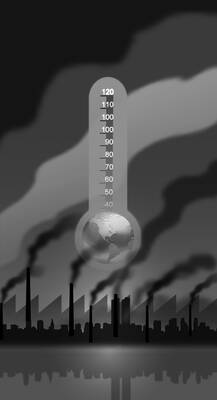
The closure of the Strait of Hormuz has sent the vast Asian chemicals industry into a tailspin. Deprived of the likes of Qatari natural gas and Saudi Arabian oil, the region’s fertilizer and plastics plants are slowing production or even shutting down. Everywhere except China, that is. In petrochemicals, China is unique. As well as a traditional industry that uses oil and gas as feedstock, it has parallel output that relies on its abundant domestic coal. Unsurprisingly, India and other regional powers want to copy and paste the Chinese method. This would not be easy — or climate friendly. The
Indonesian President Prabowo Subianto says he knows how to fix the problems facing Indonesia. Yet his economic mismanagement and authoritarian tendencies are steering the nation toward a familiar mix of currency instability and political chaos. The world’s fourth-most populous nation risks reversing the hard-won democratic and business reforms that came after the Asian Financial Crisis in 1997. At that time, the rupiah collapsed and the political upheaval that followed forced former president Haji Mohamed Suharto from power. Prabowo’s administration is ignoring similar warning signs. That disconnect was apparent in a national address on Wednesday, when Prabowo projected the swagger that has


 RSS
RSS