


On Monday, a dozen civic and student groups held a press conference to profess the “declaration of the new Constitution movement,” with some student representatives urging Taiwanese to seize the opportunity that arose in the wake of the Sunflower movement to bring about a rebirth of the nation’s democracy and create a constitution capable of implementing generational justice.
The day after the declaration, Premier Jiang Yi-huah (江宜樺) attended a business breakfast where he accused those who took part in the student-led movement against the government’s handling of the cross-strait service pact of being uncompetitive and of blaming others for their failures. He then announced plans to create opportunities for young people who do not spend their time complaining about the government.
Meanwhile, President Ma Ying-jeou (馬英九) blamed the student movement for having to call an extraordinary legislative session. This made it evident that he has not reflected at all on why the Legislative Yuan — in which his Chinese Nationalist Party (KMT) holds a majority — is always calling extraordinary sessions to deal hastily with major issues, and how unprofessional and incompetent it is for a legislative body to do this habitually.
The kinds of “victor’s declarations” made by Ma and Jiang are just an attempt to make excuses for their own failures in governance.
If the demands raised by the nation’s younger generation are compared with the kind of language used by those in power, which side is in greater need of help?
At the breakfast conference, Jiang said he had met with many “young people from outside the student protest movement,” but what he either did not acknowledge or realize is that many of the young entrepreneurs he spoke with either supported or took part in the movement that occupied the Legislative Yuan in Taipei.
If the spirit of adventure and hard work exhibited by these student entrepreneur representatives who won his praise is what Jiang sees as the hope for Taiwan’s future, he should be aware that these are the same people who stood alongside the protesting students throughout the occupation, who shared their purpose of not wanting the country to continue sinking, who cheered each other on and gave each other practical support.
Some of these same protesters are interested in taking part in the government’s planned national affairs conference on economics and business, where they would sit down with some of the targets of the Sunflower movement to talk about Taiwan’s future.
These young people who are not content with the nation’s current condition and who dare to face challenges may be seen as essential partners in dialogue, and as people upon whom one can pin hopes for Taiwan overcoming its problems. If so, what was Jiang aiming to achieve by attempting to sow divisions among the younger generation, while speaking at a forum where politicians and businesspeople were cozying up together?
Apart from intensifying social conflict, what could such divisive maneuvering possibly achieve?
Jiang’s comments distort the meaning of adventurousness and innovation. They categorize young people as either “good” or “bad,” and are meant to win the ears and votes of conservative forces. Beyond that, they are perhaps meant to convey the idea that “your” destiny is in “our” hands and that “you” have no future prospects unless you obey “us” in all things without complaining.
The idea espoused by Jiang’s remarks seems to be that “we” are the rulers and always will be, no matter how many scandals break out in which politicians, businesspeople and academics are found to have been colluding together and covering up for one another. “You” young people, are under “our” control, the message goes, so it would be in “your” best interests to obediently follow the lines “we” lay down.
In any normal democracy, Jiang’s promise that he will create opportunities for young people who do not gripe about the government would be totally unacceptable to the public. This comment is not just antidemocratic and authoritarian, but also reflects a prejudiced attitude.
The premier is trying to sow differences among young people where none exist, by discriminating between those who do and do not complain about the government, and giving or withholding opportunities accordingly.
This idea runs completely contrary to the principles of equal protection and equal treatment upon which any constitutional democracy is founded.
Young people naturally have the right to ask the government what right it has to define their image and treat individual youths better or worse accordingly. They also have the right to reject discriminatory treatment, because, as members of Taiwan’s constitutional community, no one is under any obligation to accept a style of government that illegitimately demands total obedience.
The way in which governments treat young people tends to determine the dreams of that generation, as well as the manner in which that nation’s youth seek to achieve those dreams.
Sowing divisions on the basis of party allegiance and social class, while resorting to scare tactics in a bid to make people subservient will not lead to happy outcomes for young people, or for the government.
Young people in today’s society are full of discontent, but all they really want the government to do is to explain itself without trying to dupe anyone and to face up to its responsibilities.
They want to change the system of constitutional government in ways that will save the nation from continued failure. If those in power cannot grasp such simple ideas, who is really in need of help? The government or the nation’s youth? The answer should be clear to all.
Liu Ching-yi is a professor at National Taiwan University’s College of Social Sciences.
Translated by Julian Clegg
A gap appears to be emerging between Washington’s foreign policy elites and the broader American public on how the United States should respond to China’s rise. From my vantage working at a think tank in Washington, DC, and through regular travel around the United States, I increasingly experience two distinct discussions. This divergence — between America’s elite hawkishness and public caution — may become one of the least appreciated and most consequential external factors influencing Taiwan’s security environment in the years ahead. Within the American policy community, the dominant view of China has grown unmistakably tough. Many members of Congress, as

After declaring Iran’s military “gone,” US President Donald Trump appealed to the UK, France, Japan and South Korea — as well as China, Iran’s strategic partner — to send minesweepers and naval forces to reopen the Strait of Hormuz. When allies balked, the request turned into a warning: NATO would face “a very bad” future if it refused. The prevailing wisdom is that Trump faces a credibility problem: having spent years insulting allies, he finds they would not rally when he needs them. That is true, but superficial, as though a structural collapse could be caused by wounded feelings. Something
Former Taipei mayor and Taiwan People’s Party (TPP) founding chairman Ko Wen-je (柯文哲) was sentenced to 17 years in prison on Thursday, making headlines across major media. However, another case linked to the TPP — the indictment of Chinese immigrant Xu Chunying (徐春鶯) for alleged violations of the Anti-Infiltration Act (反滲透法) on Tuesday — has also stirred up heated discussions. Born in Shanghai, Xu became a resident of Taiwan through marriage in 1993. Currently the director of the Taiwan New Immigrant Development Association, she was elected to serve as legislator-at-large for the TPP in 2023, but was later charged with involvement
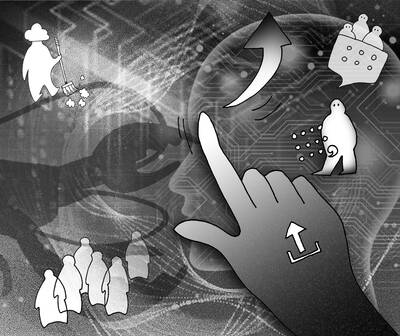
Weeks into the craze, nobody quite knows what to make of the OpenClaw mania sweeping China, marked by viral photos of retirees lining up for installation events and users gathering in red claw hats. The queues and cosplay inspired by the “raising a lobster” trend make for irresistible China clickbait. However, the West is fixating on the least important part of the story. As a consumer craze, OpenClaw — the AI agent designed to do tasks on a user’s behalf — would likely burn out. Without some developer background, it is too glitchy and technically awkward for true mainstream adoption,


 RSS
RSS