


A single picture captures the regret, shame and rage that Kim Gun-ja has harbored through most of her 89 years. Photographed in a long white wedding gown, she carries a bouquet of red flowers and stares at the camera, her deep wrinkles obscured by makeup and a diaphanous veil.
A local company arranged wedding-style photo shoots as gifts for Kim and other elderly women at the House of Sharing, a museum and nursing home for South Koreans forced into brothels by Japan during World War II. Kim and many of the other women never married, giving the pictures a measure of bitterness.
“That could have been my life: Meet a man, get married, have children, have grandchildren,” Kim said in her small, tidy room at the nursing home south of Seoul. “But it never happened. It could never be.” Japanese soldiers stole her youth, she said, and now, “The Japanese are waiting for us to die.”
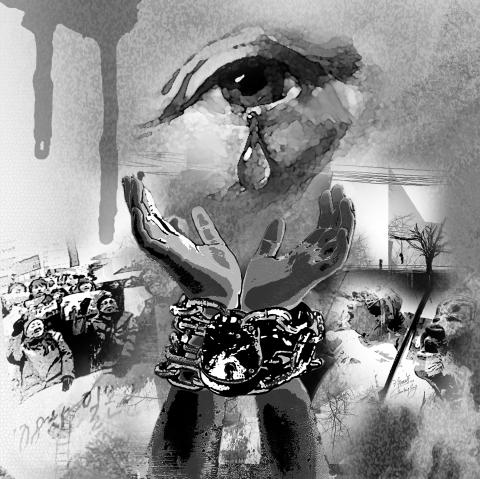
Illustration: Kevin Sheu
There are just 55 women left who registered with the South Korean government as former “comfort women” from WWII — down from a peak of more than 230. Their average age is 88. As their numbers dwindle and a rising Japanese nationalism provokes anger from war victims in South Korea and China, the 10 women who live at the House of Sharing know they are running out of time to pressure Tokyo to make amends.
“Once the victims are gone,” Kim said, “who will step in and fight for us?”
At first glance, the women might seem an obstacle to soothing the decades-old war tensions between Seoul and Tokyo.
“I want the Japanese to come here, kneel before us, state everything that they did wrong to each one of us and apologize,” Yi Ok-seon, 88, said, showing what she said were sword wounds from Japanese soldiers on her arms and feet.
However, the women may also be the last chance for the US’ two most important Asian allies to settle a dispute that has boiled over in recent years, as more of the victims, also known as “sex slaves,” die and Tokyo and Seoul trade increasingly bitter comments about their bloody history.
“It will be much harder to solve, or more realistically mitigate, the issue after these women pass away,” Robert Dujarric, an Asia specialist at Temple University’s Tokyo campus, said in an e-mail. “Now, there are people — the former sex slaves — to apologize to. Afterward, there will be no one left to receive the apology.”
Some historians say that as many as 200,000 Asian women, mostly Korean but also Chinese and others, were forced into Japan’s military brothel system during the war. Japan has apologized many times over the years, including a landmark 1993 statement by then-Chief Cabinet Secretary Yohei Kono that acknowledges Japan’s responsibility over military brothels and says wartime documents, statements and other records were enough to assume many women were deceived or forced into them. Some past premiers have also written letters of apology to the women.
However, many South Koreans see the repeated apologies and past efforts at private compensation as insufficient. One big reason is because they have been consistently undermined by the incendiary comments of many Japanese politicians, officials and right-wing activists.
The new head of Japanese public broadcaster NHK, for example, recently downplayed the issue by saying the use of women as military prostitutes was common worldwide during the WWII. Despite testimony from many of the women, Japanese nationalists have said there is no clear evidence proving the military or government systematically used coercion to recruit them. Many average Japanese are sympathetic to the women, but some also see a steady politicization of the issue by South Korean lawmakers and activists stoking anti-Japanese anger.
“In Japan, the ‘comfort women’ issue is now seen as a larger part of a Korean moral-philosophical assault on Japan” that includes a territorial dispute over islets in the sea between the countries and other issues that both sides have increasingly taken to international audiences, said Robert Kelly, a political scientist at Pusan National University in South Korea.
The political leaders are also unable to agree. Japanese Prime Minister Shinzo Abe has previously questioned past apologies and expressed hope for revision, although after criticism he promised to stick with them. He also recently visited the Yasukuni Shrine that honors Japan’s war dead, including convicted criminals.
South Korean President Park Geun-hye, the daughter of a deceased dictator widely seen as pro-Japanese, has vowed a tough line until Abe does more to acknowledge his country’s wartime past. Anger in Seoul is met by frustration in Tokyo.
“The Japanese seem to be of the view that whatever they do will not be enough to satisfy the Koreans, so why bother?” said Ralph Cossa, president of the Pacific Forum CSIS think tank in Hawaii.
At the House of Sharing, the women spend their days watching TV, exercising, meditating and talking with volunteers, including regular Japanese visitors and the occasional US politician and media crew. Many are sick, but several are active, making plans to give public testimony in Japan and the US, and to take part in protests. A weekly demonstration in their honor has been held in Seoul for more than 20 years.
Some of the women suffer from mental disorders and sexually transmitted diseases from the war, according to Ahn Shin-kwon, manager of the home. There is also shame and bitterness.
“My life has been ruined. Even though I managed to survive and return home, I feel like my fellow Koreans will point their fingers at me if they discover my past, even though what happened to me was against my will,” said an 87-year-old who would only give her surname, Kim, because of embarrassment. “I don’t even want to go outside.”
At a museum near the women’s living quarters, a large map of Asia is marked with dozens of “comfort stations,” from northern China to Indonesia in the south, identified through official documents and testimony from former “comfort women” and soldiers.
Nearby is a cramped room paneled with rough wood intended to recreate the conditions of the brothels. It is lit by one dim electric bulb. A wooden bed with a thin mattress is the only furniture. Small wooden placards carved with the Japanese female names given to the “comfort women” hang on hooks on an outside wall.
“I am not looking for a reward. A reward is given to the needy,” said Yi Ok-seon, who was kidnapped at 15. “I am asking for compensation for the Japanese who beat and stabbed me, for those who made me bleed. We came back as cripples.”
When Chinese President Xi Jinping (習近平) sits down with US President Donald Trump in Beijing on Thursday next week, Xi is unlikely to demand a dramatic public betrayal of Taiwan. He does not need to. Beijing’s preferred victory is smaller, quieter and in some ways far more dangerous: a subtle shift in American wording that appears technical, but carries major strategic meaning. The ask is simple: replace the longstanding US formulation that Washington “does not support Taiwan independence” with a harder one — that Washington “opposes” Taiwan independence. One word changes; a deterrence structure built over decades begins to shift.
The cancelation this week of President William Lai’s (賴清德) state visit to Eswatini, after the Seychelles, Madagascar and Mauritius revoked overflight permits under Chinese pressure, is one more measure of Taiwan’s shrinking executive diplomatic space. Another channel that deserves attention keeps growing while the first contracts. For several years now, Taipei has been one of Europe’s busiest legislative destinations. Where presidents and foreign ministers cannot land, parliamentarians do — and they do it in rising numbers. The Italian parliament opened the year with its largest bipartisan delegation to Taiwan to date: six Italian deputies and one senator, drawn from six
Recently, Taipei’s streets have been plagued by the bizarre sight of rats running rampant and the city government’s countermeasures have devolved into an anti-intellectual farce. The Taipei Parks and Street Lights Office has attempted to eradicate rats by filling their burrows with polyurethane foam, seeming to believe that rats could not simply dig another path out. Meanwhile, as the nation’s capital slowly deteriorates into a rat hive, the Taipei Department of Environmental Protection has proudly pointed to the increase in the number of poisoned rats reported in February and March as a sign of success. When confronted with public concerns over young
Taipei is facing a severe rat infestation, and the city government is reportedly considering large-scale use of rodenticides as its primary control measure. However, this move could trigger an ecological disaster, including mass deaths of birds of prey. In the past, black kites, relatives of eagles, took more than three decades to return to the skies above the Taipei Basin. Taiwan’s black kite population was nearly wiped out by the combined effects of habitat destruction, pesticides and rodenticides. By 1992, fewer than 200 black kites remained on the island. Fortunately, thanks to more than 30 years of collective effort to preserve their remaining


 RSS
RSS