


Along with the arrival of spring this year came one of the most horrific experiences of my life — being severely assaulted without warning by a total stranger at a public park in Taipei.
In early March on the night in question, I was sitting on a park bench having a conversation with a friend. Out of nowhere, a towering figure wearing a motorcycle helmet started pounding on my face. After my friend pulled him off me and became entangled in defending himself from our assailant, my friend asked him several times why he was attacking us, but after a few minutes our reticent attacker simply returned across the street to his apartment.
With both of us lying on the ground disfigured and disoriented, I managed to call 119 and mumble through my mangled lips our whereabouts to the emergency authorities and that we had been attacked.
Within 10 minutes, two police officers and an ambulance arrived on the scene and I was whisked away to the emergency room, despite an entreaty to point out the person responsible for our plight, who was hiding just beyond a door next to the ambulance.
Appallingly, they denied my pleas and in the following days the police who were initially handling our case did nothing besides give the case to someone in the investigative brigade — the detective assigned to our case — who was, we were told, on vacation for three weeks and could not be reached.
After the investigator had ostensibly returned from vacation, the case was immediately transferred to a public prosecutor at the Taipei District Court, where it sat for over a month until we and our attacker were finally called in for a preliminary hearing with the prosecutor. However, the prosecutor, who decides if the charges justify a court case, had not been given crucial evidence pertaining to our case — footage from a CCTV surveillance camera at the park that shows the perpetrator darting from the doorway of his apartment building to attack us from behind, and then nonchalantly walking back to his building several minutes later with his helmet in his hand.
It is now several months after the initial hearing, but we have not heard a peep from the authorities or received any indication that an inkling of justice shall be achieved in this case.
According to a pivotal witness in our case who recently contacted us quite out of the blue, the man confessed to the witness that he attacked us, bragging about carrying out his premeditated plans to physically hurt anyone sitting at the park having an audible conversation late at night, particularly foreigners.
Unfortunately, the witness was too spooked to provide accurate testimony in court after being threatened by our malefactor.
After listening to a number of fellow expatriates complain about Taiwan’s flawed legal system in recent months, especially in dealing with injustices concerning foreigners, and forewarning us that nothing much judicially will happen to our attacker, it has come to my attention that the systemic inadequacies of the judicial and executive branches of government need to be better explained to foreign residents, as well as Taiwanese, for that matter.
The recent handling of the death of army corporal Hung Chung-chiu (洪仲丘) has certainly exemplified the formidable ineptitude of these systems and their representatives.
To offer some comparative insight, if our assailant had assaulted someone in Georgia, the US state he hails from — which he has on at least two verifiable occasions — he would be jailed for up to one year and fined up to US$1,000. However, in Taiwan, although he could theoretically be sentenced to serve one year in jail, he will most likely receive a slap on the wrist — a fine of up to NT$1,000 for the misdemeanor of simple battery.
According to Article 277 of the Criminal Code: “A person who causes injury to another shall be sentenced to imprisonment for not more than three years, short-term imprisonment, or a fine of not more than one thousand yuan.”
People who commit the crime of assault or simple battery rarely, if ever, actually see jail time because it is viewed as a minor offense within the judicial system.
Yet what does it say to people when the penalty for battery and assault is less than that for traffic violations, such as speeding or not yielding to pedestrians? Taiwan fines people less for beating a stranger in the head with a baseball bat than for being impetuous drivers.
Not to give in to the xenophobic tendencies and racial prejudices of this country, but Taiwan might do well to look at what the Swiss government did in 2010, when it adopted new regulations stipulating that any foreigner who commits a serious crime in the country, including murder, burglary and social security fraud, will be deported without appeal. Would not one of the most densely populated countries in the world do well to rid itself of foreign criminals, especially those who have committed similar crimes on a number of occasions in their own country?
Criminal background checks in Taiwan for foreign residents are meant to protect the country from unwanted recidivists, but typically only consist of asking whether the person, who is expected to be honest about past trespasses, has ever been convicted of a crime. For most countries, including the US, a central database for conducting criminal background checks is not readily available, making it relatively easy for criminals to find safe haven in foreign lands like Taiwan.
In our case, we were able to search individual court databases online, which are open to the public, because we were made privy to our attacker’s former state of residence in the US. As was to be expected, we soon discovered that he had indeed been convicted of battery on more than one occasion, not to mention burglary and possession of a pistol without a license. In most cases, however, foreign residents can easily evade criminal background checks.
Without membership in the International Criminal Police Organization, Taiwan can only depend on bilateral judicial cooperation pacts such as the one signed with the US in 2002 and the cross-strait crime-fighting pact signed with China in 2009, but such pacts are almost exclusively used to locate and extradite high-profile criminals. They offer no help when trying to prevent petty violators of the law from taking up residence in Taiwan.
One can only hope that Mahatma Gandhi was right when he said: “Truth never damages a cause that is just.”
Kyle Jeffcoat is a translator at the Taipei Times
A gap appears to be emerging between Washington’s foreign policy elites and the broader American public on how the United States should respond to China’s rise. From my vantage working at a think tank in Washington, DC, and through regular travel around the United States, I increasingly experience two distinct discussions. This divergence — between America’s elite hawkishness and public caution — may become one of the least appreciated and most consequential external factors influencing Taiwan’s security environment in the years ahead. Within the American policy community, the dominant view of China has grown unmistakably tough. Many members of Congress, as
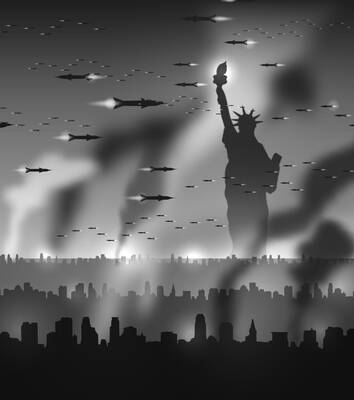
After declaring Iran’s military “gone,” US President Donald Trump appealed to the UK, France, Japan and South Korea — as well as China, Iran’s strategic partner — to send minesweepers and naval forces to reopen the Strait of Hormuz. When allies balked, the request turned into a warning: NATO would face “a very bad” future if it refused. The prevailing wisdom is that Trump faces a credibility problem: having spent years insulting allies, he finds they would not rally when he needs them. That is true, but superficial, as though a structural collapse could be caused by wounded feelings. Something
Former Taipei mayor and Taiwan People’s Party (TPP) founding chairman Ko Wen-je (柯文哲) was sentenced to 17 years in prison on Thursday, making headlines across major media. However, another case linked to the TPP — the indictment of Chinese immigrant Xu Chunying (徐春鶯) for alleged violations of the Anti-Infiltration Act (反滲透法) on Tuesday — has also stirred up heated discussions. Born in Shanghai, Xu became a resident of Taiwan through marriage in 1993. Currently the director of the Taiwan New Immigrant Development Association, she was elected to serve as legislator-at-large for the TPP in 2023, but was later charged with involvement
Out of 64 participating universities in this year’s Stars Program — through which schools directly recommend their top students to universities for admission — only 19 filled their admissions quotas. There were 922 vacancies, down more than 200 from last year; top universities had 37 unfilled places, 40 fewer than last year. The original purpose of the Stars Program was to expand admissions to a wider range of students. However, certain departments at elite universities that failed to meet their admissions quotas are not improving. Vacancies at top universities are linked to students’ program preferences on their applications, but inappropriate admission


 RSS
RSS