


The case of air force serviceman Chiang Kuo-ching (江國慶), who confessed to a crime after torture and was wrongfully executed in 1997, is generating a heated debate in Taiwan. However, are the right conclusions being drawn and is Taiwan learning the right lessons about the kind of society it wants to be?
While it is good that the facts of the case finally came to light, the Legislative Yuan is primarily concerned with discussing what kind of cap there should be on cash compensation to Chiang’s family.
It should be discussing how this egregious miscarriage of justice and violation of human rights could happen in the first place, and how it can safeguard human rights so that similar cases will not happen again.
When, in September 1996, a five-year-old girl was found raped and murdered on a military base, the case created a media sensation and public outrage.
Of course, there was an outcry and military authorities were under pressure to solve the case quickly.
However, in their rush to judgement, the military justice system itself made a number of fundamental mistakes, violating some basic human rights. Chiang and three other suspects were arrested, but Chiang was the only one who did not pass a lie detector test.
The military subsequently sent in counterintelligence officers, who subjected him to various forms of torture and extracted a confession from the young airman.
He was indicted in October 1996, but once in court he recanted and told the court that he had confessed under torture. The military court never investigated the torture charges. Instead, it convicted him and sentenced him to death. He was executed in August 1997 at the age of 21.
Early on, the case attracted the attention of lawyer Chiang Peng-chien (江鵬堅), the first chairman of the Democratic Progressive Party (DPP) from 1986 to 1987, who became a member of the Control Yuan in 1996. Chiang Peng-chien had a long history of fighting for human rights.
In the spring of 1980, he was a defense lawyer in the trials of defendants of the Kaohsiung Incident and he was also the founder of the Taiwan Association for Human Rights. However, Chiang Peng-chien died of cancer in 2000 and the investigation into the Chiang Kuo-ching case lingered on the Control Yuan’s back burner until last year.
It was two new members of the Control Yuan who asked to reopen the case after finding major flaws in the trial proceedings, including the coercion of Chiang Kuo-ching’s confession by military investigators.
Early this year, DNA evidence proved the airman’s innocence and Hsu Jung-chou (許榮洲) has been formally charged with the crime.
The question now is how Taiwan should respond as a society. Compensating Chiang Kuo-ching’s family is the proper thing to do, but shouldn’t those who were responsible for the injustice be held accountable? And does the judicial system now need reform, so that an injustice such as this can never happen again?
Ironically, the military officers who abused Chiang Kuo-ching’s human rights and wrongfully convicted him were amply rewarded for “solving” the case. Military authorities say that those military personnel will not be prosecuted for their involvement in the case — according to the statute of limitations, a wrongdoing cannot be prosecuted if it occurred more than 10 years ago.
Yet these violations of human rights, like crimes against humanity, should not have a statute of limitations. The military officials should be held accountable for their wrongdoing. Isn’t that what true justice is meant to be about?
However, it is the responsibility of the members of a civilized society to have a conscience and to stand up for what is right and just. A shared civility and conscience could not have allowed former chief of the general staff Peng Meng-chi (彭孟緝), known as the “Butcher of Kaohsiung” for his role in the 228 Incident, to live freely and openly in Taiwan, and subsequently in the US, for many decades.
The leaders of Serbia recently tried to make amends for the past when they handed general Ratko Mladic, the alleged mastermind of the 1995 Srebrenica massacre, to the International Court of Justice in The Hague. Such a cleansing of the past has never happened in Taiwan.
Another heinous crime, the 1980 murder of the mother and twin daughters of former DPP chairman Lin Yi-hsiung (林義雄), is to this day “unsolved” because no one who has knowledge of what happened has come forward with information.
It is regrettable that Taiwanese society is still lacking a conscience. We need to be less preoccupied with making money and focus more on building a caring society where the people themselves ensure that grave excesses like the 228 Massacre, the murder of Lin’s family and the wrongful execution of Chiang Kuo-ching cannot and do not recur.
This takes moral courage from the citizenry, but it also requires laws and judicial procedures that protect the rights of individuals. One very fundamental violation of human rights is the death penalty itself. If Taiwan really wants to be part of the 21st century, abolition would be a good first step.
Chen Mei-chin is a Washington-based commentator.
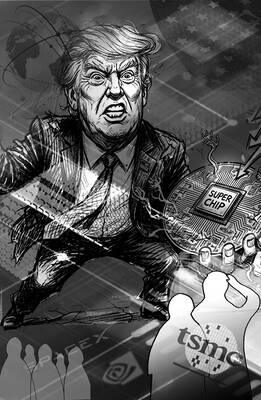
The White House’s decision to take a 9.9 percent stake in Intel Corp is looking like very shrewd business indeed. Since the government bought in at US$20.47 a share last August, the US chipmaker’s surging stock price has delivered the US a US$43 billion return. One of the reasons the investment has so far proved so sound is that the White House has made sure of it. According to The Wall Street Journal, Howard personally pushed deals on Intel’s behalf with some of the most lucrative clients imaginable. They include Nvidia Corp, the company at the heart of the AI
The Ministry of the Interior, working with the navy and coast guard, is organizing Taiwan’s first joint exercise simulating escort tankers carrying liquefied natural gas (LNG) and oil through a Chinese blockade. The drills simulate fuel transport along three maritime corridors leading toward Japan, the Philippines and the US. Deputy Minister of the Interior Sawyer Mars (馬士元) said that a blockade of the Taiwan Strait would amount to “almost a 100 percent blockade of the regional energy supply.” Minister of National Defense Wellington Koo said planning to counter a blockade is standard practice in Taipei. While the exercise is limited in
A single photograph can cut through a lot of noise, but it can also be used to misrepresent the truth. At the very least, it can concentrate the mind on something that requires further investigation. On Monday last week, Ma Ying-jeou Foundation CEO Tai Hsia-ling (戴遐齡) and former National Security Council secretary-general King Pu-tsung (金溥聰) held a news conference in which they showed a photograph of former foundation CEO Hsiao Hsu-tsen (蕭旭岑), now Chinese Nationalist Party (KMT) deputy chairman. In the image Hsiao is seated next to Xiamen Taiwan Businessmen Association chairman Han Ying-huan (韓螢煥). The two men were holding
I first met Professor Ray Jiing (井迎瑞) as a film and documentary student at Shih Hsin University’s (SHU) Department of Radio Television and Film in 1988. The following year, he went on to become the director of the Chinese Taipei Film Archive — forerunner of the Taiwan Film and Audiovisual Institute (TFAI). Over his eight-year tenure, Jiing rescued and restored over 200 classic Taiwanese films. In 1997, he established the Graduate Institute of Studies in Documentary and Film Archiving at Tainan National University of the Arts (TNNUA), and I joined the program in his third cohort of students. Beyond a


 RSS
RSS