


Living in the most northern permanently inhabited settlements in the world, the Inughuit people, or Polar Eskimos as they are often known, have eked out an existence in this Arctic desert in the northwest corner of Greenland for centuries.
The Inughuit are one of the smallest indigenous groups in the world with a population of just 800 people spread across the four settlements that make up the Thule region. More than 1,600km away from the capital, Nuuk, and occupying an unfeasibly remote corner of our world, the Inughuit enjoy their own distinct subculture based on the hunting of marine mammals.
Unlike other Inuit populations across the Arctic, the Inughuit have maintained where possible their ancient way of life, using kayaks and harpoons to hunt narwhal and traveling by dog-sled in the winter.
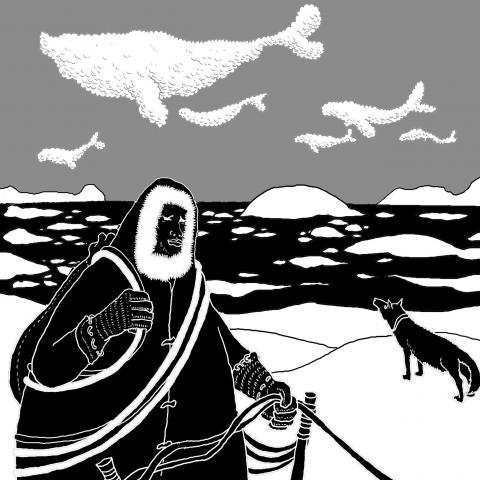
mountain people
This unique way of life is now under threat. A tiny society whose basis is just a half dozen families, some of whom are descendants of the polar explorers Robert Peary and Matthew Henson, say they are being “squeezed” out of existence. Draconian hunting quotas have been imposed by politicians in the south, many of whom have never ventured this far north. The hunting restrictions have pushed up the cost of sea mammals and some Inughuit are switching to a Western diet of imported food.
Even if they can afford to eat their traditional diet, certain environmental groups advise them not to do so. The levels of mercury in some marine mammals are thought to pose a health hazard, and the risks of radioactive contamination from the nearby nuclear accident in 1968 when a US Air Force B-52 crash-landed with four hydrogen bombs on board are still unknown.
The one-price policy that used to operate across Greenland, effectively subsidizing the more remote settlements, has also been abolished, and the result is that the cost of living has rocketed.
Local people believe the government, which has self-rule within Denmark’s small commonwealth, has a hidden agenda to force out the people living in the most remote communities, creating three or four urban centers in Greenland and thus reducing the burdensome cost of servicing such isolated settlements.
My journey to Greenland took me through pretty, picture-postcard Ilulissat in the south. Here, small amphitheaters of ice seemed to go nowhere, just sitting and collecting dirt, before sinking into oblivion. As we skirted the ice sheet, heading northwards, it seemed gray and thinning. Lakes appeared all over the ice, a tragic testament of the all too rapidly changing natural environment.
It is a picture of transition, and a disturbing one at that: It speaks dislocation and a sense of foreboding.
The Inughuit, however, are already a people in exile. Qaanaaq, by far the largest Inughuit settlement, was established in 1953, when the Inughuit people were given three days to leave their ancient homeland in Uummannaq, 150km to the south, to make way for the controversial US air base at Thule. But now these displaced people face a new and unprecedented threat to their culture: global warming.
A local woman who has spent nearly all her life living in Qaanaaq stands in my green prefabricated wooden hut, on the vast polar bear and musk-oxen skins that cover the floor. Dried, pungent blubber sits on the racks outside. Looking out across Ingelfield Bay and the whale-shaped Herbert Island, toward the exploding icebergs that sit like vast lumps of polystyrene in the Murchison Sound, there is a sadness in her eyes.
“Twenty years ago, my children used to go skating on the ice at this time of the year. Just 15 years ago, the sea ice in the bay was up to 3 meters thick. Last year the ice was so thin that a young hunter and his dog team of 12 fell through the thin ice to their early deaths. If the sea ice goes completely, there will be no need for the dogs [huskies] and our culture will disappear,” she said.
It is late September in the High Arctic, the outside temperature is –3?C and there is little hope of the sea ice forming any time soon. Local hunters tell me they know it is warmer than it used to be because the dogs’ breath used to be denser in the cold.
While global warming may be toasted in southern Greenland, where farmers see many benefits, it is unequivocally bad news for this tiny indigenous group.
Not only has global warming made hunting considerably more dangerous, it has also halved the hunting season. In the summer months the Inughuit hunt narwhal deep within Ingelfield Bay, using kayaks and harpoons.
The narwhal leave the bay in September. The Inughuit used to start hunting seal with dog sled at this time of the year, but that is no longer possible as the sea has not yet frozen over. A couple of years ago, the sea ice did not form at all until December and was gone again in March. In the months of October, November and December, when the settlement is plunged into 24-hour darkness, there are few options for the hunters. The narwhal do not arrive until May, but by then the sea ice is long gone.
Like many Inughuit, this woman has relatives in the Canadian Arctic, where the Inughuit are originally from.
“Previously, we used to travel across the Smith Sound to Canada on dog-sled [a distance of 40km]. Now that journey is impossible because the sea ice has disappeared,” she said.
Global warming has a human cost too, tearing families apart. To visit their Canadian relatives, these people would now have to fly to Copenhagen 4,000km away and then across the Atlantic to Montreal and up from there. Air travel is prohibitively expensive in Greenland and such a journey would cost several thousand dollars: a price that very few can afford. Historically, the Inughuit people were semi-nomadic, moving between the different settlements at certain times of the year for hunting purposes and to visit family.
The disappearing ice has meant that it is now too dangerous to visit the outer settlements on dog-sled, but what ice remains means that travel by boat is not an option either. Often, the only alternative is a very expensive helicopter trip. The sense of shrinking space here is almost tangible.
The threat of global warming to their traditional hunting life, alongside a host of political factors, has left the Inughuit believing that their current settlements will not be here in 15 years’ time, that people will relocate southwards and that they will assimilate into a broader Inuit culture. Young people, recognizing that their parents are no longer able to make a living from hunting alone, are leaving the community to live a very different life in modern apartments in Nuuk.
Last week Moriusaq, the smallest of the Inughuit settlements, was finally closed and the other settlements are looking increasingly endangered.
Fascinated by the Far North since I was a small child, it was about 10 years ago when I discovered the Inughuit through my reading of a book called The Snow People by Marie Herbert. This tiny Arctic community that insisted on maintaining its ancient way of life at the top of the world struck me as remarkable, and I decided that I wanted to visit these people. More recently, in Cambridge, I came to understand how endangered this culture and their language was.
It is widely understood how global warming is threatening the natural environment (not least here in Greenland, with the vast iceberg that broke off recently from the nearby Petermann glacier), but the Inughuit represent a bona fide example of how climate change impacts on local cultures.
If the Inughuit are forced to leave their ancient homeland, it is likely that the language of these Arctic hunters will disappear. With it, their already endangered ancient spoken traditions — a rich depository of indigenous cultural knowledge about how they relate to the land, sea and ice, bound up in stories, myths and folklore — will also be lost.
The Inughuit are immensely proud of their language, Inuktun. While strictly speaking a dialect of Greenlandic, Inuktun is much closer to some of the Canadian Inuit dialects and the phonology is quite distinct from Standard West Greenlandic.
Working with the last handful of storytellers, I have come here to document their stories and narratives in the old Inuktun language and hope that this will act as a record of this unique and endangered culture.
Rather than writing a grammar or dictionary, it is hoped that an “Ethno-graphy of Speaking” will show how their language and culture are interconnected and how their knowledge and sociocultural experience are transmitted and performed through the filter of these spoken traditions.
The stories, narratives and myths that underpin the ancient Inughuit culture will be recorded, digitized and ultimately returned to the community.
One elderly Inughuit tells me this is our last chance: “We inherited our ancient language from our ancestors. If we lose it without record, future generations will know nothing about their rich past.”
With 16 others and a small mountain of freight as co-passengers, I arrived in the community aboard a Dash 7 turboprop aircraft just over a month ago. Clouds lingered just above the brightly colored wooden houses. Beneath were the world’s most northerly people living in a quite implausible environment.
My very first impression was the otherworldliness of the place. After four-and-a-half hours of flying up the west Greenland coast with nothing to see but bare ancient rock, meandering glaciers licking the horizon and icebergs littering the fjords, this dry polar desert with its omnipresent rocks and boulders and lack of vegetation seemed completely out of place.
Sitting just 960km from the North Pole, I felt as if I had come to a different world altogether rather than to the top of my own.
I had often speculated as to how I would be received coming into this community, and the result was quite unexpected. But I’ll save that for my next dispatch.
Stephen Leonard is an anthropological linguist at the Scott Polar Research -Institute and research fellow at Trinity Hall, Cambridge University. He will be living with the Inughuit people for 12 months. His research is funded by the British Academy and the World Oral Literature Project in Cambridge.
Endangered languages
Five of the world’s most endangered languages, as chosen by Peter Austin of the School of Oriental and African Studies:
Jeru (or Great Andamanese) is spoken by fewer than 20 people on the Andaman Islands in the Indian Ocean and is thought to predate the Neolithic era.
Yuchi is spoken in the state of Oklahoma by just five people, all older than 75. Unusually, the nouns of the language have 10 genders. Many Yuchi decendents now belong to the Muscogee (Creek) Nation.
Oro Win — the Oro Win in Rondonia, Brazil, were first contacted by outsiders in 1963, but after attacks now number just 50, only five of whom speak the language.
Kusunda — until recently it was thought this language of former hunter-gatherers from western Nepal was extinct, but in 2004 academics located eight people who still speak it.
Guugu Yimidhirr is an Australian Aboriginal language spoken at Hopevale in northern Queensland by about 200 people. The word “kangaroo” came from Guugu Yimidhirr.

A gap appears to be emerging between Washington’s foreign policy elites and the broader American public on how the United States should respond to China’s rise. From my vantage working at a think tank in Washington, DC, and through regular travel around the United States, I increasingly experience two distinct discussions. This divergence — between America’s elite hawkishness and public caution — may become one of the least appreciated and most consequential external factors influencing Taiwan’s security environment in the years ahead. Within the American policy community, the dominant view of China has grown unmistakably tough. Many members of Congress, as

After declaring Iran’s military “gone,” US President Donald Trump appealed to the UK, France, Japan and South Korea — as well as China, Iran’s strategic partner — to send minesweepers and naval forces to reopen the Strait of Hormuz. When allies balked, the request turned into a warning: NATO would face “a very bad” future if it refused. The prevailing wisdom is that Trump faces a credibility problem: having spent years insulting allies, he finds they would not rally when he needs them. That is true, but superficial, as though a structural collapse could be caused by wounded feelings. Something
Former Taipei mayor and Taiwan People’s Party (TPP) founding chairman Ko Wen-je (柯文哲) was sentenced to 17 years in prison on Thursday, making headlines across major media. However, another case linked to the TPP — the indictment of Chinese immigrant Xu Chunying (徐春鶯) for alleged violations of the Anti-Infiltration Act (反滲透法) on Tuesday — has also stirred up heated discussions. Born in Shanghai, Xu became a resident of Taiwan through marriage in 1993. Currently the director of the Taiwan New Immigrant Development Association, she was elected to serve as legislator-at-large for the TPP in 2023, but was later charged with involvement
Out of 64 participating universities in this year’s Stars Program — through which schools directly recommend their top students to universities for admission — only 19 filled their admissions quotas. There were 922 vacancies, down more than 200 from last year; top universities had 37 unfilled places, 40 fewer than last year. The original purpose of the Stars Program was to expand admissions to a wider range of students. However, certain departments at elite universities that failed to meet their admissions quotas are not improving. Vacancies at top universities are linked to students’ program preferences on their applications, but inappropriate admission


 RSS
RSS