


T he US Federal Reserve Board recently adopted a policy under which bank supervisors, the guardians of the financial system’s safety and soundness, would review the compensation structures of bank executives. Authorities elsewhere are considering or adopting similar programs. But what structures should regulators seek to encourage?
It is now widely accepted that it is important to reward bankers for long-term results. Rewarding bankers for short-term results, even when those results are subsequently reversed, produces incentives to take excessive risks.
However, tying executive payoffs to long-term results does not provide a complete answer to the challenge facing firms and regulators. The question still remains: Long-term results for whom?
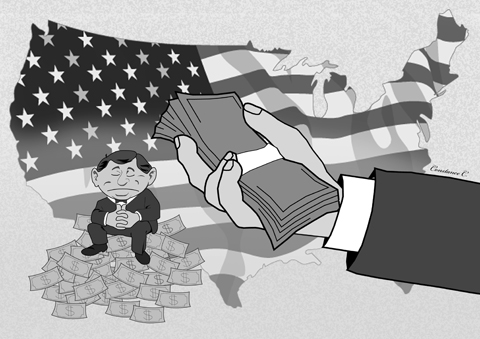
Equity-based awards, coupled with the highly leveraged capital structure of banks, tie executives’ compensation to a leveraged bet on the value of banks’ assets. As Holger Spamann and I show in our research, executive payoffs should be tied to the long-term value delivered not only to shareholders, but also to other contributors to banks’ capital. As it is, bank executives expect to share in any gains that might flow to common shareholders, but they are insulated from the consequences that losses, produced by their choices, could impose on preferred shareholders, bondholders, depositors, or the government as a guarantor of deposits.
Insulating executives from losses to stakeholders other than shareholders can be expected to encourage them to make investments and take on obligations that increase the likelihood and severity of losses that exceed the shareholders’ capital. In addition, such insulation discourages the raising of additional capital, inducing executives to run banks with a capital level that provides an inadequate cushion for bondholders and depositors. The more thinly capitalized banks are, the more severe these distortions — and the larger the expected costs rising from insulating executives from potential losses to non-shareholder stakeholders.
How could pay arrangements be redesigned to address these problems?
To the extent that executive compensation is tied to the value of specified securities, such pay could be tied to a broader basket of securities, not only common shares.
Thus, rather than tying executive pay to a specified percentage of the value of the bank’s common shares, compensation could be tied to a specified percentage of the aggregate value of the bank’s common shares, preferred shares and all the outstanding bonds issued by the bank. Because such a compensation structure would expose executives to a broader share of the negative consequences of risks taken, it would reduce their incentives to take excessive risks.
Nevertheless, while such a compensation structure would lead executives to internalize the interests of preferred shareholders and bondholders, thereby improving incentives, it would be insufficient to induce executives to internalize fully the interests of the government as the guarantor of deposits. To do so, executive payoffs could be made dependent on changes in the value of the banks’ credit-default swaps, which reflect the probability that the bank will not have sufficient capital to meet its full obligations.
In addition, bonus compensation should be redesigned. In the past, bank executives’ bonuses were often based on accounting measures that are of interest primarily to common shareholders, such as return on equity or earnings per common share. In the future, banks should consider basing bonus compensation on broader measures, such as earnings before any payments made to bondholders.
Recognizing the value of tying executive payoffs to the effects of executives’ choices on non-shareholders highlights the important role of bank regulators in this area. The common shareholders in financial firms do not have an incentive to induce executives to take into account the losses that risks can impose on preferred shareholders, bondholders, depositors and taxpayers. Consequently, governance improvements that make directors more focused on shareholder interests cannot be relied on to tie executive payoffs to the interests of shareholders and non-shareholders alike. Regulatory encouragement may be helpful, perhaps even necessary.
Getting executives to internalize perfectly the expected losses that their choices might impose on contributors of capital other than shareholders is complex. However, moving in this direction, even if imperfectly, would mean real progress. Motivating financial executives to focus on the effects of their choices on all those contributing capital to the bank would significantly improve their risk-taking incentives. It thus would also contribute to making our financial systems safer.
Lucian Bebchuk is a professor of law, economics and finance and director of the Corporate Governance Program at Harvard Law School.
COPYRIGHT: PROJECT SYNDICATE

Elbridge Colby, America’s Under Secretary of Defense for Policy, is the most influential voice on defense strategy in the Second Trump Administration. For insight into his thinking, one could do no better than read his thoughts on the defense of Taiwan which he gathered in a book he wrote in 2021. The Strategy of Denial, is his contemplation of China’s rising hegemony in Asia and on how to deter China from invading Taiwan. Allowing China to absorb Taiwan, he wrote, would open the entire Indo-Pacific region to Chinese preeminence and result in a power transition that would place America’s prosperity
A few weeks ago in Kaohsiung, tech mogul turned political pundit Robert Tsao (曹興誠) joined Western Washington University professor Chen Shih-fen (陳時奮) for a public forum in support of Taiwan’s recall campaign. Kaohsiung, already the most Taiwanese independence-minded city in Taiwan, was not in need of a recall. So Chen took a different approach: He made the case that unification with China would be too expensive to work. The argument was unusual. Most of the time, we hear that Taiwan should remain free out of respect for democracy and self-determination, but cost? That is not part of the usual script, and
All 24 Chinese Nationalist Party (KMT) lawmakers and suspended Hsinchu Mayor Ann Kao (高虹安), formerly of the Taiwan People’s Party (TPP), survived recall elections against them on Saturday, in a massive loss to the unprecedented mass recall movement, as well as to the ruling Democratic Progressive Party (DPP) that backed it. The outcome has surprised many, as most analysts expected that at least a few legislators would be ousted. Over the past few months, dedicated and passionate civic groups gathered more than 1 million signatures to recall KMT lawmakers, an extraordinary achievement that many believed would be enough to remove at
Behind the gloating, the Chinese Nationalist Party (KMT) must be letting out a big sigh of relief. Its powerful party machine saved the day, but it took that much effort just to survive a challenge mounted by a humble group of active citizens, and in areas where the KMT is historically strong. On the other hand, the Democratic Progressive Party (DPP) must now realize how toxic a brand it has become to many voters. The campaigners’ amateurism is what made them feel valid and authentic, but when the DPP belatedly inserted itself into the campaign, it did more harm than good. The


 RSS
RSS