


One weighty decision that the world will need to make this year is whether to support an idea raised by Anatoly Perminov, the head of the Russian space agency Roscosmos, to launch an unmanned mission to redirect a large asteroid that might collide with Earth after 2030.
At more than 360m in diameter, the asteroid, Apophis, is a dozen times larger than the Tunguska space object (presumably a meteorite or comet) that devastated a large part of eastern Siberia a century ago. As far as can be determined, that object detonated on June 30, 1908, with the power of a nuclear weapon, felling 80 million trees over a 2,000km² area.
NASA has said that if Apophis hit the Earth, it could release more than 100,000 times the energy of the Tunguska event. Thousands of square kilometers could vaporize in the blast, but the whole Earth would suffer from the loss of sunlight and other effects of the dust released into the atmosphere. This danger explains why a Russian analyst has called Apophis a “space terrorist.”
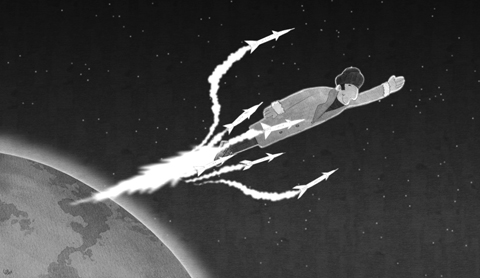
Current projections are that Apophis, which was discovered in 2004, will orbit near the earth several times between 2029 and 2036. Last October, near-Earth object (NEO) trackers Steve Chesley and Paul Chodas of NASA’s Jet Propulsion Laboratory in Pasadena, California, placed the odds of Apophis striking Earth in 2036 at about one in 233,000, lower than previous estimates.
But their forecast that it would come within 30,000km of our planet in 2029 (closer than some geostationary communications satellites, as well as the Moon) is more likely to please astronomers than international security experts. Some unknown comet or other space object could fly near enough to the asteroid in the next few decades to change its predicted path, perhaps in a way that redirected it toward Earth.
Perminov said the proposals that Roscosmos is considering do not envision trying to destroy the asteroid, but rather to use the laws of physics to change its path. He says that if Roscosmos’ management decided to act, it would work with experts from Europe, the US, China and other space powers to decide how best to proceed.
Scientists have proposed various ways to deflect an asteroid away from the Earth. Some have suggested placing a large object nearby to change its trajectory through mutual gravitational attraction.
Another method is to use mirrors, light, or painted colors to change the way the asteroid absorbs heat, which could also shift its direction. Attaching “solar sails” to the asteroid could cause the Sun’s particles to steer it along a different course. Others have suggested ramming a spacecraft or other object into the asteroid to alter its momentum.
A few scientists, and many science-fiction writers, have also speculated about using nuclear weapons to destroy or damage an asteroid, comet, meteor, or alien spacecraft heading toward the earth. The Outer Space Treaty bans placing nuclear weapons in orbit, on celestial bodies, or stationing “such weapons in outer space in any other manner,” but may be interpreted to permit their one-time use. It also could be amended, or the states “attacking” the asteroid could withdraw from the agreement by giving one year’s notice.
The more practical problem is that even a nuclear explosion might not prove sufficiently powerful. Even if the nuclear warhead broke the asteroid into many small pieces, they could have time to re-combine into another large object. In addition, the space vehicle carrying the weapon might malfunction, and the nuclear warhead could land (and perhaps detonate) somewhere on Earth.
The safest approach might be to test several techniques on nearby asteroids before using them against Apophis when it approaches Earth.
Unfortunately, it is estimated that “attacking” an asteroid would cost billions of dollars, especially since multiple space launches would likely be needed to ensure that the required number of probes could complete the mission.
This raises the issue of who should pay for such a mission and, more fundamentally, who can authorize it. These global governance questions also apply to other worldwide threats, such as climate change, that threaten humanity’s survival.
In 2008, a report by space experts called for the UN Security Council to make the final decision about how to counter potential threats from near-Earth objects. The council normally votes on issues that threaten international peace and security, but this method would allow only a small number of governments to decide Earth’s fate. Perminov similarly seemed to suggest that only countries with large existing space programs could participate in the Apophis decision.
Since an asteroid collision could, like global climate change, affect all of humanity, should not everyone have some say in the decision? Perhaps every country should vote in the UN General Assembly on how to proceed; the option receiving the most votes — with a possible mandatory minimum requirement, such as requiring an alternative to win a majority or some higher number of votes — would prevail.
Another option would be to allow every adult to vote directly in a global referendum for his or her preferred option.
An interesting issue would arise if some countries wanted to act, but others did not. Would Russia or a coalition of willing countries have the right to attempt to alter Apophis’ orbit without the approval of other states?
What are the rights and duties of scientists and governments who consider the risks to be graver than their counterparts in other countries do? Are they precluded from acting without unanimity?
Perminov’s proposal has raised important questions — both scientific and political. Whatever the danger posed by Apophis, we would do well to begin addressing them.
Richard Weitz is a senior fellow and director of the Center for Political-Military Analysis at the Hudson Institute.
COPYRIGHT: PROJECT SYNDICATE

A gap appears to be emerging between Washington’s foreign policy elites and the broader American public on how the United States should respond to China’s rise. From my vantage working at a think tank in Washington, DC, and through regular travel around the United States, I increasingly experience two distinct discussions. This divergence — between America’s elite hawkishness and public caution — may become one of the least appreciated and most consequential external factors influencing Taiwan’s security environment in the years ahead. Within the American policy community, the dominant view of China has grown unmistakably tough. Many members of Congress, as

After declaring Iran’s military “gone,” US President Donald Trump appealed to the UK, France, Japan and South Korea — as well as China, Iran’s strategic partner — to send minesweepers and naval forces to reopen the Strait of Hormuz. When allies balked, the request turned into a warning: NATO would face “a very bad” future if it refused. The prevailing wisdom is that Trump faces a credibility problem: having spent years insulting allies, he finds they would not rally when he needs them. That is true, but superficial, as though a structural collapse could be caused by wounded feelings. Something
Former Taipei mayor and Taiwan People’s Party (TPP) founding chairman Ko Wen-je (柯文哲) was sentenced to 17 years in prison on Thursday, making headlines across major media. However, another case linked to the TPP — the indictment of Chinese immigrant Xu Chunying (徐春鶯) for alleged violations of the Anti-Infiltration Act (反滲透法) on Tuesday — has also stirred up heated discussions. Born in Shanghai, Xu became a resident of Taiwan through marriage in 1993. Currently the director of the Taiwan New Immigrant Development Association, she was elected to serve as legislator-at-large for the TPP in 2023, but was later charged with involvement
Out of 64 participating universities in this year’s Stars Program — through which schools directly recommend their top students to universities for admission — only 19 filled their admissions quotas. There were 922 vacancies, down more than 200 from last year; top universities had 37 unfilled places, 40 fewer than last year. The original purpose of the Stars Program was to expand admissions to a wider range of students. However, certain departments at elite universities that failed to meet their admissions quotas are not improving. Vacancies at top universities are linked to students’ program preferences on their applications, but inappropriate admission


 RSS
RSS