


The administration of President Ma Ying-jeou (馬英九) recently relaxed regulations on Chinese reporters stationed in Taiwan. Chinese journalists will now be free to move around and interview people without informing the authorities beforehand. The government now encourages local as well as national Chinese media to station correspondents in Taiwan, and Chinese media workers will be able to save money by renting apartments rather than being confined to staying at certain hotels.
Ma and his ministers are always trying to please China, and these latest relaxed rules for Chinese journalists are another expression of their loyalty to what they see as their motherland. Chinese journalists have reacted to the gesture with an unexpected lack of appreciation, writing a lot of nonsense in the Chinese media to the effect that, although the new measures will allow them to save some money, they may expose them to attacks by extremists such as Taiwanese independence supporters or Tibetan independence activists residing in Taiwan.
Speaking off the record, a government official objected to these reports, saying that Taiwan is a country under the rule of law, and the suggestions made in the Chinese media were quite unwarranted in the light of the Taiwanese side’s goodwill.
Chinese reporters stationed in Taiwan have expressed these views not because they are really worried about possible attacks, but to discredit Taiwan’s democracy and give a false impression about the mainstream of public opinion in Taiwan. First, they want people in China to think Taiwan is a violent place where people’s lives and property are always under threat. Second, they want to portray Taiwanese independence advocates as a minority, and a violent one at that.
This kind of distortion of facts about Taiwan by Chinese reporters posted here is not an isolated case — it is part of a long-term strategy. Even since Taiwan first allowed Chinese media to post reporters in Taiwan, their reports have invariably taken a greater-China standpoint, painting a distorted picture of the country and completely disregarding Taiwan’s greatest achievements in realizing the core values of democracy, freedom and human rights. The suggestion that Chinese reporters might be attacked if they rented their own apartments and offices is clearly just another attempt to vilify Taiwan.
Why do we say that Chinese reporters posted here denigrate Taiwan’s democracy? The answer is plain and simple: Since these Chinese journalists are based in Taiwan, they must be perfectly aware that it is a free country with a pluralistic society in which each and every person is at liberty to express his or her political beliefs. The Constitution protects people’s personal security from repression by those in power or attacks by people holding different political opinions. The expression of differing views is well established as the norm in Taiwan. Just as politicians have their own beliefs and ideas, so do different media outlets have different political leanings. Appearing on radio and television chat shows, politicians and commentators cross swords over the airwaves. It really is a case of letting “a hundred flowers bloom and a hundred schools of thought contend.”
Even though debate may be fierce and comments incisive, it is rare for anyone to be attacked physically just because of their opinions or ideology. Taiwanese people are traditionally kind and tolerant and do not normally resort to violence against those who have a different point of view. Living and working as they do in this land of freedom, Chinese journalists must be well aware of how strikingly this situation contrasts with China’s dictatorship. What justification can they possibly have, then, for the spurious suggestion that they fear attacks by supporters of Taiwanese or Tibetan independence?
Actually, our main purpose in drawing readers’ attention to this issue is not to highlight the distorted image of Taiwan given by Chinese reporters stationed here, but to question the wisdom of the Ma administration’s moves to open up cross-strait exchanges in news reporting. There is no need at all for such exchanges.
First, Chinese journalists reporting from Taiwan all serve the predetermined purposes of promoting the notion of “one China” and ultimately annexing Taiwan. That being the case, they cannot be expected to do much in the way of fair and truthful reporting. Taiwan is a sovereign and independent country, and the mainstream of opinion is in favor of Taiwan’s own cultural and political identity.
However, Taiwan’s sovereignty is nowhere to be seen in the writings of Chinese reporters. They would rather portray the tiny minority who support unification as the mainstream. They would have their readers and viewers believe that everyone in Taiwan is “yearning for the motherland.” This kind of distorted reporting does nothing to promote understanding between the two sides. What is the point in having cross-strait exchanges in news reporting if this is the outcome?
Second, China is a dictatorship with no freedom of reporting to speak of. Just recently, Reporters without Borders (RSF) ranked China eighth from the bottom in its annual Press Freedom Index, above only a handful of notoriously repressive countries such as Laos, Cuba, Burma, Iran and North Korea. The RSF report accuses Chinese authorities of enforcing strict controls on news reporting by filtering the Internet and arresting journalists, bloggers, dissidents and human rights activists.
While the Ma government has gradually relaxed regulations about where Chinese reporters can live and work, China still uses various administrative means to severely restrict the activities of Taiwanese reporters, preventing them from gathering news freely and investigating the true face of Chinese society.
Since China does not reciprocate Taiwan’s treatment of its reporters, why should Taiwan one-sidedly relax its regulations? Besides, while Taiwan places no restrictions on the content of reports made by Chinese journalists, Taiwanese reporters in China have to be very careful, otherwise they may find themselves framed and thrown in jail, accused of infringing China’s national security.
All in all, the Ma government’s relaxation of restrictions on Chinese media will not help people in China to get a better understanding of Taiwan’s freedom and democracy. On the contrary, deliberately distorted reports will give ordinary Chinese an even more twisted impression of Taiwan. Besides, freedom of reporting is nonexistent under China’s dictatorship. Taiwanese reporters in China cannot gather news freely, and in attempting to tell the truth they are walking through a minefield in which their safety and liberty are always under threat.
Above all, China makes no secret of its intention to annex Taiwan, and Chinese media are a fifth column that serves precisely that purpose. In such circumstances, the media exchanges the Ma government wants to have with China provide the other side with a means of undermining Taiwan. Since the conditions for news reporting on each side of the Taiwan Strait are so unequal, what is the point of going on with such a policy?
TRANSLATED BY JULIAN CLEGG
A gap appears to be emerging between Washington’s foreign policy elites and the broader American public on how the United States should respond to China’s rise. From my vantage working at a think tank in Washington, DC, and through regular travel around the United States, I increasingly experience two distinct discussions. This divergence — between America’s elite hawkishness and public caution — may become one of the least appreciated and most consequential external factors influencing Taiwan’s security environment in the years ahead. Within the American policy community, the dominant view of China has grown unmistakably tough. Many members of Congress, as
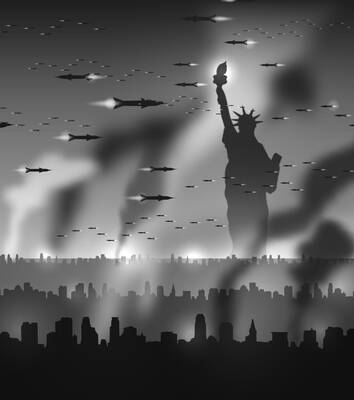
After declaring Iran’s military “gone,” US President Donald Trump appealed to the UK, France, Japan and South Korea — as well as China, Iran’s strategic partner — to send minesweepers and naval forces to reopen the Strait of Hormuz. When allies balked, the request turned into a warning: NATO would face “a very bad” future if it refused. The prevailing wisdom is that Trump faces a credibility problem: having spent years insulting allies, he finds they would not rally when he needs them. That is true, but superficial, as though a structural collapse could be caused by wounded feelings. Something
Former Taipei mayor and Taiwan People’s Party (TPP) founding chairman Ko Wen-je (柯文哲) was sentenced to 17 years in prison on Thursday, making headlines across major media. However, another case linked to the TPP — the indictment of Chinese immigrant Xu Chunying (徐春鶯) for alleged violations of the Anti-Infiltration Act (反滲透法) on Tuesday — has also stirred up heated discussions. Born in Shanghai, Xu became a resident of Taiwan through marriage in 1993. Currently the director of the Taiwan New Immigrant Development Association, she was elected to serve as legislator-at-large for the TPP in 2023, but was later charged with involvement
Out of 64 participating universities in this year’s Stars Program — through which schools directly recommend their top students to universities for admission — only 19 filled their admissions quotas. There were 922 vacancies, down more than 200 from last year; top universities had 37 unfilled places, 40 fewer than last year. The original purpose of the Stars Program was to expand admissions to a wider range of students. However, certain departments at elite universities that failed to meet their admissions quotas are not improving. Vacancies at top universities are linked to students’ program preferences on their applications, but inappropriate admission


 RSS
RSS