


South Korea has long felt under-recognized for its many achievements: It built an economic powerhouse from the ruins of a vicious war in just decades and, after years of authoritarian rule, has created one of Asia’s most vibrant democracies.
Now, one South Korean woman, Lee Ki-nam, is determined to wring more recognition from the world with an unusual export: the Korean alphabet. Lee is using a fortune she made in real estate to try to take the alphabet to places where native peoples lack indigenous written systems to record their languages.
Her project had its first success — and generated headlines — in July, when children from an Indonesian tribe began learning the Korean alphabet, called Hangul.
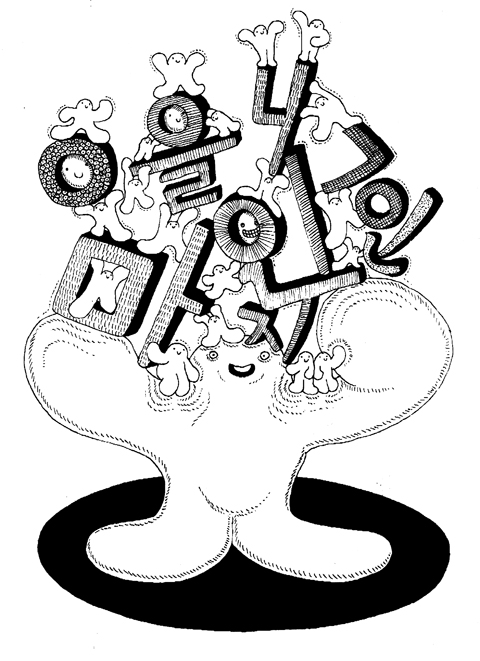
“I am doing for the world’s nonwritten languages what Doctors Without Borders is doing in medicine,” Lee, 75, said in an interview. “There are thousands of such languages. I aim to bring Hangul to all of them.”
While her quest might seem quixotic to non-Koreans, in this country — which has a national holiday called Hangul Day — it is viewed with enormous pride. Newspapers have gushed, and a Korean political party praised her feat in Indonesia — which Lee says involves just 50 children so far — as “a heroic first step toward globalizing Hangul.”
Such effusiveness is tied to Koreans’ attachment to their alphabet — a distinctive combination of circles and lines — and what they believe its endurance says about them as a people. During decades of Japanese colonial rule in the past century, Koreans were banned from using their language and alphabet in business and other official settings; schools were forbidden from teaching the language. Illiteracy in Korean soared, but many Koreans broke the rules to teach the language to their children and others.
Lee’s father, a linguist and professor, secretly taught his children and other students the language. She sees her mission as honoring his legacy, honoring Korea and helping the world.
Kim Ju-won, a linguist at Seoul National University and the president of the Hunminjeongeum Society, which Lee established to propagate Hangul, summarized the mission this way: “By giving unwritten languages their own alphabets, we can help save them from extinction and thus ensure mankind’s linguistic and cultural diversity.”
Still, the country’s linguistic ambitions have already raised some concerns, not long after some Muslim countries complained about South Korea’s missionary zeal in trying to spread Christianity.
In Indonesia, where the government is encouraging its 240 million people to learn a “language of unity,” Bahasa Indonesia, for effective communication among a vast array of ethnic groups, Lee’s project raises delicate issues.
“If this is a kind of hobby, that’s fine,” Nicholas Dammen, the Indonesian ambassador to South Korea, said recently, referring to the decision by the Cia-Cia ethnic minority to adopt Hangul. “But they don’t need to import the Hangul characters. They can always write their local languages in the Roman characters.”
Shin Eun-hyang, an official at the Korean language division of the Ministry of Culture, Sports and Tourism in Seoul, said: “This is diplomatically sensitive. The government is limited in how much direct support it can provide to such projects.”
The government says it does not provide money to Lee’s group, but she said it offered indirect support by giving linguists grants to pursue their work, which can include teaching Hangul abroad.
Lee started trying to spread Hangul in 2003. She first tried relying on Korean Christian missionaries in Nepal, Mongolia, Vietnam and China. But because the missionaries’ primary concern was religious, not linguistic, she said, none of those programs succeeded.
She later began working with linguists in South Korea, and by 2007 they had an ally. South Korean popular culture — soap operas, music, pop stars — had mesmerized much of Asia.
People like the Cia-Cia, a minority of 60,000 people in Indonesia, were eager to embrace things Korean, according to a Korean documentary shot on their island.
In July last year, Lee led a delegation to Baubau, a town on Buton Island, off southeastern Sulawesi. In meetings with officials and tribal chieftains, she offered to create writing systems and textbooks based on Hangul so they could teach their children their own languages in school. She also offered to build a US$500,000 Korean cultural center and promote economic development.
A deal was signed. Two teachers representing two language groups in Baubau came to Seoul for a six-month training course in Hangul at Seoul National University. One quit, complaining about the cold weather. The other, a Cia-Cia man named Abidin, stayed on. In July, Abidin, using a textbook from South Korea, began teaching the Cia-Cia language, written in Hangul, to 50 third graders in Baubau.
Although Indonesia’s government has not interfered in the Hangul project, Dammen said he feared that the rest of Baubau’s 16 tribes might become jealous of the “special treatment” the Koreans were giving the Cia-Cia.
“If others say, ‘Oh, we can also invite Japan, we can invite Russia, we can invite India, we can invite China, even Arabs,’ then things become messy,” he said.
For Lee, meanwhile, the program for the Cia-Cia is just the beginning of her ambitions for Hangul.
By sharing the script with others, Lee said, she is simply expressing the will of her ancestor King Sejong, who promulgated the script. (She is a direct descendant, 21 generations removed.)
The national holiday, Hangul Day, on Oct. 9, celebrates the king’s introduction of the script in 1446. Before that, Koreans had no writing system of their own. The elite studied Chinese characters to record the meaning, but not the sound, of Korean.
“Many of my illiterate subjects who want to communicate cannot express their concerns,” the king is recorded to have said in explaining the reason for Hunminjeongeum, the original name for Hangul. “I feel sorry for them. Therefore I have created 28 letters.”
“The king propagated Hangul out of love of his people,” Lee said. “It’s time for Koreans to expand his love for mankind by propagating Hangul globally. This is an era of globalization.”
When Chinese President Xi Jinping (習近平) sits down with US President Donald Trump in Beijing on Thursday next week, Xi is unlikely to demand a dramatic public betrayal of Taiwan. He does not need to. Beijing’s preferred victory is smaller, quieter and in some ways far more dangerous: a subtle shift in American wording that appears technical, but carries major strategic meaning. The ask is simple: replace the longstanding US formulation that Washington “does not support Taiwan independence” with a harder one — that Washington “opposes” Taiwan independence. One word changes; a deterrence structure built over decades begins to shift.
The cancelation this week of President William Lai’s (賴清德) state visit to Eswatini, after the Seychelles, Madagascar and Mauritius revoked overflight permits under Chinese pressure, is one more measure of Taiwan’s shrinking executive diplomatic space. Another channel that deserves attention keeps growing while the first contracts. For several years now, Taipei has been one of Europe’s busiest legislative destinations. Where presidents and foreign ministers cannot land, parliamentarians do — and they do it in rising numbers. The Italian parliament opened the year with its largest bipartisan delegation to Taiwan to date: six Italian deputies and one senator, drawn from six
Recently, Taipei’s streets have been plagued by the bizarre sight of rats running rampant and the city government’s countermeasures have devolved into an anti-intellectual farce. The Taipei Parks and Street Lights Office has attempted to eradicate rats by filling their burrows with polyurethane foam, seeming to believe that rats could not simply dig another path out. Meanwhile, as the nation’s capital slowly deteriorates into a rat hive, the Taipei Department of Environmental Protection has proudly pointed to the increase in the number of poisoned rats reported in February and March as a sign of success. When confronted with public concerns over young
Taipei is facing a severe rat infestation, and the city government is reportedly considering large-scale use of rodenticides as its primary control measure. However, this move could trigger an ecological disaster, including mass deaths of birds of prey. In the past, black kites, relatives of eagles, took more than three decades to return to the skies above the Taipei Basin. Taiwan’s black kite population was nearly wiped out by the combined effects of habitat destruction, pesticides and rodenticides. By 1992, fewer than 200 black kites remained on the island. Fortunately, thanks to more than 30 years of collective effort to preserve their remaining


 RSS
RSS