


The message was clear. The sign carried by a 51-year-old man last week outside a raucous town hall meeting on healthcare in Hagerstown, Maryland, read “Death to Obama.” Just to emphasize his point, a second message was also scrawled on the cardboard placard. “Death to Obama, Michelle and 2 stupid kids,” it stated.
Welcome to the disturbing new face of the radical right in the US. Across the country, extremism is surging, inflamed by conservative talk show hosts, encouraged by Republican leaders and propagating a series of wild conspiracy theories. Many fear it might end in tragedy.
Obama has been labeled as a threat to democracy and an anti-white racist by senior presenters on the TV channel Fox News. Republicans, seizing on the fierce debate over Obama’s plans to reform healthcare, have called him a socialist who plans “death panels” for the elderly. Rumors have circulated that Obama was not born in the US and that he plans to ban firearms.
Despite having no basis in fact, they have become widely believed. A recent poll in Virginia showed only 53 percent of voters believed Obama was born in the US. In neighboring North Carolina, 54 percent of voters shared that opinion.
Such extremism is becoming a major security issue, prompting fears of an attack on Obama’s life or some other incident of domestic terrorism.
“This is a very dangerous situation that can spin off ‘lone wolf’ individuals who decide now is the time to act against people they see as an enemy,” said Chip Berlet, senior analyst at Political Research Associates and author of a book on rightwing extremists.
Federal authorities have launched a program to try to detect any individuals who might be planning rightwing attacks similar to those that in recent months have killed a Kansas abortion doctor and a black security guard at Washington’s Holocaust Museum.
At the same time, the watchdog group the Southern Poverty Law Center (SPLC) has issued a report that warns of rising numbers of potentially violent rightwing militia groups. The number of hate groups has grown from 602 in 2000 to 926, the organization found. Its report quoted one senior federal law enforcement official, Bart McEntire, as saying: “This is the most significant growth we’ve seen in 10 to 12 years. All it’s lacking is a spark.”
Many experts believe that spark is no longer missing.
Critics say that Republican politicians have let loose a wave of anger tied to the healthcare debate.
Fueled by racial issues and the economic crisis, it may be impossible to control.
“The idea that they are going to be able to control what they have unleashed is plain wrong,” said James Corcoran of Simmons College, the author of two books on US domestic terrorism.
Republican leaders have moved to scupper Obama’s healthcare plans by inflaming myths and lies about the system. Former Alaska governor Sarah Palin has refused to back away from her comments over “death panels” despite the fact that the part of the healthcare bill she is referring to does not set up such things and was drawn up by a fellow Republican. Other Republicans have been equally vociferous in attacking Obama.
Senator Chuck Grassley warned his constituents that Obama’s plan could “pull the plug on grandma.” Former senator Rick Santorum, who is a possible 2012 presidential hopeful, recently sent out an e-mail warning that Obama was “determined to remake America as a socialist utopia.” Representative John Sullivan told supporters in his Oklahoma that Obama was creating an “enemies list” of those opposed to healthcare.
The cacophony of gibes and unfounded claims is loudest, however, on rightwing TV and radio. Fox News presenter Glenn Beck has claimed Obama dislikes white people.
“This guy is, I believe, a racist,” Beck said.
Beck has also discussed allegations that Obama is setting up a network of secret internment camps and joked about poisoning Democratic Representative Nancy Pelosi. Meanwhile Rush Limbaugh, whose weekly radio show is listened to by millions of Americans, has compared the Democrats to the Nazi Party. Perhaps taking him at his word, some healthcare protesters have carried signs featuring swastikas and Obama with a “Hitler” moustache.
It is in the so-called “birther” movement that the radical right has gained the most traction. The myth, which has been debunked, holds that Obama was not born in the US. Numerous Republican politicians have floated the idea based on the false allegation that Obama cannot provide a birth certificate.
The theme has been picked up by the media, including mainstream outlets such as CNN. Experts say such rhetoric inflames individuals who might already be planning acts of violence and gives them a sense of legitimacy.
“It is a climate where extremists in society will start to believe their views are mainstream,” Corcoran said.
The SPLC report warns that the militia movement in the US had a long history of smaller attacks in the 1990s, leading up to the terrorist bombing of a federal building in Oklahoma City by Timothy McVeigh in 1995. It believes the same pattern could be about to repeat itself and points to numerous incidents in recent years.
Last week, William Kostric, a gun-rights advocate, turned up at an Obama town hall meeting in New Hampshire with a loaded handgun strapped to his leg.
Some were more worried, however, by the sign that Kostric carried that referred to a Thomas Jefferson quote about refreshing the “tree of liberty” with the blood of patriots.
That was the same quote on a T-shirt McVeigh was wearing when he was arrested.
A gap appears to be emerging between Washington’s foreign policy elites and the broader American public on how the United States should respond to China’s rise. From my vantage working at a think tank in Washington, DC, and through regular travel around the United States, I increasingly experience two distinct discussions. This divergence — between America’s elite hawkishness and public caution — may become one of the least appreciated and most consequential external factors influencing Taiwan’s security environment in the years ahead. Within the American policy community, the dominant view of China has grown unmistakably tough. Many members of Congress, as
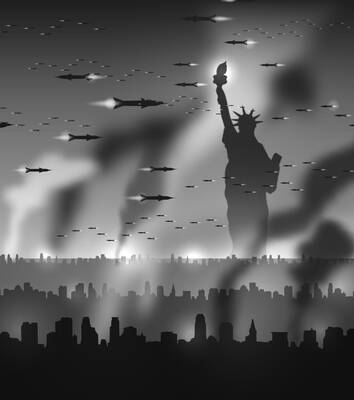
After declaring Iran’s military “gone,” US President Donald Trump appealed to the UK, France, Japan and South Korea — as well as China, Iran’s strategic partner — to send minesweepers and naval forces to reopen the Strait of Hormuz. When allies balked, the request turned into a warning: NATO would face “a very bad” future if it refused. The prevailing wisdom is that Trump faces a credibility problem: having spent years insulting allies, he finds they would not rally when he needs them. That is true, but superficial, as though a structural collapse could be caused by wounded feelings. Something
Former Taipei mayor and Taiwan People’s Party (TPP) founding chairman Ko Wen-je (柯文哲) was sentenced to 17 years in prison on Thursday, making headlines across major media. However, another case linked to the TPP — the indictment of Chinese immigrant Xu Chunying (徐春鶯) for alleged violations of the Anti-Infiltration Act (反滲透法) on Tuesday — has also stirred up heated discussions. Born in Shanghai, Xu became a resident of Taiwan through marriage in 1993. Currently the director of the Taiwan New Immigrant Development Association, she was elected to serve as legislator-at-large for the TPP in 2023, but was later charged with involvement
Out of 64 participating universities in this year’s Stars Program — through which schools directly recommend their top students to universities for admission — only 19 filled their admissions quotas. There were 922 vacancies, down more than 200 from last year; top universities had 37 unfilled places, 40 fewer than last year. The original purpose of the Stars Program was to expand admissions to a wider range of students. However, certain departments at elite universities that failed to meet their admissions quotas are not improving. Vacancies at top universities are linked to students’ program preferences on their applications, but inappropriate admission


 RSS
RSS