


In the 1990s, Son Joo-eun was a success in South Korea’s hypercompetitive business of preparing students for the national college entrance exam. He had an annual income of 720 million won (US$573,000 today) as a private tutor helping children from rich families in Seoul win admission to elite universities.
Then, he says, he had an epiphany: “What I was doing — helping the rich lift their children to the top of the ladder while pushing others down — was deepening inequality in education.”
In 1999, while watching a home-shopping channel on television, Son formulated the idea for an online test preparatory school. As South Koreans were embracing broadband Internet, he thought, why not bring classes into the home, too?
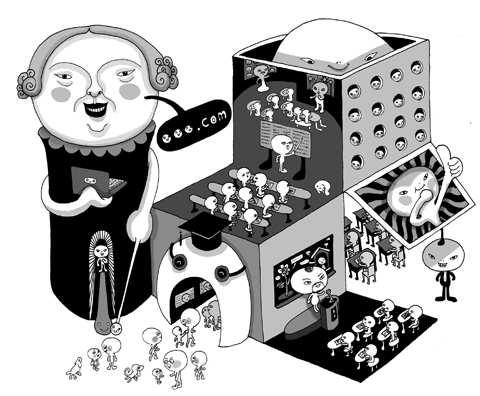
He turned to the Web to provide “an honest, inexpensive education available to everyone” — and South Korea’s multibillion-dollar test preparation industry has never been the same.
Megastudy.net, the online tutoring service Son started in 2000, may be the perfect convergence of South Korea’s dual obsessions with educational credentials and the Internet. In this country, where people’s status and income at 60 are largely determined by which college they entered at 18, South Korean parents’ all-consuming task is to ensure that their children enter an elite university. And that requires a high score on the college entrance exam.
By tapping into those anxieties, which deepen during recessions, Megastudy has become South Korea’s fastest-growing technology company, with sales expected to grow 22.5 percent this year to 245 billion won (US$195 million) even as the country’s economy is projected to contract.
About 2.8 million students, including approximately half of all college-bound high school seniors, are members of Megastudy, which allows them access to some of the country’s most celebrated exam tutors. For a fraction of what they would pay at traditional private “cram schools,” students can watch video-on-demand tutorials on home computers or download them into hand-held devices for viewing in the subway or parks. They can skip or fast-forward through some parts of a lecture and bookmark or repeat the rest.
The explosive growth of Megastudy and other Web cram schools it inspired has taken place against the backdrop of a phenomenon that many, including South Korean President Lee Myung-bak, have deplored: Students’ chances of entering a top university are often determined by their parents’ ability to pay for after-school tutoring.
Last year, South Korea spent 55 trillion won — 6 percent of its GDP — on public education. But private education expenditures amounted to an additional 20 trillion won, a burden that has been cited as a factor in South Korea’s low birth rate. Eight of every 10 students from elementary school through high school take after-school classes from private tutors or at cram schools, online or offline. Offline cram school courses cost up to five times as much as their online counterparts.
Lee recently lamented the fading tradition of “dragons ascending from the sewers” — smart children from poor families rising to the highest levels of business and government, as he himself did.
“These days, the rich get the help of cramming tutors and get good exam scores to enter colleges,” he said. “This discriminates against children who can’t afford private education.”
The government considers the Web to be an ally in curbing the runaway costs of private education. In 2004, EBS, a government-run educational TV network, opened a Web site that offered free tutorials on the national exam and now has 2.8 million members.
Online commercial services like Megastudy charge a relatively small fee, averaging 40,000 to 50,000 won (US$30 to US$40), for each course a student selects from thousands of online tutorials. But as they grow bigger and more commercialized, schools like Megastudy create a new divide in education, this time on the Web, said Yang Jung-ho, a professor of pedagogy at Sungkyunkwan University in Seoul.
“At Megastudy, a subject, for instance English, is split into many different classes, such as different levels of grammar, so that it becomes a financial burden for low-income families if their children subscribe to multiple classes,” Yang said.
Although entry costs are lower, the educational gap still exists.
“How much private education a student can get in South Korea is determined by how rich his parents are,” he said.
Well-off families prefer commercial Web schools like Megastudy, which is engaging but requires fees, while rural or low-income families gravitate toward free public services like EBS, which students find less interesting, he said.
To compete with the free online schools, Megastudy hires teachers with followings that rival those of pop stars. Some teachers lose their contracts if their popularity ratings drop. Last year, one Megastudy teacher generated 10 billion won (nearly US$8 million) in online sales and pocketed 23 percent as his share.
At Megastudy, high school students can choose from 2,500 courses. Tailored for students at various stages of academic achievement, the courses offer options unimaginable at the country’s crowded public schools, like some that promise to teach modern poetry in two weeks. The courses are made up of 10 to 20 lectures that last as long as three hours each.
“Think of your mother!” a message chastises if a student logs off without finishing a tutorial.
Megastudy runs seven offline cram schools, whose classes are recorded and offered on the Web. Its teachers also record tutorials.
Teachers are under pressure to hold onto their audiences.
“This is an intensely competitive market,” said Kang Su-hyun, 36, a Megastudy teacher who offers 50 courses on Korean language and literature. “Some teachers undergo cosmetic surgery and hire makeup artists.”
Son’s idea for cheap mass education has made him one of the richest men in the country. Sales at his company, which went public in 2004, jumped to 202 billion won last year from 579 million won in 2000, when the company was formed. From high school-level courses, Megastudy has expanded into elementary school and opened courses for college students studying to get into medical and law school.
Besides South Koreans’ affinity for all things online, whether shopping or watching TV, Son’s success also rests on distrust of the public school system.
“If we have a question, we don’t ask our teachers. We go to our cram school and ask,” said Lee Jee-nee, 17, who has taken Megastudy courses.
But the Web schools have their drawbacks. Lee Won-jin, 17, a Seoul high school senior who has also attended the offline Megastudy classes and who is not related to Lee Jee-nee, said: “You pay less attention in online classes than in real offline classrooms where you face the teacher in the flesh.”
Critics say online cramming adds to a student’s already intense schedule. But Son dismisses such views, saying that the energy demonstrated by South Koreans who “study like crazy” is what keeps the country’s economy going.
With the country pouring billions of dollars into making its Internet 10 times faster by 2014, Son suggested that the world turn to South Korea for a glimpse of what education might look like in the future.
“Offline schools will become supplemental to online education,” he predicted. “Students will go to school, perhaps once a week, for group activities like sports.”
A gap appears to be emerging between Washington’s foreign policy elites and the broader American public on how the United States should respond to China’s rise. From my vantage working at a think tank in Washington, DC, and through regular travel around the United States, I increasingly experience two distinct discussions. This divergence — between America’s elite hawkishness and public caution — may become one of the least appreciated and most consequential external factors influencing Taiwan’s security environment in the years ahead. Within the American policy community, the dominant view of China has grown unmistakably tough. Many members of Congress, as

After declaring Iran’s military “gone,” US President Donald Trump appealed to the UK, France, Japan and South Korea — as well as China, Iran’s strategic partner — to send minesweepers and naval forces to reopen the Strait of Hormuz. When allies balked, the request turned into a warning: NATO would face “a very bad” future if it refused. The prevailing wisdom is that Trump faces a credibility problem: having spent years insulting allies, he finds they would not rally when he needs them. That is true, but superficial, as though a structural collapse could be caused by wounded feelings. Something
Former Taipei mayor and Taiwan People’s Party (TPP) founding chairman Ko Wen-je (柯文哲) was sentenced to 17 years in prison on Thursday, making headlines across major media. However, another case linked to the TPP — the indictment of Chinese immigrant Xu Chunying (徐春鶯) for alleged violations of the Anti-Infiltration Act (反滲透法) on Tuesday — has also stirred up heated discussions. Born in Shanghai, Xu became a resident of Taiwan through marriage in 1993. Currently the director of the Taiwan New Immigrant Development Association, she was elected to serve as legislator-at-large for the TPP in 2023, but was later charged with involvement
Out of 64 participating universities in this year’s Stars Program — through which schools directly recommend their top students to universities for admission — only 19 filled their admissions quotas. There were 922 vacancies, down more than 200 from last year; top universities had 37 unfilled places, 40 fewer than last year. The original purpose of the Stars Program was to expand admissions to a wider range of students. However, certain departments at elite universities that failed to meet their admissions quotas are not improving. Vacancies at top universities are linked to students’ program preferences on their applications, but inappropriate admission


 RSS
RSS