


In a spare half-hour while discussing bailing out US capitalism, the US House of Representatives recently voted through an extraordinary bill with far-reaching implications for Britain’s courts. Yet it has received no publicity here and few of Britain’s lawyers even know of its existence.
By amending the legal code three weeks ago in order to prohibit the recognition and enforcement of foreign defamation judgments in the US, politicians sealed off the US’ newspaper and book publishers from libel tourism — the use of British libel laws by non-nationals to sue foreign-owned publications such as books, newspapers and magazines that are distributed in Britain, even if only a few copies are involved.
Britain’s libel laws are widely considered to be among the most severe on publishers and have been used by people from around the world — increasingly by Hollywood celebrities — because US defamation laws give publications much greater license.
Representative Steve Cohen, the congressman who drew up the new US legislation, believes it will prevent the exploitation of defamation laws in Britain and other countries that lack the broad protections guaranteed by the US first amendment.
His measure is hugely popular in the US. It was passed unanimously, enjoying cross-party support and will now go to the Senate for ratification; it was applauded by the Association of American Publishers, the country’s principal book publishing trade body and greeted enthusiastically by the New York Times on behalf of the newspaper industry.
It “strikes an important blow for free expression,” said a leading article, which noted that people have been getting around the US’ “high bar on libel lawsuits” by “bringing lawsuits in Britain where libel protections are notoriously weak.”
There have been very few voices raised against the measure. Two of the most notable have been a Belfast-based solicitor, Paul Tweed, who has a lengthy record of success acting for US celebrities in libel actions in England and Ireland, and a leading New York lawyer, John Walsh.
“I have a respect for British jurisprudence and I also esteem responsible journalism,” Walsh said. “This bill makes it less likely that people who suffer from irresponsible journalism in publications that appear in Britain will have the chance for redress.”
Walsh believes that the US, by seeking immunity from court decisions elsewhere, is in effect trying to export its first amendment to the rest of the globe.
Tweed, speaking from New York where he is lobbying to appear before the Senate’s Judiciary Committee before it rubber-stamps the bill, said: “It’s disgraceful. Congress is cocking a snook at UK libel law without considering all the implications. I want to give senators a balanced view.”
He knows, however, that he is facing an uphill battle. In an odd twist, the so-called libel tourism bill is the federal offshoot of a law passed by the state of New York that is connected to fears of terrorism.
In 2004, the Saudi billionaire Khalid bin Mahfouz launched a libel action against Rachel Ehrenfeld, the author of a book entitled Funding Evil: How Terrorism is Financed and How to Stop it, which alleged that Mahfouz financed al-Qaeda in the years leading up to Sept. 11, 2001, a claim that Mahfouz strenuously denied.
Even though the book was not published in Britain, a British court agreed to hear the case because some copies were sold online. Ehrenfeld did not appear to defend it, and Mahfouz was awarded substantial damages. Ehrenfeld then sued Mahfouz in New York to obtain a declaration that the judgment would not be enforced in the US because her book was not defamatory under US law.
That suit was dismissed and in response to this judgment, the New York state legislature passed the libel terrorism protection act.
Walsh and Tweed believe that the link between libel terrorism and libel tourism has played a large part in convincing politicians to transform the New York law into a federal one.
“It means that people will be denied a way of obtaining recompense for injury to their reputations,” Tweed said. “And it is an insult to the British legal system, which was the foundation stone of America’s laws too.”
But Tweed’s sense of outrage is certainly not shared by every British media lawyer. Mark Stephens, for example, represented Ehrenfeld and advised her not to fight the Mahfouz action in London, predicting that she would lose even if she appeared. He welcomes the new US law.
“It means that libel tourists will not be able to use their wealth and power against people who cannot afford to defend themselves in Britain,” he said. “It should be the case that people should sue in the jurisdiction where an alleged libel is published.”
Stephens is also planning to address the Senate Judiciary Committee — where he says he will point out that Tweed’s major concern is that he will lose part of his income from representing US celebrities.
I put this to Tweed, who rejects the idea that he is “the king of libel tourism.”
“People come to me because they want fair play and Britain’s libel laws offer a way of achieving it that is not available under American laws. Anyway, the cases I handle for high-profile personalities form only a small proportion of my workload,” Tweed said.
But he acknowledges that he has helped a string of “personalities” to win damages against both US-based and British publications by adopting a strategy of suing simultaneously in London, Belfast and Dublin. Among his clients have been Britney Spears, Jennifer Lopez, Whitney Houston, Michael Jackson, Colin Farrell and Harrison Ford. He has never lost a case.
Though Tweed is far from alone in representing actors in libel tourism cases, his fight in the US has little support from other lawyers who handle similar cases. A leading London-based lawyer who is well-known for representing celebrities in libel cases feels relaxed about it.
“US courts have failed for some time to recognize British libel rulings unless there is clear proof of malice by the offender. This won’t change anything,” he said.
But Paul Gilbert, a media lawyer for Finers Stephens Innocent, disagrees. He thinks US organizations sued in London will take heart from the new law and dig in their heels if judgments go against them. Their insurers may well make it as difficult as possible to extract payment. US publishers may also reduce their assets in London to avoid paying damages.
The walls of Tweed’s Belfast office are lined with framed newspaper articles about his famous clients. It looks very likely that he will not be adding to that collection.
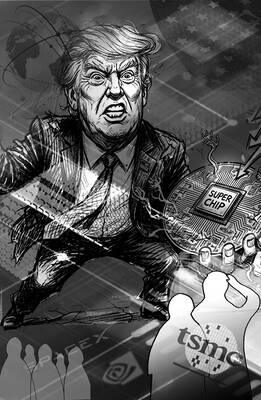
The White House’s decision to take a 9.9 percent stake in Intel Corp is looking like very shrewd business indeed. Since the government bought in at US$20.47 a share last August, the US chipmaker’s surging stock price has delivered the US a US$43 billion return. One of the reasons the investment has so far proved so sound is that the White House has made sure of it. According to The Wall Street Journal, Howard personally pushed deals on Intel’s behalf with some of the most lucrative clients imaginable. They include Nvidia Corp, the company at the heart of the AI
In a Taiwanese university classroom, a lecturer asks in English: “Can anyone give me an example from Taiwan?” Students look down. No one answers. After class, one student writes on the course platform in Mandarin: “I understood the concept, but I didn’t know how to answer in English.” That moment highlights a key issue in Taiwan’s English-medium instruction (EMI) reform: It is not just about more English-taught courses, but whether students can learn, participate and belong. EMI expansion is part of the Bilingual 2030 policy and the Ministry of Education’s BEST Program, aiming to improve English ability, support EMI teaching
A single photograph can cut through a lot of noise, but it can also be used to misrepresent the truth. At the very least, it can concentrate the mind on something that requires further investigation. On Monday last week, Ma Ying-jeou Foundation CEO Tai Hsia-ling (戴遐齡) and former National Security Council secretary-general King Pu-tsung (金溥聰) held a news conference in which they showed a photograph of former foundation CEO Hsiao Hsu-tsen (蕭旭岑), now Chinese Nationalist Party (KMT) deputy chairman. In the image Hsiao is seated next to Xiamen Taiwan Businessmen Association chairman Han Ying-huan (韓螢煥). The two men were holding
The Ministry of the Interior, working with the navy and coast guard, is organizing Taiwan’s first joint exercise simulating escort tankers carrying liquefied natural gas (LNG) and oil through a Chinese blockade. The drills simulate fuel transport along three maritime corridors leading toward Japan, the Philippines and the US. Deputy Minister of the Interior Sawyer Mars (馬士元) said that a blockade of the Taiwan Strait would amount to “almost a 100 percent blockade of the regional energy supply.” Minister of National Defense Wellington Koo said planning to counter a blockade is standard practice in Taipei. While the exercise is limited in


 RSS
RSS