


Anti-smoking lobby groups can take a degree of comfort from the decision of the state-run Taiwan Tobacco and Liquor Corp (TTLC) on Wednesday to remove the number "520" from the name of a recently launched cigarette brand.
The decision to remove the numerals was made after TTLC came under pressure from campaigners who accused it of targeting the cigarettes at young people and trying to capitalize on the inauguration of president-elect Ma Ying-jeou (馬英九) — “520” means “I love you” in text messaging culture and also happens to be the date of Ma’s swearing-in.
In announcing the decision, company officials disingenuously said that the product launch late last month “had nothing to do with the inauguration of the new president,” while rejecting the anti-smoking groups’ arguments that the new brand was designed to appeal to young women in particular.
With a rose-like flavor, a heart-shaped filter and pink packaging, it is unlikely that these cigarettes were ever going to appeal to older male smokers.
The company’s announcement appears even less credible given that international tobacco conglomerates have targeted young, female smokers in the last few years to boost flagging sales around the globe.
In an interview in January last year, TTLC chairman Martin Tsai (蔡木霖) said that the success of the company’s “Gentle” (尊爵) cigarette brand was another example of how the corporation was targeting young customers.
A more important issue than the company’s cynical attempts to attract a new generation of smokers, however, is whether the state should be involved in selling these kinds of products in the first place.
Its role becomes all the more questionable when one considers how much money the government’s National Health Insurance Bureau has to spend each year treating patients suffering from tobacco and alcohol-related illnesses.
It is simply indefensible for the state to spend tax dollars promoting commercial products that harm people and eat into health infrastructure.
The idea of government owning a company that sells alcohol and cigarettes is an anachronism dating back to the post-war monopoly period when the Chinese Nationalist Party (KMT) regime had to be involved in absolutely everything.
This may have been acceptable a few decades ago when the effects of smoking were not properly understood, but now that so much empirical evidence exists demonstrating the damage that smoking and alcohol consumption can cause, there is no way out for government advocates of this corporation.
Admittedly, the government has been trying for more than six years to privatize TTLC — that is, since accession to the WTO in 2001 required opening the tobacco and alcohol markets to foreign competition.
However, as with the banking sector, this has met with predictable resistance from the company’s labor union.
It would therefore be best for all concerned if the new government took advantage of its fresh start and swiftly privatized the TTLC.
Then the authorities could concentrate on the roles that a state ought to perform: regulation and enforcement.
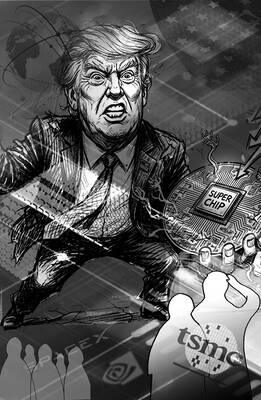
The White House’s decision to take a 9.9 percent stake in Intel Corp is looking like very shrewd business indeed. Since the government bought in at US$20.47 a share last August, the US chipmaker’s surging stock price has delivered the US a US$43 billion return. One of the reasons the investment has so far proved so sound is that the White House has made sure of it. According to The Wall Street Journal, Howard personally pushed deals on Intel’s behalf with some of the most lucrative clients imaginable. They include Nvidia Corp, the company at the heart of the AI
The Ministry of the Interior, working with the navy and coast guard, is organizing Taiwan’s first joint exercise simulating escort tankers carrying liquefied natural gas (LNG) and oil through a Chinese blockade. The drills simulate fuel transport along three maritime corridors leading toward Japan, the Philippines and the US. Deputy Minister of the Interior Sawyer Mars (馬士元) said that a blockade of the Taiwan Strait would amount to “almost a 100 percent blockade of the regional energy supply.” Minister of National Defense Wellington Koo said planning to counter a blockade is standard practice in Taipei. While the exercise is limited in
A single photograph can cut through a lot of noise, but it can also be used to misrepresent the truth. At the very least, it can concentrate the mind on something that requires further investigation. On Monday last week, Ma Ying-jeou Foundation CEO Tai Hsia-ling (戴遐齡) and former National Security Council secretary-general King Pu-tsung (金溥聰) held a news conference in which they showed a photograph of former foundation CEO Hsiao Hsu-tsen (蕭旭岑), now Chinese Nationalist Party (KMT) deputy chairman. In the image Hsiao is seated next to Xiamen Taiwan Businessmen Association chairman Han Ying-huan (韓螢煥). The two men were holding
I first met Professor Ray Jiing (井迎瑞) as a film and documentary student at Shih Hsin University’s (SHU) Department of Radio Television and Film in 1988. The following year, he went on to become the director of the Chinese Taipei Film Archive — forerunner of the Taiwan Film and Audiovisual Institute (TFAI). Over his eight-year tenure, Jiing rescued and restored over 200 classic Taiwanese films. In 1997, he established the Graduate Institute of Studies in Documentary and Film Archiving at Tainan National University of the Arts (TNNUA), and I joined the program in his third cohort of students. Beyond a


 RSS
RSS