


It has been 27 years since the Chiang Kai-shek Memorial Hall was completed and opened to the public. The authority in charge of the hall is the National Chiang Kai-shek Memorial Hall Management Office, which falls under the jurisdiction of the Ministry of Education. Because of the recent controversy about tearing down the wall surrounding the hall, the Department of Cultural Affairs of the Taipei City Government this March quickly proclaimed it a temporary historical site according to article 17 of the Cultural Heritage Protection Law (文化資產保存法). The article stipulates that a "temporary historical site" is considered a historical site while its historical value is being evaluated, and is managed and protected accordingly.
On May 19, the Chiang Kai-shek Memorial Hall Management Office and the ministry conducted a name change ceremony, unveiling a plaque with the name "National Taiwan Democracy Memorial Hall," and hanging large ceremonial banners from the northern and southern walls of the hall. On May 20, the Taipei City Government, stating that this went against Article 30 of the Cultural Heritage Protection Law, issued a fine of NT$100,000 in accordance with Article 97, Section 1, Clause 4 of same law. One day later, the city government issued another fine of NT$200,000. On May 22, the city government, again citing the regulations of the above law, took the matter upon itself and tore down the banners. The manner in which the city government handled the matter is objectionable for several reasons.
First, according to Article 30 of the Cultural Heritage Protection Law, construction work and other development activities are not allowed to damage the integrity of the historical site, block the outside of the historical site from view, or obstruct passageways. "Construction work" in this case refers to "civil and construction work as well as related operations," as stated in the Construction Industry Act (
"Other development activities," for its part, refers to other development activities related to the construction work that can be harmful to the historical site. Although the Chiang Kai-shek Memorial Hall is undergoing partial renovation work, banners were hung up for the name-changing ceremony, and had no connection to the renovation. Therefore, no fine can be issued in accordance with Articles 30 or 97 of the Cultural Heritage Protection Law.
Second, regarding the Taipei City Government issuing a second fine of NT$200,000: Article 97, Section 2, of the Cultural Heritage Protection Law states that no rectification has been made within the time specified by the competent authorities, or the rectifications made do not conform to the items specified for rectification, punishment may be administered for each instance until rectification has been duly made. If the situation is urgent, the competent authorities should carry out necessary measures, the expenses of which will be imposed on the party who conducted the actions.
These rules distinguish between "administrative fines" and "executive fines." Executive fines are issued in accordance with Article 31 of the Administrative Enforcement Law (行政執行法). If a penalty is issued and obligations remain unfulfilled, the competent authorities can issue another penalty. Those regulations stipulate punishment may be administered for each instance, meaning that every time rectification is not made within the time specified, a fine can be issued.
This does not mean that a new fine can be issued immediately following a failure to make a rectification within the timeframe specified. Hence, the city government's issuance of a second fine immediately after the first was not in accordance with the stipulations in this law.
Third, as to the city government tearing down said banners: Article 97, Section 2, of the Cultural Heritage Protection Law when the situation is urgent, the competent authorities should carry out necessary measures. This urgent situation refers to a situation when there are fears that the historical site faces immediate destruction or damage, and when the only option is for the competent authorities to intervene, as there is no other way to avert this danger.
In this case, hanging up the banners did not constitute an immediate danger of damaging or destroying the Chiang Kai-shek Memorial Hall. There was no pressing need for the city government to tear them down.
The conduct of the Taipei City Government -- issuing fines and tearing down the banners -- is not in accordance with the law. In the end, examining the historical value of the Chiang Kai-shek Memorial Hall, which now has temporary historical site status, should be carried out as soon as possible, so that a decision can be made soon and so that controversy can be avoided.
Chang Long is an adviser on the Legal Affairs Committee for the Council of Cultural Affairs.
translated by Anna Stiggelbout
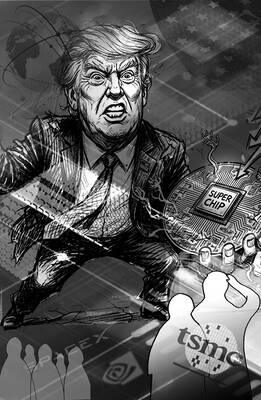
The White House’s decision to take a 9.9 percent stake in Intel Corp is looking like very shrewd business indeed. Since the government bought in at US$20.47 a share last August, the US chipmaker’s surging stock price has delivered the US a US$43 billion return. One of the reasons the investment has so far proved so sound is that the White House has made sure of it. According to The Wall Street Journal, Howard personally pushed deals on Intel’s behalf with some of the most lucrative clients imaginable. They include Nvidia Corp, the company at the heart of the AI
In a Taiwanese university classroom, a lecturer asks in English: “Can anyone give me an example from Taiwan?” Students look down. No one answers. After class, one student writes on the course platform in Mandarin: “I understood the concept, but I didn’t know how to answer in English.” That moment highlights a key issue in Taiwan’s English-medium instruction (EMI) reform: It is not just about more English-taught courses, but whether students can learn, participate and belong. EMI expansion is part of the Bilingual 2030 policy and the Ministry of Education’s BEST Program, aiming to improve English ability, support EMI teaching
A single photograph can cut through a lot of noise, but it can also be used to misrepresent the truth. At the very least, it can concentrate the mind on something that requires further investigation. On Monday last week, Ma Ying-jeou Foundation CEO Tai Hsia-ling (戴遐齡) and former National Security Council secretary-general King Pu-tsung (金溥聰) held a news conference in which they showed a photograph of former foundation CEO Hsiao Hsu-tsen (蕭旭岑), now Chinese Nationalist Party (KMT) deputy chairman. In the image Hsiao is seated next to Xiamen Taiwan Businessmen Association chairman Han Ying-huan (韓螢煥). The two men were holding
The Ministry of the Interior, working with the navy and coast guard, is organizing Taiwan’s first joint exercise simulating escort tankers carrying liquefied natural gas (LNG) and oil through a Chinese blockade. The drills simulate fuel transport along three maritime corridors leading toward Japan, the Philippines and the US. Deputy Minister of the Interior Sawyer Mars (馬士元) said that a blockade of the Taiwan Strait would amount to “almost a 100 percent blockade of the regional energy supply.” Minister of National Defense Wellington Koo said planning to counter a blockade is standard practice in Taipei. While the exercise is limited in


 RSS
RSS