


The daily press briefing was routine. Marie Okabe, a spokeswoman for UN Secretary-General Ban Ki-moon, read a five-minute update on Somalia, Darfur and the Security Council's actions and about 30 journalists quietly listened.
In the third row, Matthew Lee tapped away at his laptop and scribbled on two notepads with the intensity of a graduate student at thesis time. When Okabe asked for questions, Lee, the resident blogger of the UN press corps, pounced, asking almost as many questions in 20 minutes as the other correspondents combined.
Lee, a well-known gadfly who often presses banks to revise their policies on mortgage loans to the poor, is the only blogger at the UN with media credentials, entitling him to free office space and access to briefings and press conferences. There had been a second accredited blogger, Pincas Jawetz, a 73-year-old retired energy policy consultant, but he was ejected in March on the grounds that he had distracted too many briefings with off-topic questions.
The UN is one of the only institutions of its size and importance that currently allow bloggers not affiliated with larger, more traditional media companies into the permanent press corps.
The Democrats and Republicans allowed bloggers into their 2004 conventions. But the question of whether bloggers should be considered credentialed journalists is a relatively new one at the UN -- in part, it seems, because the foreign policy debates here are considered mind-numbing to many US citizens.
"Bloggers in the US seem mostly concerned about domestic politics," said Lee, one of about 200 full-time resident correspondents at the UN.
Another 1,500 correspondents have permanent credentials.
The day-to-day work of the UN, he said, involves passing "boring resolutions and delivering food."
Most of Okabe's answers during a daily briefing made it into one of several daily posts on Lee's Web site, innercitypress.com, which has covered everything from fire drills at the UN headquarters building to potential financial abuses at its agencies. He says that this site gets about 90,600 visitors a month.
Another site he runs, innercitypress.org, which he calls "more openly advocacy," gets 289,000 monthly visitors.
Lee is also well-known in banking circles. This month, for instance, he took a break from his foreign affairs duties to attend a Citigroup shareholder meeting.
He established Inner City Press in 1987 as a print newsletter and turned his attention to the UN in late 2005. Today, Inner City Press operates as both an online nonprofit organization and as a Web site with the motto "investigative reporting from the inner city to Wall Street to the United Nations."
Lee draws a distinction between his investigations at the UN and the criticism the institution faces from right-wing bloggers.
"I end up getting a lot of dirt -- not because I'm a right-winger, just because I write about the agencies," said Lee, 41, who says he regularly works 13-hour days and lives on the money from several fellowships he won a few years ago.
Stephane Dujarric, who was chief spokesman for former UN secretary-general Kofi Annan, is now working for the department that oversees media accreditation at the UN. He said that guidelines for bloggers are a work in progress. The goal is to balance concerns about openness, security and professional standards with growing interest from online journalists, he said.
"New media is definitely a challenge to all organizations who accredit journalists, and I think we're doing well in meeting that challenge," Dujarric said. "Our priority is to make sure we provide an environment that is as open to journalists doing their work, as much as possible."
For people without credentials -- journalists or non-journalists alike -- the UN posts transcripts and live Web casts on its site.
"We're trying to make information about the UN as accessible as possible," Dujarric said.
The debate over who should gain access to the inner sanctum came to a head in March when Jawetz, who follows sustainable development for his Web site called SustainabiliTank.info, did not have his accreditation renewed.
The UN Department of Public Information cited his Web site's lack of "a substantial amount of original news content" as well as complaints from other reporters that Jawetz's questions were "more consistent with that of a nongovernmental organization advocate."
On March 29, his last day at the noon briefing, Jawetz created a scene by using the question period to read a letter informing him that his renewal request had been declined.
"I'm not covering everything; I'm writing about what is important," said Jawetz, who said in an interview that his site published impartial journalism, not advocacy.
Although UN reporters and officials refer to Lee as the only remaining blogger, he is not the only member of the press corps who blogs. Joe Lauria, who covers the UN on a freelance basis for the Boston Globe, writes for the Huffington Post, a liberal-leaning Web log.
On the more conservative side, Claudia Rosett, a contributor to National Review and a former member of the Wall Street Journal's editorial board, has a blog at claudiarosett.pajamasmedia.com.
And in the more distant blogosphere, the UN is a favorite punching bag for many political blogs like littlegreenfootballs.com.
"Bloggers, serious ones, do contribute to the spread of information," said Tuyet Nguyen, a correspondent for the German press service DPA and president of the UN Correspondents Association.
He said of Lee: "I don't see any difference in what he's doing and what we are doing."
Lee is a bit like a bull in the carefully diplomatic china shop of the UN press corps. He has broken a few stories and irritated more than one senior official. He has printed gossip, rumors and what several officials called lies, and was once called a "jerk" by Annan's deputy secretary-general, Mark Malloch Brown.
But he seems to have earned the respect of his colleagues; In December, he was elected to the executive committee of the UN Correspondents Association.
"I know my place; It's a supplement. It's a sidebar on issues that everyone else cares about," Lee said.
He said he can devote his time and Web space to issues often overlooked by larger media.
"It's not like newsprint costs are going to kill me," he said.
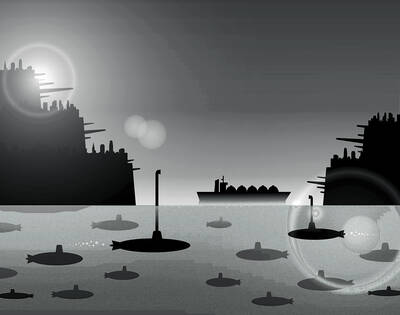
In the event of a war with China, Taiwan has some surprisingly tough defenses that could make it as difficult to tackle as a porcupine: A shoreline dotted with swamps, rocks and concrete barriers; conscription for all adult men; highways and airports that are built to double as hardened combat facilities. This porcupine has a soft underbelly, though, and the war in Iran is exposing it: energy. About 39,000 ships dock at Taiwan’s ports each year, more than the 30,000 that transit the Strait of Hormuz. About one-fifth of their inbound tonnage is coal, oil, refined fuels and liquefied natural gas (LNG),
To counter the CCP’s escalating threats, Taiwan must build a national consensus and demonstrate the capability and the will to fight. The Chinese Communist Party (CCP) often leans on a seductive mantra to soften its threats, such as “Chinese do not kill Chinese.” The slogan is designed to frame territorial conquest (annexation) as a domestic family matter. A look at the historical ledger reveals a different truth. For the CCP, being labeled “family” has never been a guarantee of safety; it has been the primary prerequisite for state-sanctioned slaughter. From the forced starvation of 150,000 civilians at the Siege of Changchun
The two major opposition parties, the Chinese Nationalist Party (KMT) and the Taiwan People’s Party (TPP), jointly announced on Tuesday last week that former TPP lawmaker Chang Chi-kai (張啟楷) would be their joint candidate for Chiayi mayor, following polling conducted earlier this month. It is the first case of blue-white (KMT-TPP) cooperation in selecting a joint candidate under an agreement signed by their chairpersons last month. KMT and TPP supporters have blamed their 2024 presidential election loss on failing to decide on a joint candidate, which ended in a dramatic breakdown with participants pointing fingers, calling polls unfair, sobbing and walking
In the opening remarks of her meeting with Chinese President Xi Jinping (習近平) in the Great Hall of the People in Beijing on Friday, Chinese Nationalist Party (KMT) Chairwoman Cheng Li-wun (鄭麗文) framed her visit as a historic occasion. In his own remarks, Xi had also emphasized the history of the relationship between the KMT and the Chinese Communist Party (CCP). Where they differed was that Cheng’s account, while flawed by its omissions, at least partially corresponded to reality. The meeting was certainly historic, albeit not in the way that Cheng and Xi were signaling, and not from the perspective


 RSS
RSS