


A new book titled The Tracks of Women (女人屐痕) and published in the name of the National Cultural Association, but jointly written by cultural workers involved in the women's movement, has finally come off the presses. As the title implies, the book tells the story of gender reform and the impact it has had on society.
It is a landmark documenting Taiwan's gender culture. In contrast to the political crisis and the wanton exposure of unsubstantiated scandals over the past few months, the book represents the pure voice of enduring gender reform that has stayed true to its ideals.
The book is like an in-depth travel guide to the history of Taiwan's gender reform. It features both text and illustrations, but also functions as educational material. With the in-depth guidance provided by The Tracks of Women, readers are able to travel across the gender space which on this beautiful island is scarred and marked by conflict.
The book begins with a historical look at gender education in Taiwan's early modern history. It shows us that modern Western education for women was only introduced in the late 19th century by Canadian Presbyterian missionary George Leslie Mackay. Mackay founded a school for girls in Huwei -- the old name for Tamsui -- later renamed Tamsui Girls' School.
It is interesting to learn that the first Taiwanese woman to receive a complete Western education was an Aboriginal named Hsieh A-yun (
In this book, we learn that during the 1950s White Terror era, dancer Tsai Jui-yueh (蔡瑞月) -- also called the Matriarch of Taiwan's modern dance -- maintained her exuberant vitality and courageously carried on alone after her husband was arrested. In 1953, Tsai founded the Chung-hua Dance Research Institute, Taiwan's first modern dance studio. It is now called the Tsai Jui-yueh Dance Research Institute.
Shifting our gaze to southern Taiwan, we can see that working-class women were the major contributors behind Taiwan's economic miracle. We should therefore look back and rewrite the history of the 25 unmarried female workers who drowned in a boat accident in 1973 on their way to jobs in the city. We should create a monument for these women to affirm their contributions to the development of Kaohsiung.
Following the tracks of Taiwan's women as they moved toward modern democratic society, we can clearly see the emergence of women's movements around the time of the lifting of martial law. From Pioneer Publishing, founded by Vice President Annette Lu (
Starting from the development of personal gender awareness and following through to the emergence of a gender landscape, The Tracks of Women not only provides a historical summary, it is also marks the beginning of the restoration of a spatial awareness to gender politics.
Feminist geographer Linda McDowell once said that space is not a static container, but rather both the material foundation for gender consciousness, and the base where gender-power relations and gender identity are reproduced.
Redefining the meaning of space means that the reappearance of the gender issue no longer simply relates to appointing political representatives. Rather, the question involves how to negotiate the core values of gender reform and bring about their universal implementation -- from the legislature into our daily lives.
Competitive global tourism is almost upon us, bringing with it worries that we have no stories to tell foreign visitors. But The Tracks of Women is an excellent alternative visitors' guide. We no longer have to envy the US for its guide to the historical monuments of its women's rights movement in Ithaca, New York -- now we can proudly say to our foreign visitors: "Do you want to know the history of Taiwan's gender reform? Follow me, and I'll show you."
Sabina Sun is an assistant professor in the Graduate School of Fine Arts at National Taiwan University of Arts, and a board member of the Taiwanese Association of Feminist Scholars.
Translated by Lin Ya-ti
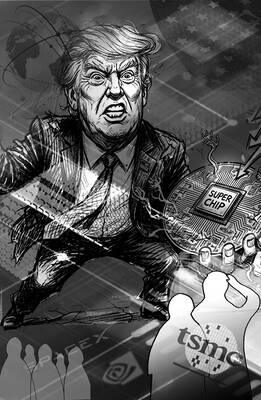
The White House’s decision to take a 9.9 percent stake in Intel Corp is looking like very shrewd business indeed. Since the government bought in at US$20.47 a share last August, the US chipmaker’s surging stock price has delivered the US a US$43 billion return. One of the reasons the investment has so far proved so sound is that the White House has made sure of it. According to The Wall Street Journal, Howard personally pushed deals on Intel’s behalf with some of the most lucrative clients imaginable. They include Nvidia Corp, the company at the heart of the AI
In a Taiwanese university classroom, a lecturer asks in English: “Can anyone give me an example from Taiwan?” Students look down. No one answers. After class, one student writes on the course platform in Mandarin: “I understood the concept, but I didn’t know how to answer in English.” That moment highlights a key issue in Taiwan’s English-medium instruction (EMI) reform: It is not just about more English-taught courses, but whether students can learn, participate and belong. EMI expansion is part of the Bilingual 2030 policy and the Ministry of Education’s BEST Program, aiming to improve English ability, support EMI teaching
A single photograph can cut through a lot of noise, but it can also be used to misrepresent the truth. At the very least, it can concentrate the mind on something that requires further investigation. On Monday last week, Ma Ying-jeou Foundation CEO Tai Hsia-ling (戴遐齡) and former National Security Council secretary-general King Pu-tsung (金溥聰) held a news conference in which they showed a photograph of former foundation CEO Hsiao Hsu-tsen (蕭旭岑), now Chinese Nationalist Party (KMT) deputy chairman. In the image Hsiao is seated next to Xiamen Taiwan Businessmen Association chairman Han Ying-huan (韓螢煥). The two men were holding
The Ministry of the Interior, working with the navy and coast guard, is organizing Taiwan’s first joint exercise simulating escort tankers carrying liquefied natural gas (LNG) and oil through a Chinese blockade. The drills simulate fuel transport along three maritime corridors leading toward Japan, the Philippines and the US. Deputy Minister of the Interior Sawyer Mars (馬士元) said that a blockade of the Taiwan Strait would amount to “almost a 100 percent blockade of the regional energy supply.” Minister of National Defense Wellington Koo said planning to counter a blockade is standard practice in Taipei. While the exercise is limited in


 RSS
RSS