


Ahead of the first anniversary of China's passage of the "Anti-Secession" Law on March 14, the Cabinet designated the day as a national remembrance day -- "Anti-Aggression Day" -- to remind the people of Taiwan of China's aggressive ambitions.
Meanwhile, in China, where the National People's Congress (NPC) was convening, NPC member Chen Yunying (
If China really did that, it would be the best thing that could happen, since protecting the interests of their Taiwanese compatriots is the exact opposite of committing aggression against Taiwan. Their Taiwanese compatriots are apparently still so poor that they are forced to eat banana peels to feed themselves, and that is why China needs to "protect" Taiwan by annexing it. Small wonder that Chen's husband had to swim from Kinmen to China to find food.
To commemorate this anniversary, some people in Taiwan claim that China is opposing Taiwanese independence rather than promoting unification. This claim ignores China's greedy and aggressive ambitions, and in fact helps make China look good. At the same time, Chinese Nationalist Party (KMT) Chairman Ma Ying-jeou (
So is it true that China is not promoting unification?
First of all, the "united front" strategy was one of Mao Zedong's (
I have heard nothing about them abolishing this department, nor have China's hired overseas organizations changed their activities from "opposing independence and promoting unification" to "preventing independence."
Nor have I heard any Chinese officials announce any strategic changes.
Second, China's defense expenditures will increase by 14.7 percent this year. This is the largest annual increase in recent years -- and that still doesn't include other, hidden spending.
Meanwhile, in addition to the annual rise in the number of missiles it has aimed at Taiwan, the People's Liberation Army has announced that it will begin developing aircraft carriers.
From the perspective of military strength, those who talk about preventing independence must be asked where they draw the line between preventing independence and promoting unification.
Third, toward the end of his stint as KMT chairman, Lien Chan (
Can it really be that cooperation between the KMT and the CCP has reached the level where the KMT relieves the CCP of its task to promote unification and takes it upon itself to perform this task instead?
This being the situation, we must ask whether certain KMT politicians have already taken up positions as CCP spokespersons and are working to explain CCP strategy.
There are indeed two advantages to having the KMT explain changes in CCP policy. One advantage is that it is deceptive, because no matter what the KMT's image is, it will be better than the CCP's. The second advantage is that the CCP escapes responsibility, so in future, the KMT alone will have to bear full responsibility for having deceived the Taiwanese people.
Becoming a Chinese pawn is Ma's own choice, since he is gambling with his own political future. But the people of Taiwan should think twice about the fact that he is putting up their democracy and freedom in his game with the CCP.
Paul Lin is a New York-based political commentator.
Translated by Perry Svensson
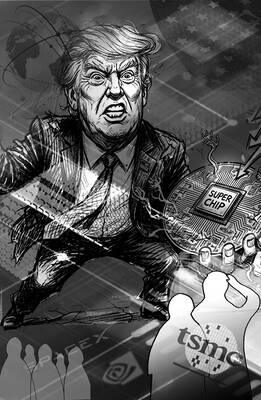
The White House’s decision to take a 9.9 percent stake in Intel Corp is looking like very shrewd business indeed. Since the government bought in at US$20.47 a share last August, the US chipmaker’s surging stock price has delivered the US a US$43 billion return. One of the reasons the investment has so far proved so sound is that the White House has made sure of it. According to The Wall Street Journal, Howard personally pushed deals on Intel’s behalf with some of the most lucrative clients imaginable. They include Nvidia Corp, the company at the heart of the AI
The Ministry of the Interior, working with the navy and coast guard, is organizing Taiwan’s first joint exercise simulating escort tankers carrying liquefied natural gas (LNG) and oil through a Chinese blockade. The drills simulate fuel transport along three maritime corridors leading toward Japan, the Philippines and the US. Deputy Minister of the Interior Sawyer Mars (馬士元) said that a blockade of the Taiwan Strait would amount to “almost a 100 percent blockade of the regional energy supply.” Minister of National Defense Wellington Koo said planning to counter a blockade is standard practice in Taipei. While the exercise is limited in
A single photograph can cut through a lot of noise, but it can also be used to misrepresent the truth. At the very least, it can concentrate the mind on something that requires further investigation. On Monday last week, Ma Ying-jeou Foundation CEO Tai Hsia-ling (戴遐齡) and former National Security Council secretary-general King Pu-tsung (金溥聰) held a news conference in which they showed a photograph of former foundation CEO Hsiao Hsu-tsen (蕭旭岑), now Chinese Nationalist Party (KMT) deputy chairman. In the image Hsiao is seated next to Xiamen Taiwan Businessmen Association chairman Han Ying-huan (韓螢煥). The two men were holding
I first met Professor Ray Jiing (井迎瑞) as a film and documentary student at Shih Hsin University’s (SHU) Department of Radio Television and Film in 1988. The following year, he went on to become the director of the Chinese Taipei Film Archive — forerunner of the Taiwan Film and Audiovisual Institute (TFAI). Over his eight-year tenure, Jiing rescued and restored over 200 classic Taiwanese films. In 1997, he established the Graduate Institute of Studies in Documentary and Film Archiving at Tainan National University of the Arts (TNNUA), and I joined the program in his third cohort of students. Beyond a


 RSS
RSS