


China faces a "critical period" in trying to stop the spread of HIV/AIDS in the general population, a senior official said on Monday as he announced another sharp rise in the number of recorded HIV infections.
"Although the epidemic is still spreading at a comparatively low speed in the country, the number of infection cases is still rising, especially among certain groups of people and in several regions," state media quoted Vice Minister of Health Wang Longde (王隴德) as saying.
Recorded cases among sex workers and pregnant women in regions with high rates of HIV infection had both increased, the official Xinhua news agency quoted Wang as saying.
"This indicates that the epidemic is spreading from high-risk groups to ordinary people, and that China is in a critical period for AIDS prevention," Wang said.
Health departments across China have reported a cumulative total of 135,630 cases of HIV infection by the end of September, of which 31,143 had developed AIDS, he said. That number was up 7.7 per cent from the 126,808 cases recorded by the end of June.
The number of recorded HIV cases has tripled in the last two years, but experts say this does not necessarily reflect a rapid spread of the disease. A campaign to test hundreds of thousands of rural residents who sold their blood in the 1990s was believed to be the major factor behind the sharp rise in recorded infections.
"We don't have the impression that there is an overall increase in infections," the spokeswoman for China at the World Health Organization, Aphaluck Bhatiasevi, said.
Recent random surveys seemed to "show little increase" in the number of HIV infections in China, Bhatiasevi said.
Wang said five regions accounted for 77 percent of recorded HIV cases. He said about 41 percent of cases were linked to intravenous drug use, 23 percent to the sale of blood and 9 percent to unprotected sex. The remaining 23 percent were infected through "unknown channels," though Wang said he believed most were also from unprotected sex.
UN health experts have warned that 10 million Chinese could be HIV-positive by 2010 if the government fails to expand its HIV/AIDS education, prevention and anti-discrimination campaigns.
"There are indications of spread of the epidemic to the general population and that's what the government is worried about," said Joel Rehnstrom, UNAIDS country coordinator for China.
Most HIV infection cases are believed to be still undiagnosed because of ignorance, fear, poverty and other factors.
China's official estimate of 840,000 HIV infections is expected to be revised on or around World AIDS Day.
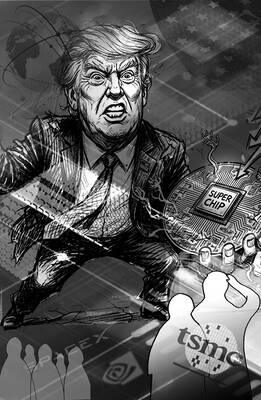
The White House’s decision to take a 9.9 percent stake in Intel Corp is looking like very shrewd business indeed. Since the government bought in at US$20.47 a share last August, the US chipmaker’s surging stock price has delivered the US a US$43 billion return. One of the reasons the investment has so far proved so sound is that the White House has made sure of it. According to The Wall Street Journal, Howard personally pushed deals on Intel’s behalf with some of the most lucrative clients imaginable. They include Nvidia Corp, the company at the heart of the AI
In a Taiwanese university classroom, a lecturer asks in English: “Can anyone give me an example from Taiwan?” Students look down. No one answers. After class, one student writes on the course platform in Mandarin: “I understood the concept, but I didn’t know how to answer in English.” That moment highlights a key issue in Taiwan’s English-medium instruction (EMI) reform: It is not just about more English-taught courses, but whether students can learn, participate and belong. EMI expansion is part of the Bilingual 2030 policy and the Ministry of Education’s BEST Program, aiming to improve English ability, support EMI teaching
A single photograph can cut through a lot of noise, but it can also be used to misrepresent the truth. At the very least, it can concentrate the mind on something that requires further investigation. On Monday last week, Ma Ying-jeou Foundation CEO Tai Hsia-ling (戴遐齡) and former National Security Council secretary-general King Pu-tsung (金溥聰) held a news conference in which they showed a photograph of former foundation CEO Hsiao Hsu-tsen (蕭旭岑), now Chinese Nationalist Party (KMT) deputy chairman. In the image Hsiao is seated next to Xiamen Taiwan Businessmen Association chairman Han Ying-huan (韓螢煥). The two men were holding
The Ministry of the Interior, working with the navy and coast guard, is organizing Taiwan’s first joint exercise simulating escort tankers carrying liquefied natural gas (LNG) and oil through a Chinese blockade. The drills simulate fuel transport along three maritime corridors leading toward Japan, the Philippines and the US. Deputy Minister of the Interior Sawyer Mars (馬士元) said that a blockade of the Taiwan Strait would amount to “almost a 100 percent blockade of the regional energy supply.” Minister of National Defense Wellington Koo said planning to counter a blockade is standard practice in Taipei. While the exercise is limited in


 RSS
RSS