


On Nov. 16, pan-blue camp legislators cut over NT$500 million (US$14.87 million) from the Mainland Affairs Council's (MAC) budget for next year, leaving only NT$268 million for personnel costs.
They also set five conditions for reinstating the budget: the implementation of direct cross-strait transport links; removing all restrictions on the small three links; making it easier for Chinese tourists to visit Taiwan; charter flight services over the Lunar New Year holiday; and direct flight services between Hong Kong and Macau, and Taipei's Sungshan Airport, Kaohsiung's Hsiaokang International Airport and Taichung's Chingchuankang Airport.
MAC Chairman Joseph Wu (
The blue camp has cut the council's budget in an act of vengeance because the government has taken a strict approach to Chen's application to participate in a KMT-Chinese Communist Party (CCP) Forum next month.
The government has demanded that China agree to negotiate the application with Taiwan.
When the pan-blue camp was first threatening to slash the MAC's budget, it faced criticism from the public, with many people wondering which country's legislature the pan-blue legislators belonged to and why they were using Taiwanese taxpayers' money to do work for China.
When the pan-blues unexpectedly disregarded this criticism and went ahead and with wanton deep cuts to the MAC's budget, they showed they had lost all judgement.
The action revealed two frightening attitudes. First, the blue camp's budget review was devoid of professional standards.
They disregarded the well-being of the public and national development needs, they abandoned the principle of social justice and they let political beliefs and ideology decide the budget's fate.
In the current atmosphere of a mutual lack of trust and a stand-off between the government and opposition, government budgets have often encountered unreasonable problems and obstruction.
In cutting the council's budget, pan-blue camp legislators have simply found another way to vent their anger over a strict review of broadcasting license extensions by the Government Information Office (GIO) that raised suspicions that TVBS was funded by Hong Kong and Macau investors.
In addition, the pan-blue camp's refusal to review the eight-year, NT$80 billion flood control and the arms procurement bills shows that they only care about their own partisan interests, and ignore the public's interests.
Second, the pan-blues are also opposing the MAC for the sake of opposition. It seems that these pan-blue legislators are only willing to submit themselves to Beijing, and only consider the benefits for China's leadership when reviewing the MAC's budget.
In the past, the pan-blue camp did not dare to openly collude with Beijing, although it never denied possessing a "greater China complex."
However, since being defeated in last year's presidential elections, the pan-blues have ceased to conceal their pro-China stance.
Furthermore, pan-blue political has-beens such as former KMT chairman Lien Chan (連戰) and People First Party Chairman James Soong (宋楚瑜) have found great solace in Beijing's use of its "united front" strategy after their first-ever visits to China this spring. Other pan-blue politicians have followed suit, jumping on the "China fever" bandwagon.
Since the visits, the pan-blue camp has stopped covering up its pro-Beijing nature and has strengthened its efforts to obstruct the arms procurement bill without considering the welfare of the Taiwanese.
Now, they have gone overboard by slashing the MAC's entire budget and offering the five conditions for reversing its decision as a way to win Beijing's praise.
This week, while traveling to Kyoto, Japan, US President George W. Bush lauded Taiwan's democracy, freedom and prosperity, and urged China to emulate its achievements.
Therefore, we believe Taiwan's most precious assets are its Taiwanese awareness and democratic and economic achievements. Nonetheless, it is tragic to see all of this constantly disparaged by the pan-blues and the nation's pro-China media.
The pan-blue camp has spoken for China and extolled the CCP, and promoted China's "united front" strategy against the Taiwanese. It is also abusing its legislative majority and serving as Beijing's pawn, pressuring the government to open up to China with threats to slash the budgets of all government agencies.
The pan-blues' decision to slash the MAC's budget and its failure to pass the arms procurement bill can not be regarded as a simple check and balance under a democratic system.
Rather, it is a warning for all Taiwanese to be alert to the pan-blues' drift toward China.
Translated by Perry Svensson and Daniel Cheng
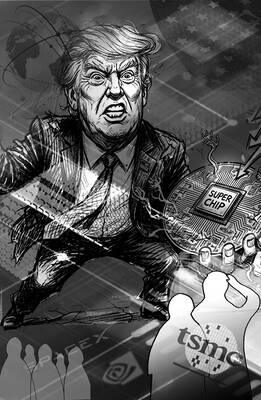
The White House’s decision to take a 9.9 percent stake in Intel Corp is looking like very shrewd business indeed. Since the government bought in at US$20.47 a share last August, the US chipmaker’s surging stock price has delivered the US a US$43 billion return. One of the reasons the investment has so far proved so sound is that the White House has made sure of it. According to The Wall Street Journal, Howard personally pushed deals on Intel’s behalf with some of the most lucrative clients imaginable. They include Nvidia Corp, the company at the heart of the AI
In a Taiwanese university classroom, a lecturer asks in English: “Can anyone give me an example from Taiwan?” Students look down. No one answers. After class, one student writes on the course platform in Mandarin: “I understood the concept, but I didn’t know how to answer in English.” That moment highlights a key issue in Taiwan’s English-medium instruction (EMI) reform: It is not just about more English-taught courses, but whether students can learn, participate and belong. EMI expansion is part of the Bilingual 2030 policy and the Ministry of Education’s BEST Program, aiming to improve English ability, support EMI teaching
A single photograph can cut through a lot of noise, but it can also be used to misrepresent the truth. At the very least, it can concentrate the mind on something that requires further investigation. On Monday last week, Ma Ying-jeou Foundation CEO Tai Hsia-ling (戴遐齡) and former National Security Council secretary-general King Pu-tsung (金溥聰) held a news conference in which they showed a photograph of former foundation CEO Hsiao Hsu-tsen (蕭旭岑), now Chinese Nationalist Party (KMT) deputy chairman. In the image Hsiao is seated next to Xiamen Taiwan Businessmen Association chairman Han Ying-huan (韓螢煥). The two men were holding
The Ministry of the Interior, working with the navy and coast guard, is organizing Taiwan’s first joint exercise simulating escort tankers carrying liquefied natural gas (LNG) and oil through a Chinese blockade. The drills simulate fuel transport along three maritime corridors leading toward Japan, the Philippines and the US. Deputy Minister of the Interior Sawyer Mars (馬士元) said that a blockade of the Taiwan Strait would amount to “almost a 100 percent blockade of the regional energy supply.” Minister of National Defense Wellington Koo said planning to counter a blockade is standard practice in Taipei. While the exercise is limited in


 RSS
RSS