


As I write this, violent clashes with the police have been going on for nearly two weeks in the suburbs of Paris and other French cities, with cars being set on fire at a rate of nearly 1,000 per night. Why is this happening? How far can it go?
The existence of thousands of unemployed young people, without income or roots, idle and knowing only violence to express their quest for recognition, is not particularly French.
Everyone remembers the Watts, Newark and Detroit riots in the US in the 1960s, and the riots in Liverpool in the UK in the early 1980s, as well as in Bradford, Oldham and Burnley in recent years. Likewise, France witnessed riots in Vaux-en-Velin, near Lyon, 20 years ago. So it is important to distinguish what is common to many developed countries and what is specific to France.
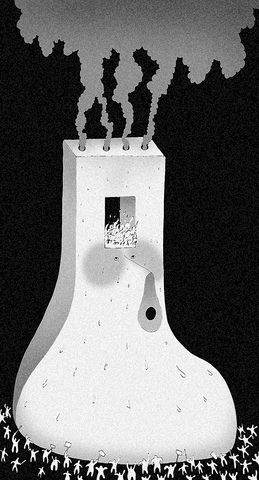
All the developed economies have undergone profound changes over the last 30 years. We have gone from managerial to stockowner capitalism, from economies with large doses of state direction to far more deregulated markets, from the active and expansive social policies of the 1960s and 1970s to a world in which such spending is constantly shrinking.
Although wealth has been growing constantly -- GDP has more than doubled in the last 50 years -- the share of wages in the total has diminished by 10 percent, even while millions of the rich have become much richer.
Everywhere, this has meant massive pauperization of the least favored part of the population. In rich countries, mass poverty, which seemed to have been eliminated around the 1980s, has reappeared.
Access to good education, and even more so to the labor market, is increasingly restricted for many young people, especially those who come from poor or single-parent families or from minority ethnic backgrounds, languages or religions.
restrictions
These people feel rejected and unrecognized. "Because they want to break us, we will break everything" is the motto that best expresses their mood. There are untold reservoirs of social violence in all of our lands.
But against this shared background, France exhibits some important distinctive features.
First, demography: for the last 50 years France has had much higher fertility rates than the rest of Europe -- 1.9 children per woman, compared with the European average of 1.6 and the German or Spanish rates of 1.3.
In Germany, every generation entering the labor market is smaller than the one exiting it. In France, by contrast, 200,000 to 300,000 more people enter the labor market than leave it in each generation -- and this does not include immigration, which, although slowing recently, represents a large number of job seekers. As rates of economic growth have declined, this has meant growing unemployment.
Then there is geography: France's massive urban concentration around the capital -- Paris and its suburbs contain nearly 20 percent of the population -- is unique in Europe. The sheer number of confused and disoriented young people has overwhelmed the French system's capacity to integrate them -- even though its capacity in this regard is, in fact, impressive.
Indeed, France has opened its public educational system to an extraordinary degree, refusing all group rights to minorities, but vigorously affirming personal rights, including full access to all social services, regardless of language, religion, or skin color.
The system is cracking, but only because of the limits of its absorptive capacity, not because of its core principles.
In these circumstances, every French politician has known for the last 20 years that France has been living with a growing risk that isolated incidents might coalesce into a critical mass of violence.
The task of social workers and police, therefore, is to try to resolve -- quickly and discreetly -- each particular incident, in order to dampen the revolt.
What needs to be done also has been well known since 20 years ago, when a nonpartisan report by a cross-party group of big-city mayors unanimously agreed on measures to be taken: efficient repression, highly developed social prevention, a permanent local police presence, and a renewed effort at reintegrating delinquents.
The difficulty with implementing this policy has been that its preventive aspects -- social support and reintegration of delinquents -- appear to the frightened population living in the affected areas as being "soft on crime" and overly generous.
But for the past three years, France has had a government that no longer believes that a socially oriented urban policy works. It believes only in repression and says so openly. As a result, local police forces have been reduced from 20,000 to 11,000, while the national riot police have been reinforced.
insane policy
France is now experiencing a practical demonstration of this insane and totally inefficient policy, with Minister of the Interior Nicolas Sarkozy providing a telling illustration of the new orientation when he described the rebellious young as "scum." It was the proverbial match thrown by a careless smoker into a parched forest. The young responded with a vengeance to Sarkozy's provocation.
The main risk now is that events in the suburbs of large French cities will serve as an example to other young people, whether in the less urban areas of France or in other European countries, who feel socially excluded and are, perhaps, just as prone to violent outbursts.
Solving the problems underlying the French revolt will require time, discretion, mutual respect, community-based social and police work -- rather than a centralized, repressive approach -- and a lot of money. But France is by no means the only country that should be worried.
Michel Rocard, a former French prime minister and leader of the Socialist Party, is a member of the European Parliament.
Copyright: Project Syndicate
When Chinese President Xi Jinping (習近平) sits down with US President Donald Trump in Beijing on Thursday next week, Xi is unlikely to demand a dramatic public betrayal of Taiwan. He does not need to. Beijing’s preferred victory is smaller, quieter and in some ways far more dangerous: a subtle shift in American wording that appears technical, but carries major strategic meaning. The ask is simple: replace the longstanding US formulation that Washington “does not support Taiwan independence” with a harder one — that Washington “opposes” Taiwan independence. One word changes; a deterrence structure built over decades begins to shift.
The cancelation this week of President William Lai’s (賴清德) state visit to Eswatini, after the Seychelles, Madagascar and Mauritius revoked overflight permits under Chinese pressure, is one more measure of Taiwan’s shrinking executive diplomatic space. Another channel that deserves attention keeps growing while the first contracts. For several years now, Taipei has been one of Europe’s busiest legislative destinations. Where presidents and foreign ministers cannot land, parliamentarians do — and they do it in rising numbers. The Italian parliament opened the year with its largest bipartisan delegation to Taiwan to date: six Italian deputies and one senator, drawn from six
Recently, Taipei’s streets have been plagued by the bizarre sight of rats running rampant and the city government’s countermeasures have devolved into an anti-intellectual farce. The Taipei Parks and Street Lights Office has attempted to eradicate rats by filling their burrows with polyurethane foam, seeming to believe that rats could not simply dig another path out. Meanwhile, as the nation’s capital slowly deteriorates into a rat hive, the Taipei Department of Environmental Protection has proudly pointed to the increase in the number of poisoned rats reported in February and March as a sign of success. When confronted with public concerns over young
Taipei is facing a severe rat infestation, and the city government is reportedly considering large-scale use of rodenticides as its primary control measure. However, this move could trigger an ecological disaster, including mass deaths of birds of prey. In the past, black kites, relatives of eagles, took more than three decades to return to the skies above the Taipei Basin. Taiwan’s black kite population was nearly wiped out by the combined effects of habitat destruction, pesticides and rodenticides. By 1992, fewer than 200 black kites remained on the island. Fortunately, thanks to more than 30 years of collective effort to preserve their remaining


 RSS
RSS