


Maybe Premier Frank Hsieh (謝長廷) really is a seer and was able to predict the current awkward political situation.
Before the new legislative session began on Tuesday, he had already taken the example of Japanese Prime Minister Junichiro Koizumi to heart and requested that the pan-blue camp, if it didn't support the Cabinet's flood control bill, overturn the government with a vote of no confidence and let President Chen Shui-bian (
That Hsieh was blocked from delivering his policy report as scheduled on the legislative session's opening day shows he is an intelligent, far-sighted politician, albeit not clever enough to find a way out of his predicament. Instead, he sat there silently, like a character out of a Hemingway novel, waiting unhurried until the bitter end.
The call to dissolve the legislature is of course merely words and not a well thought out political plan. Since a new election would carry potentially high costs for incumbents, lawmakers from both the blue and green camps are unwilling to follow through on the call. And even if an election were to result in the pan-blue camp retaining its majority, it is still not certain that Chen would let them form a Cabinet, since the legislature no longer has the right to approve the premier. Here is why: Chinese Nationalist Party Chairman Ma Ying-jeou (
It is this constitutional shortcoming that has led to the past few years of political deadlock. The governing party's minority in the legislature dictated the development of the conflicts over both the Fourth Nuclear Power Plant four years ago and last year's clash over the 319 Shooting Truth Investigation Special Committee Statute. Although the opposition tried to use the legislature to manipulate the shooting investigation issue, executive power remains in the hands of the Democratic Progressive Party (DPP).
The outcome, when the opposition forced the issue, was the unconstitutional and unworkable 319 Shooting Truth Investigation Special Committee Statute. Faced with the opposition's obstruction, the DPP has been unable to move issues such as the arms purchase, the flood control bill or the right to approve Control Yuan members out of the Procedure Committee and have them passed into law.
Nor is it able to dissolve the legislature and put the issue to the public. This situation has created a political problem that is impacting the people of Taiwan and has become symbolic of the government's inability rule.
In fact, Chen cannot take the initiative to dissolve the legislature. Nor does the legislature have the right to ratify the appointment of the premier. Although the administration has been hampered by the pan-blue camp majority, it is really no more than harassment of the executive.
But the pan-blue camp remains in high spirits as Chinese Nationalist Party (KMT) Chairman Ma Ying-jeou (
This is probably why pan-blue legislators seem to have lost all sense of restraint. Even the sensible Ma seems pleased about their ridiculous performance, while the general public does not even seem to be bothered by the farce.
The political impasse has led to endless conflicts, and with the politicians acting so willfully, the people have realized they can no longer count on politicians to look after their interests. This is a clear example of how the Constitution has succumbed to politics; whether it is the pan-blues undermining the government or the pan-greens reacting fiercely, the model is one of party-to-party confrontation. It is this that has led to a stalemate over the past five years that has hurt both sides grievously.
Even if the public has decided to unseat the government, it will have to wait until 2008 when the next presidential elections are held. By then, will Taiwan's democracy have degenerated into that of a banana republic? This is not a prophecy of doom, but rather a rational prediction of the ugly fate that awaits Taiwan if the present situation persists.
In fact, most people in Taiwan have become disillusioned with the political parties and politicians of both sides. But they can't envision any changes to the current situation. They also tend to look askance at so-called constitutional reform, as they are aware that no politician has a blueprint for reform that goes beyond the immediate concerns of the 2008 presidential election.
The nation has reached a crossroads. It is the pessimistic yet sensible Taiwanese people rather than the selfish politicians that have to decide if they want to shake off this predicament. Whether it is by punishing parties in the year-end mayoral and county commissioner elections, or through a grassroots constitutional movement, it is necessary for the people to find a constitutional framework to keep the two parties in line. This will be the greatest challenge to Taiwan's democracy.
Hsu Yung-ming is a research fellow at the Research Center for Humanities and Social Sciences at Academia Sinica.
TRANSLATED BY PERRY SVENSSON AND DANIEL CHENG
A gap appears to be emerging between Washington’s foreign policy elites and the broader American public on how the United States should respond to China’s rise. From my vantage working at a think tank in Washington, DC, and through regular travel around the United States, I increasingly experience two distinct discussions. This divergence — between America’s elite hawkishness and public caution — may become one of the least appreciated and most consequential external factors influencing Taiwan’s security environment in the years ahead. Within the American policy community, the dominant view of China has grown unmistakably tough. Many members of Congress, as
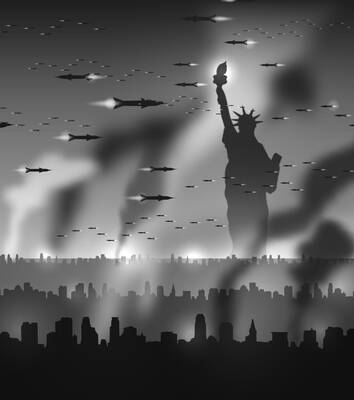
After declaring Iran’s military “gone,” US President Donald Trump appealed to the UK, France, Japan and South Korea — as well as China, Iran’s strategic partner — to send minesweepers and naval forces to reopen the Strait of Hormuz. When allies balked, the request turned into a warning: NATO would face “a very bad” future if it refused. The prevailing wisdom is that Trump faces a credibility problem: having spent years insulting allies, he finds they would not rally when he needs them. That is true, but superficial, as though a structural collapse could be caused by wounded feelings. Something
Former Taipei mayor and Taiwan People’s Party (TPP) founding chairman Ko Wen-je (柯文哲) was sentenced to 17 years in prison on Thursday, making headlines across major media. However, another case linked to the TPP — the indictment of Chinese immigrant Xu Chunying (徐春鶯) for alleged violations of the Anti-Infiltration Act (反滲透法) on Tuesday — has also stirred up heated discussions. Born in Shanghai, Xu became a resident of Taiwan through marriage in 1993. Currently the director of the Taiwan New Immigrant Development Association, she was elected to serve as legislator-at-large for the TPP in 2023, but was later charged with involvement
Out of 64 participating universities in this year’s Stars Program — through which schools directly recommend their top students to universities for admission — only 19 filled their admissions quotas. There were 922 vacancies, down more than 200 from last year; top universities had 37 unfilled places, 40 fewer than last year. The original purpose of the Stars Program was to expand admissions to a wider range of students. However, certain departments at elite universities that failed to meet their admissions quotas are not improving. Vacancies at top universities are linked to students’ program preferences on their applications, but inappropriate admission


 RSS
RSS