


A source at The Times Magazine, on strict condition of anonymity, tipped me weeks ago that the theme of Sunday's issue would be Money. One article, whispered Rob Hoerburger, copy-desk head (oops! burned another source), would be about Silicon Valley's brat pack: "those who, for example, made upward of US$10 million in the dot-com era but who consider that chump change."
In the grand scheme of American economic linguistics, far more significant than the profits or predations of Web-site wizards is the emergence and staying power of the phrase chump change. The alliteration that drove its predecessor phrase, chicken feed, into innocuous desuetude is a stinging attack on the arrogance of those enviable richies who supposedly use the term.
Begin with chump. In the 1864 edition of J.C. Hotten's Slang Dictionary, it was defined as "the head or face. ... A half-idiotic or daft person is said to be off his chump." The chump then became synonymous with "fool": Senator Marcus A. Hanna, who considered "politician" to be a high calling, in 1902 derided an opponent: "I used to think he was a politician, but I don't now. He's a chump."
That sense of being a jerk, easily defeated, was accentuated by its contrast with the similar-sounding champ. But by 1930, in his Dictionary of the Underworld, Eric Partridge detected a sinister connotation in the verb form of chump, meaning "to hoodwink": "Every once in a while I chump a guy for some real dough." That meaning was taken up in the world of prostitution, married to "trivial amount," and in 1967, Robert Beck wrote in Pimp that in the 1940s "Western whores were lazy and satisfied with making `chump change.'" The novelist George Cain wrote in the 1970 Blueschild Baby, "The toughs stand at the entrances ... jingling chump change in their pockets." James Ellroy had his fictional villain in 1988 "only making chump change gigging on Central Avenue."
Now the phrase is used 24/7 (a numeric locution that has temporarily replaced the nondigital round the clock as well as the slangily natural allatime). It is most frequently used to describe a huge number that pales in comparison with an even bigger number: "An extra US$11 billion in the highway bill may seem like chump change to most of the Senate," grumbles the San Antonio Express. Or, as my source uses the phrase, it's what dot-com dukes think of as a measly US$10 million.
Relatedly....
NOMICSNOMICS
I had a hand, as a White House speechwriter back in 1969, in popularizing the word Nixonomics. It seemed like a nice encapsulation of a philosophy of a "full-employment budget" but soon became a handy phrase that liberals could use to castigate stagflation and conservatives to hoot at wage and price controls.
Now the last two syllables of economics are making a comeback. Nomics is in, with or without the initial n. We have genomics, mapping the DNA sequencing of sets of genes, and the more recent proteomics, analyzing the interaction of the proteins produced by the genes of a particular cell. Ergonomics is the science of designing modern equipment to reduce discomfort as we plonk our way painfully through the carpel tunnel of love. Leaping on the -nomics bandwagon, with the vowel o inserted, is rockonomics, the monetary machinations of the huge and lucrative music industry.
Here's my advice to White House aides of all stripes: If your president's name ends with an n, brace yourself for an -omics branding. Thus did we have Nixonomics, Reaganomics and Clintonomics. We did not have Fordonomics or Carternomics or Bushonomics, nor would we have had Dukakisonomics or Gorenomics or Kerrynomics. It has nothing to do with politics; it's the elision quality of the last letter of the president's last name.
BOILING BOOTS
President Vladimir Putin of Russia angrily rebutted charges at a news conference in Yalta last fall that he was trying to extend his power into the former Soviet republics of Belarus, Kazakhstan and Ukraine: "This is total nonsense, absurdity, soft-boiled boots." The Russian adjective was vsmiatku, meaning "lightly boiled," which professor Paul Austin and professor Tatiana Patera at McGill University in Canada inform me literally modifies cooked eggs and is used colloquially, especially in relation to boots, to mean "nonsense."
Last month, faced with a similar accusation that he was putting pressure on defiant Baltic states, Putin returned to his favorite figure of speech: "This is complete nonsense -- soft-boiled boots."
Russians classify such a figure of speech as Putinki, the equivalent of our "Bushisms." Perhaps this one is rooted in frozen-Siberian lore; perhaps not. In the back part of my frontal cortex, where I store unforgettable movie scenes from 1925, there is Charlie Chaplin's Thanksgiving dinner in The Gold Rush. The Tramp, starving and freezing, stews one of his leather boots and eats it fastidiously, as at a feast: first filleting it, then twirling the laces on his fork and daintily sucking the nails of the boot as if they were succulent quail bones. Inspired "nonsense."
Could it be that Russians, who enjoyed Chaplin in his silent days, absorbed that scene into their culture? We will see if citations turn up from before 1925, because Russian lexicographic irregulars keep a close eye on this space.
In an article on the need to steal words from other languages to fill our vocabu-gap, I noted references to razbliuto, "a feeling a person has for someone he or she once loved but no longer feels the same way about." It came to me from some Russian speakers but generated a dozen letters from others who insist that the word does not exist. These nyet-sayers are joined by the two experts I consulted, Austin and Patera at McGill. Others write that the word my original sources must have had in mind is the verb razliubit, which means simply "to stop loving."
My next column may be about the word retraction.
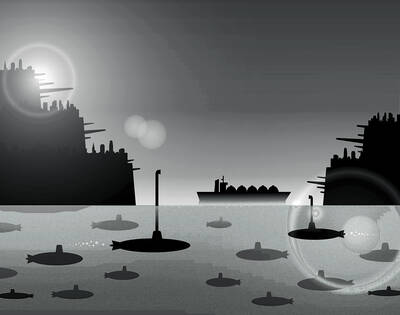
In the event of a war with China, Taiwan has some surprisingly tough defenses that could make it as difficult to tackle as a porcupine: A shoreline dotted with swamps, rocks and concrete barriers; conscription for all adult men; highways and airports that are built to double as hardened combat facilities. This porcupine has a soft underbelly, though, and the war in Iran is exposing it: energy. About 39,000 ships dock at Taiwan’s ports each year, more than the 30,000 that transit the Strait of Hormuz. About one-fifth of their inbound tonnage is coal, oil, refined fuels and liquefied natural gas (LNG),
To counter the CCP’s escalating threats, Taiwan must build a national consensus and demonstrate the capability and the will to fight. The Chinese Communist Party (CCP) often leans on a seductive mantra to soften its threats, such as “Chinese do not kill Chinese.” The slogan is designed to frame territorial conquest (annexation) as a domestic family matter. A look at the historical ledger reveals a different truth. For the CCP, being labeled “family” has never been a guarantee of safety; it has been the primary prerequisite for state-sanctioned slaughter. From the forced starvation of 150,000 civilians at the Siege of Changchun
The two major opposition parties, the Chinese Nationalist Party (KMT) and the Taiwan People’s Party (TPP), jointly announced on Tuesday last week that former TPP lawmaker Chang Chi-kai (張啟楷) would be their joint candidate for Chiayi mayor, following polling conducted earlier this month. It is the first case of blue-white (KMT-TPP) cooperation in selecting a joint candidate under an agreement signed by their chairpersons last month. KMT and TPP supporters have blamed their 2024 presidential election loss on failing to decide on a joint candidate, which ended in a dramatic breakdown with participants pointing fingers, calling polls unfair, sobbing and walking
In the opening remarks of her meeting with Chinese President Xi Jinping (習近平) in the Great Hall of the People in Beijing on Friday, Chinese Nationalist Party (KMT) Chairwoman Cheng Li-wun (鄭麗文) framed her visit as a historic occasion. In his own remarks, Xi had also emphasized the history of the relationship between the KMT and the Chinese Communist Party (CCP). Where they differed was that Cheng’s account, while flawed by its omissions, at least partially corresponded to reality. The meeting was certainly historic, albeit not in the way that Cheng and Xi were signaling, and not from the perspective


 RSS
RSS