


On Wednesday China's Taiwan Affairs Office (TAO) made its first reaction to the results of Taiwan's legislative elections. The TAO's spokesman, Li Weiyi (
From China's official response it is clear that it has interpreted the pan-green camp's election defeat as an indication that Taiwan independence is contrary to the wishes of the Taiwanese people. China has branded Chen as the greatest disruptive force endangering stability in the Asia-Pacific region.
Lien Chan (
Furthermore, in their analysis of the elections here in Taiwan, the Western media said that the result showed a defeat for the pro-independence pan-green camp by the China-friendly pan-blue camp. In fact, these viewpoints betray a misunderstanding of the real significance of these elections, and are way off the mark of popular opinion in Taiwan.
The Japanese press, which has a greater understanding of the political situation in Taiwan, made a more accurate interpretation. According to the Tokyo Shimbun, the fact that the avidly pro-independence pan-green camp failed to get their majority in the legislature "simply shows that the public is in no rush for independence and does not want tensions to arise with China, and does not signify that the move to independence of the pan-greens has suffered a setback," and also that, "from the slight increase in seats for the pan-greens one can detect that a Taiwan consciousness continues to spread." The Asahi Shimbun said, "this legislative election result has limited Chen Shui-bian's political power, but one cannot infer that it is an obstacle to Taiwan's autonomy or independence per se." According to the Mainichi Shimbun "it is wrong to believe that these elections represent a victory for the opposition parties," and that "if China wishes to see a win-win situation, it must enter into dialogue with Taiwan." Finally, the Daily Yomiuri clearly states that "China would do well not to misread the will of the [Taiwanese] people."
To see the legislative elections as a defeat for the pan-green camp doesn't accord with the facts. In fact, in terms of the number of votes, the greens actually saw a slight increase (2.37 percent), with a gain of one seat. On the other hand, the pan-blue camp actually garnered less support compared to the last legislative elections, with a drop of 2.89 percent, and lost one seat. The problem was that the greens won over 50 percent of the vote in the March presidential election and were excessively optimistic in the run-up to these last legislative elections. The wide gap between their expectations and the election results created an impression of a defeat for the pan-green camp.
But the greens were not defeated and the blues were not victorious. Given that this was a legislative election, we cannot factor out such as personal and local loyalties. Unlike the presidential elections, the legislative elections cannot be taken as a vote on the issue of Taiwan's identity, and so naturally it cannot be interpreted as a defeat, or as saying that independence is contrary to the wishes of the people. The KMT have indeed expanded their base, but the People First Party (PFP) have shrunk in terms of both votes and seats.
Also, although the issues advocated by the pan-green camp, such as the rectification of the country's name and a new constitution, sparked heated debate, they were not the decisive factor for why people voted the way they did. As a result, this election was not about unification or independence, and the pan-green camp's inability to increase their power in the legislature does not mean that the people do not desire independence.
In fact, the turnout for the elections this time set a new low. Moderate voters' unwillingness to walk into polling stations was a silent protest against both the pan-blue and pan-green camps for failing to propose any vision on national development.
Legislative candidates and their parties should pay attention to issues related to the public's livelihood, and propose policies to attract voters' support -- not simply fight one another and talk nonsense. But the campaign was full of excessive rallies featuring heavyweight political leaders. Voters only saw those leaders accusing each other of this and that. They did not see the faces of the candidates. Nor did they understand the candidates' policies, or feel their concern for the interests of the public. These factors made almost half the electorate indifferent toward the elections, to the point that many didn't cast their vote.
Only by deeply discussing the elections from this perspective can we obtain a correct interpretation. If we purposely interpret the election results as the public's preference for unification over independence, we will be "giving strained interpretations and drawing farfetched analogies" (
Rectifying the nation's name and writing a new constitution are steps we must take in order to turn Taiwan into a normal country. The so-called "Taiwan consciousness" has grown every year, instead of shrinking. Even those who advocate maintaining the status quo realize that the Constitution of the Republic of China (ROC), based on a concept of a greater China, is unsuited to Taiwan's current situation.
In that case, eventually, the push for changing the nation's name and making a new constitution will be accepted by the majority of the Taiwanese people through education and grassroots efforts. Besides, although China has severely condemned Taiwan's push for a name change and a new constitution, if Taiwan does not do these things, can it accept the ROC Constitution which actually claims the territory and sovereignty of China and Mongolia, or the ROC's national title and flag?
Although Beijing opposes a name change or a new constitution, isn't its massive oppression of Taiwan worldwide essentially a blockade of all symbols related to the ROC? It has itself denied the legitimacy of the Constitution, national title, and flag of the ROC. Beijing should be very glad if the Taiwanese people can accomplish the goals of changing the nation's name and establishing a new constitution through democratic self-determination, and replace the ROC Constitution opposed by China with a constitution that is suited to Taiwan's current situation. How can it oppose the ROC on the one hand, while also not allowing any change to be made?
Ultimately, the legislative election simply marked a pause in the rapid expansion of the DPP's influence. As for the pan-blue camp, they have managed to maintain their position, but only just. The elections were a power struggle between the political camps, and had nothing to do with ideals or long-term goals. They were certainly not a referendum on the independence/unification issue or the definition of Taiwan as a nation. China's interpretation of the election has been distorted by ideology and reflects its inability to understand the nature of democracy and the feelings of mainstream society in Taiwan.
If China bases its future policy on this erroneous interpretation of the election, it will only increase its pressure on Taiwan, and certainly will not be interested in engaging in dialogue. So when we ask who is "the main source of chaos in the Asia-Pacific region" we can see that the answer is perfectly obvious.
Translated by Eddy Chang, Paul Cooper and Ian Bartholomew
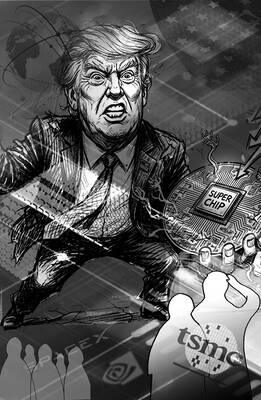
The White House’s decision to take a 9.9 percent stake in Intel Corp is looking like very shrewd business indeed. Since the government bought in at US$20.47 a share last August, the US chipmaker’s surging stock price has delivered the US a US$43 billion return. One of the reasons the investment has so far proved so sound is that the White House has made sure of it. According to The Wall Street Journal, Howard personally pushed deals on Intel’s behalf with some of the most lucrative clients imaginable. They include Nvidia Corp, the company at the heart of the AI
A single photograph can cut through a lot of noise, but it can also be used to misrepresent the truth. At the very least, it can concentrate the mind on something that requires further investigation. On Monday last week, Ma Ying-jeou Foundation CEO Tai Hsia-ling (戴遐齡) and former National Security Council secretary-general King Pu-tsung (金溥聰) held a news conference in which they showed a photograph of former foundation CEO Hsiao Hsu-tsen (蕭旭岑), now Chinese Nationalist Party (KMT) deputy chairman. In the image Hsiao is seated next to Xiamen Taiwan Businessmen Association chairman Han Ying-huan (韓螢煥). The two men were holding
I first met Professor Ray Jiing (井迎瑞) as a film and documentary student at Shih Hsin University’s (SHU) Department of Radio Television and Film in 1988. The following year, he went on to become the director of the Chinese Taipei Film Archive — forerunner of the Taiwan Film and Audiovisual Institute (TFAI). Over his eight-year tenure, Jiing rescued and restored over 200 classic Taiwanese films. In 1997, he established the Graduate Institute of Studies in Documentary and Film Archiving at Tainan National University of the Arts (TNNUA), and I joined the program in his third cohort of students. Beyond a
President William Lai Ching-te’s (賴清德) May 20 second-anniversary address was not just a routine policy review; it was damage control. US President Donald Trump’s remarks — that he did not want to see anyone move toward independence and that the delivery of a major Taiwan arms package could depend on the progress of US-China relations — unsettled Taiwan’s public and created an opening for opposition parties to question whether Taiwan was being treated as a bargaining chip in Washington’s dealings with Beijing. Lai’s speech was designed to close that opening. The address covered the expected ground: sovereignty, cross-strait relations, defense spending,


 RSS
RSS