


In Eastern European folk tales, vampires are nocturnal bloodsuckers who have risen from the dead. We know these creatures' apotheosis, Dracula, as a vampire from Transylvania, a bat-like person with long canine teeth who lies in a coffin during the day and bites necks and drinks blood for sustenance.
But why do we know about Dracula and vampires at all? Why and how did a regional myth grow into one of modern Western culture's most enduring fixtures?
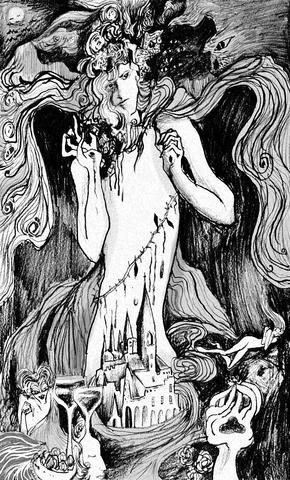
ILLUSTRATION: MOUNTAIN PEOPLE
The historical Dracula, Vlad Tepes, was no vampire. Vlad was born in 1431 and reigned on and off from 1448 as Prince Woiwode of Walachei, the southern part of today's Romania, clashing regularly with the Ottoman Empire, Hungary's King Matthias Corvinus, and the Saxon cities of Transylvania. Although he achieved important victories over the Ottomans, Corvinus took him prisoner, and he was killed in 1477 in renewed fighting with Ottoman troops.
Vlad received the nickname "Draculea" -- derived from "Dragon" -- from his father. Written another way, "Dragolea," the name means "of love" or "the lovely one" -- hardly fitting for a man who developed the unlovely habit of lancing his foes on a stake, from which the nickname "Tepes" (the Impaler) was derived.
Reports of Vlad's cruel method -- by no means unusual at the time -- were already in circulation during his lifetime, and Corvinus probably gave his brutality a particularly bloodthirsty spin. The propaganda campaign against Vlad succeeded brilliantly, satisfying the public's appetite for sensation with graphic images of the vicious, impaling prince.
These images of Vlad have been revived, particularly in the West, to demonize East Europeans. Since the 16th century, Czar Ivan IV -- Ivan the Terrible -- was called the "Russian Dracula." Similarly, the 17th-century Hungarian Transylvanian Countess Elizabeth Bathory, who tortured young girls to death and believed in the curative power of bathing in their blood, contributed to the West's image of Eastern Europe as the heart of darkness of the human soul.
Vampire panic seized the European public repeatedly in the 18th century. In 1732, news swept through the continent that a dead man from a Serbian village killed others at night. His exhumed body had not decayed. A stake was driven through his heart and his body was burned. Soon other bodies were exhumed in various places in Europe and found to be in a similar preserved condition, giving rise to a literature that rigorously examined, among other questions, the connection between vampires and bats, butterflies, and ravens.
But the parallel development of science underpinned efforts to expose such "superstition." In 1755, the enlightened absolutist monarchy in Vienna acted. Empress Maria Theresa prohibited belief in vampires and ordered a thorough examination of possible natural reasons for such unusual events, as well as the actual causes of death. Vampires, according to 18th-century science, were nothing more than the product of victims' delirium.
The spirit of science found a tactical ally in the Catholic Church, which held that belief in vampires defiles the resurrection of Jesus. This position also opened another front in the Church's battle with Eastern European Orthodox Christianity, which lent theological support to vampire myths by teaching that non-decomposed bodies could not go to heaven and could be revivified by the devil.
On both the scientific and the Catholic view, whoever believed in vampires was regarded as superstitious and condemned as uneducated. Thus, at a time when Eastern Europe began to solidify itself in the perception of the West, it did so as a bastion of heresy that had to be "civilized."
But, having debunked the vampire myth, Western intellectuals proceeded to refashion it. Voltaire transferred the image of bloodsucking vampires to speculators, merchants, kings and monks. From here, the line could be drawn to capitalists, Jews, women -- the vamp -- and politicians.
At the same time, people's irrational fears and secret desires could not be suppressed. In the West, occultism emerged in response to the Enlightenment's faith in science, helped by a number of medical professionals who claimed that vampires actually existed. Literary works in which people who committed cruel, bloody acts were transformed into vampires became popular from 1820 onwards.
Vlad Tepes was transformed into a vampire by the most famous of these stories: Bram Stoker's novel Dracula in 1897. Stoker researched vampire myths intensively, and was influenced by historical books, travel descriptions and the Hungarian orientalist Armin Vambery. He linked the various strands of popular myth with historically frightful characters to cement the association of Eastern Europe with obscurantism and darkness in the popular imagination of the West. Viewed against this foil, the West -- with Stoker's Britain at its pinnacle -- emerged as the seat of universal reason.
Belief in vampires in Eastern European societies served its own historical purposes: uniting communities and identifying outsiders, giving concrete form to death fears, explaining mysterious events and, last but not least, providing a means of resistance to the encroachment of Western ideas and patterns of thought.
If the thought of Dracula and vampires makes us shiver, then the vampire myth still fulfills its functions for us: as a projection of our fears and uncertainties, sexual desires, group and personal animosities, and longing for the dissolution of the structure of society. Ultimately, the spiritual gloom and existential dread that we have come to associate with Eastern Europe are merely an extension of our own.
Heiko Haumann is professor of East European and contemporary history, University of Basel. His books include Geschichte Russlands (History of Russia, 2003) and Geschichte der Ostjuden (History of the Jews in Eastern Europe, 1998).
Copyright: Project Syndicate/Institute for Human Sciences

A gap appears to be emerging between Washington’s foreign policy elites and the broader American public on how the United States should respond to China’s rise. From my vantage working at a think tank in Washington, DC, and through regular travel around the United States, I increasingly experience two distinct discussions. This divergence — between America’s elite hawkishness and public caution — may become one of the least appreciated and most consequential external factors influencing Taiwan’s security environment in the years ahead. Within the American policy community, the dominant view of China has grown unmistakably tough. Many members of Congress, as

After declaring Iran’s military “gone,” US President Donald Trump appealed to the UK, France, Japan and South Korea — as well as China, Iran’s strategic partner — to send minesweepers and naval forces to reopen the Strait of Hormuz. When allies balked, the request turned into a warning: NATO would face “a very bad” future if it refused. The prevailing wisdom is that Trump faces a credibility problem: having spent years insulting allies, he finds they would not rally when he needs them. That is true, but superficial, as though a structural collapse could be caused by wounded feelings. Something
Former Taipei mayor and Taiwan People’s Party (TPP) founding chairman Ko Wen-je (柯文哲) was sentenced to 17 years in prison on Thursday, making headlines across major media. However, another case linked to the TPP — the indictment of Chinese immigrant Xu Chunying (徐春鶯) for alleged violations of the Anti-Infiltration Act (反滲透法) on Tuesday — has also stirred up heated discussions. Born in Shanghai, Xu became a resident of Taiwan through marriage in 1993. Currently the director of the Taiwan New Immigrant Development Association, she was elected to serve as legislator-at-large for the TPP in 2023, but was later charged with involvement
Out of 64 participating universities in this year’s Stars Program — through which schools directly recommend their top students to universities for admission — only 19 filled their admissions quotas. There were 922 vacancies, down more than 200 from last year; top universities had 37 unfilled places, 40 fewer than last year. The original purpose of the Stars Program was to expand admissions to a wider range of students. However, certain departments at elite universities that failed to meet their admissions quotas are not improving. Vacancies at top universities are linked to students’ program preferences on their applications, but inappropriate admission


 RSS
RSS