


What do former legislative speaker and People First Party (PFP) Legislator Liu Sung-fan (劉松藩), Yunlin County Commissioner Chang Jung-wei (張榮味), independent Legislator Yen Ching-piao (顏清標), Chinese Nationalist Party (KMT) Legislator Ho Chih-hui (何智輝), former Tuntex Group chairman Chen Yu-hao (陳由豪), and former KMT-turned independent legislator Wu Tzer-yuan (伍澤元) have in common?
The first thing that comes to mind is that they are all members of the pan-blue camp.
The second thing is that they all worked very hard stumping for KMT Chairman Lien Chan (
The third thing is that they all have been under criminal investigation and that they all have been convicted of one form of corruption or another.
One is left wondering why so many pan-blue politicians and supporters have a criminal record.
Huge kickback
During his tenure as legislative speaker, Liu received a huge kickback for helping the Kuangsan Group obtain a loan from the Taichung Business Bank. He was sentenced to four years in prison for breach of trust and given a NT$30 million fine, a sentence that is final and cannot be appealed.
Yen was sentenced to eight years in prison in accordance with the Statute for Punishment of Corruption (
He was also sentenced to 13 years for corruption and attempted murder after having ordered subordinates to spray a car full of people with bullets.
Chang has an even longer record, including possession of arms and vote buying during his tenures as Yunlin County Council speaker and vice speaker. He is also suspected of being involved with the land purchase for the Linnei township incinerator.
Ho was involved in the Chiuchun construction loan scandal.
Chen is an economic fugitive, while Wu was involved in the Sipiantou scandal involving a project to build a water-pumping station in Taipei County.
The crimes of Liu, Chang, Yen, Ho, Chen and Wu comprise what is called "black gold" politics to a tee.
Corruption
This begs the question: Does the pan-blue camp attract corrupt people, or does it produce them?
In light of their role as an opposition alliance following the 2000 and 2004 presidential elections, it is surprising they have not been able to shed their connection to "black gold" politics.
The cases of Ho and Wu hardly need mentioning. Liu's resignation from his position as PFP legislator-at-large is evidence that he would rather flee abroad than go to jail.
After all, he can still find refuge in China, where Chen, Wu and Tseng Cheng-jen (曾正仁) are waiting to form a "club" where they can regain strength, and during the next presidential election, the blue camp can rely on the support of their gangsters and will not need the support of Taiwanese businesspeople in China.
Chang, Yen and Liu all claim they are the victims of "political persecution."
Given this fact, the blue camp could make this their central focus during the next presidential campaign in order show voters how authoritarian the Democratic Progressive Party is.
Chin Heng-wei is editor-in-chief of Contemporary Monthly magazine.
Translated by Perry Svensson
A gap appears to be emerging between Washington’s foreign policy elites and the broader American public on how the United States should respond to China’s rise. From my vantage working at a think tank in Washington, DC, and through regular travel around the United States, I increasingly experience two distinct discussions. This divergence — between America’s elite hawkishness and public caution — may become one of the least appreciated and most consequential external factors influencing Taiwan’s security environment in the years ahead. Within the American policy community, the dominant view of China has grown unmistakably tough. Many members of Congress, as
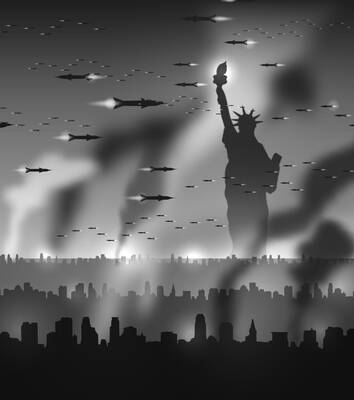
After declaring Iran’s military “gone,” US President Donald Trump appealed to the UK, France, Japan and South Korea — as well as China, Iran’s strategic partner — to send minesweepers and naval forces to reopen the Strait of Hormuz. When allies balked, the request turned into a warning: NATO would face “a very bad” future if it refused. The prevailing wisdom is that Trump faces a credibility problem: having spent years insulting allies, he finds they would not rally when he needs them. That is true, but superficial, as though a structural collapse could be caused by wounded feelings. Something
Former Taipei mayor and Taiwan People’s Party (TPP) founding chairman Ko Wen-je (柯文哲) was sentenced to 17 years in prison on Thursday, making headlines across major media. However, another case linked to the TPP — the indictment of Chinese immigrant Xu Chunying (徐春鶯) for alleged violations of the Anti-Infiltration Act (反滲透法) on Tuesday — has also stirred up heated discussions. Born in Shanghai, Xu became a resident of Taiwan through marriage in 1993. Currently the director of the Taiwan New Immigrant Development Association, she was elected to serve as legislator-at-large for the TPP in 2023, but was later charged with involvement
Out of 64 participating universities in this year’s Stars Program — through which schools directly recommend their top students to universities for admission — only 19 filled their admissions quotas. There were 922 vacancies, down more than 200 from last year; top universities had 37 unfilled places, 40 fewer than last year. The original purpose of the Stars Program was to expand admissions to a wider range of students. However, certain departments at elite universities that failed to meet their admissions quotas are not improving. Vacancies at top universities are linked to students’ program preferences on their applications, but inappropriate admission


 RSS
RSS