


Although President Chen Shui-bian's (
Yesterday, Zhang Mingqing (
China actually obtained a copy of the speech via the US and rushed to announce its position prior to Chen's inauguration. China's two reactions in a week indicate it is gravely concerned with the international response to the speech.
Chen had set goals: to calm the electorate at home, to relieve the anxious US and the international community, and to deprive China of any excuse to use force against Taiwan.
Some people in Taiwan criticized Chen for con-ceding too much regarding the cross-strait relationship in his speech, as he promised that changes to the Constitution would not touch on issues of the country's national flag, title or sovereignty. He also approached the topic of constitutional reform in terms of "re-engineering" rather than as writing a new Constitution. Despite this complaint, the speech was well-received by the public.
Chen's inauguration speech was better received by the international community. It was acclaimed as "responsible and constructive" by the US State Department and viewed positively by other governments. Compared with the international response to Chen's speech, Beijing's comment appears jarring. Its failure to influence international opinion forced it to make another statement.
Yet as the US said on May 17, China's military threat is unnecessary. What Zhang said over the weekend was a mere reiteration of intimidation, which was neither positive nor constructive for cross-strait dialogue. China's decision to make the second statement was simply another mistake.
As Taiwan offers the olive branch of peace and China rattles its saber, the international community can easily tell which side shows flexibility and aspirations for peace, and which side is the troublemaker and source of cross-strait tension. Although power and influence define a country's role in the global arena, the capacity to differentiate right and wrong cannot be ignored. It is easy to tell who is right and who is wrong in the cross-strait relationship from the statements of all sides.
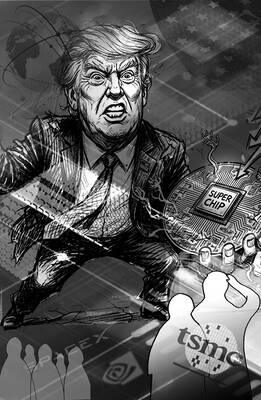
The White House’s decision to take a 9.9 percent stake in Intel Corp is looking like very shrewd business indeed. Since the government bought in at US$20.47 a share last August, the US chipmaker’s surging stock price has delivered the US a US$43 billion return. One of the reasons the investment has so far proved so sound is that the White House has made sure of it. According to The Wall Street Journal, Howard personally pushed deals on Intel’s behalf with some of the most lucrative clients imaginable. They include Nvidia Corp, the company at the heart of the AI
A single photograph can cut through a lot of noise, but it can also be used to misrepresent the truth. At the very least, it can concentrate the mind on something that requires further investigation. On Monday last week, Ma Ying-jeou Foundation CEO Tai Hsia-ling (戴遐齡) and former National Security Council secretary-general King Pu-tsung (金溥聰) held a news conference in which they showed a photograph of former foundation CEO Hsiao Hsu-tsen (蕭旭岑), now Chinese Nationalist Party (KMT) deputy chairman. In the image Hsiao is seated next to Xiamen Taiwan Businessmen Association chairman Han Ying-huan (韓螢煥). The two men were holding
I first met Professor Ray Jiing (井迎瑞) as a film and documentary student at Shih Hsin University’s (SHU) Department of Radio Television and Film in 1988. The following year, he went on to become the director of the Chinese Taipei Film Archive — forerunner of the Taiwan Film and Audiovisual Institute (TFAI). Over his eight-year tenure, Jiing rescued and restored over 200 classic Taiwanese films. In 1997, he established the Graduate Institute of Studies in Documentary and Film Archiving at Tainan National University of the Arts (TNNUA), and I joined the program in his third cohort of students. Beyond a
President William Lai Ching-te’s (賴清德) May 20 second-anniversary address was not just a routine policy review; it was damage control. US President Donald Trump’s remarks — that he did not want to see anyone move toward independence and that the delivery of a major Taiwan arms package could depend on the progress of US-China relations — unsettled Taiwan’s public and created an opening for opposition parties to question whether Taiwan was being treated as a bargaining chip in Washington’s dealings with Beijing. Lai’s speech was designed to close that opening. The address covered the expected ground: sovereignty, cross-strait relations, defense spending,


 RSS
RSS