


With solutions costing up to a mind-numbing US$18,000 trillion, it is among the most expensive questions in history -- "How do you stop people from causing dangerous global warming?"
Eighteen quadrillion dollars is almost 600 times the 2002 world gross domestic product, estimated by the World Bank, of US$32 trillion. If you glued 18 quadrillion dollar bills end to end, they would stretch way past Pluto.
Luckily, most estimates of the costs of curbing global warming by the UN's Intergovernmental Panel on Climate Change (IPCC) run to just hundreds of trillions of dollars over 100 years -- a relative pinprick for a growing world economy.
But the costs of cleaning up human emissions of greenhouse gases like carbon dioxide produced by factories and cars, and of shifting towards cleaner energies such as solar or wind power, are starting to give governments nightmares.
"The long-term costs could be enormous," said Andrei Illarionov, an adviser to Russian President Vladimir Putin, who has backed away from previous promises to quickly ratify the UN's Kyoto Protocol on curbing global warming.
Kyoto, a tiny first step towards reining in human emissions of non-toxic carbon dioxide from fossil fuels blamed for blanketing the planet and driving up temperatures, will collapse without Russia's approval. The US pulled out in 2001.
"Maybe the money would be better spent on promoting economic growth, on ending poverty or on helping developing nations," he told a climate conference in Moscow this month, pointing to the highest IPCC estimate of almost US$18 quadrillion by 2100.
Bush says Kyoto costs too much
Beyond Kyoto, which runs to 2012, climate experts say quadrillions of dollars in the 21st century may hang on interpretations of the word "dangerous."
At root is the 1992 UN Framework Convention on Climate Change, ratified by the US, which aims for "stabilization of greenhouse gas concentrations in the atmosphere that would prevent dangerous anthropogenic (human) interference with the climate system."
A heat wave in Europe this year killed about 15,000 people in France. About 1,300 died in a heat wave in India. There were 562 tornadoes in the US in May, more than any month on record. Was any of that caused by humans and "dangerous"?
If so, humanity would have to start slashing the use of the fossil fuels, a backbone of the world economy from coal-fired power plants and steel mills to trucks and cars.
IPCC chairman Rajendra Pachauri said the meaning of "dangerous" was largely a value judgment and up to governments to define. But he also said: "Scientifically, one can ask ... whether the extent of sea level rise which has taken place, the damage to coral reefs, changes in precipitation levels and impacts on water availability in different parts of the world are not enough reasons for decision makers to decide what is dangerous."
The IPCC, representing a consensus among scientists, said in 2001 there was "new and stronger evidence" that people were behind global warming. Sceptics say shifts in solar radiation, for instance, might explain rising temperatures.
President George W. Bush argues that Kyoto is too expensive and unfairly excludes developing countries. Another 119 countries have ratified the treaty and fear that inaction could bring even more catastrophic costs.
Rising sea levels could inundate some Pacific islands and ports around the world while a warmer climate may cause deserts, flooding, storms and drive many species to extinction.
"We're on the way towards causing dangerous climate change," said Steven Guilbeault of the environmental group Greenpeace. "We should act now before it's too late."
The IPCC says all but one scenario for climate costs -- the US$18 quadrillion tag -- would cut world GDP by one percent or less by 2050. "It has negligible impacts on the projected economic growth," the IPCC said in a report this month.
Even the strictest constraints would brake GDP by only 4.5 percent in 2050. Quadrillions of dollars apparently evaporate because they start in 1990 dollars and get eroded by inflation.
And the scenarios do not gauge benefits of averted climate change -- like the possibility of not having to build Dutch-style dykes -- nor examine short-cut solutions such as sucking carbon dioxide out of the air and burying it.
Even if fully implemented, Kyoto would be of little help. It would cut global temperatures by only 0.15℃ by limiting emissions of gases like carbon dioxide -- a fraction of a forecast of a global temperature rise of 1.4℃ to 5.8℃ by 2100.
A gap appears to be emerging between Washington’s foreign policy elites and the broader American public on how the United States should respond to China’s rise. From my vantage working at a think tank in Washington, DC, and through regular travel around the United States, I increasingly experience two distinct discussions. This divergence — between America’s elite hawkishness and public caution — may become one of the least appreciated and most consequential external factors influencing Taiwan’s security environment in the years ahead. Within the American policy community, the dominant view of China has grown unmistakably tough. Many members of Congress, as
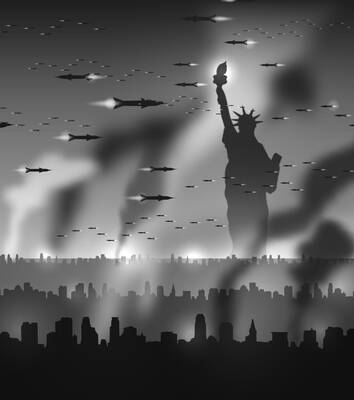
After declaring Iran’s military “gone,” US President Donald Trump appealed to the UK, France, Japan and South Korea — as well as China, Iran’s strategic partner — to send minesweepers and naval forces to reopen the Strait of Hormuz. When allies balked, the request turned into a warning: NATO would face “a very bad” future if it refused. The prevailing wisdom is that Trump faces a credibility problem: having spent years insulting allies, he finds they would not rally when he needs them. That is true, but superficial, as though a structural collapse could be caused by wounded feelings. Something
Former Taipei mayor and Taiwan People’s Party (TPP) founding chairman Ko Wen-je (柯文哲) was sentenced to 17 years in prison on Thursday, making headlines across major media. However, another case linked to the TPP — the indictment of Chinese immigrant Xu Chunying (徐春鶯) for alleged violations of the Anti-Infiltration Act (反滲透法) on Tuesday — has also stirred up heated discussions. Born in Shanghai, Xu became a resident of Taiwan through marriage in 1993. Currently the director of the Taiwan New Immigrant Development Association, she was elected to serve as legislator-at-large for the TPP in 2023, but was later charged with involvement
Out of 64 participating universities in this year’s Stars Program — through which schools directly recommend their top students to universities for admission — only 19 filled their admissions quotas. There were 922 vacancies, down more than 200 from last year; top universities had 37 unfilled places, 40 fewer than last year. The original purpose of the Stars Program was to expand admissions to a wider range of students. However, certain departments at elite universities that failed to meet their admissions quotas are not improving. Vacancies at top universities are linked to students’ program preferences on their applications, but inappropriate admission


 RSS
RSS