


Mahathir Mohamad is stepping down after serving more than 22 years as the leader of Malaysia and its ruling United Malay National Organisation (UMNO). Today's gleaming, modern Malaysia is unimaginable without Mahathir and the UMNO, which also produced Tunku Abdul Rahman, the country's first prime minister.
Like Mahathir, Malaysia's fourth prime minister, Tunku led the government and the party for more than twenty years. Generation-long reigns seem to have served Malaysia exceedingly well since independence. Indeed, the continuity delivered by these two men is the secret of Malaysia's success as a rapidly developing multicultural state.
Both began their careers as Malay nationalists who sought to promote the rights of the Malay majority after the British left. But they also recognized that the country's sizable and economically powerful Chinese and Indian minorities, among other groups, were critical to the country's development and should be persuaded to accept the new Malay-led state as their own.
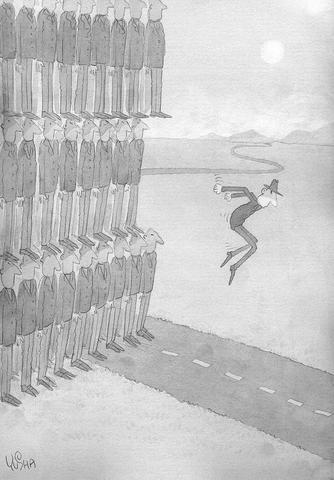
ILLUSTRATION: YU SHA
Mahathir became prime minister in 1981 when the region was on the eve of historic change, following the end of the Vietnam War and Indonesia's stabilization following the bloody civil strife of the 1960s. The global economic system was buoyant and East Asia, not least post-Mao China, was more deeply committed to supporting that system than anyone expected. This encouraged Mahathir to make a clean break with his country's British colonial heritage.
His call to "look east" marked the beginning of an ambitious industrialization policy that culminated, during his tenth year in power, with the Vision 2020 plan to catch up with Western levels of development. By 1997, Mahathir was at the pinnacle of his power, inspiring the country to believe that it would not be long before all of its communities could see themselves as sharing a common Malay nationality.
But the Asian financial crisis that struck later that year halted the region's trajectory of rapid growth. Against most international advice, Mahathir imposed capital controls and a fixed exchange rate for the ringgit to buy time for recovery. He also sought to shift the sense of crisis away from economics to politics (where he retained an iron grip) by removing his designated heir, Anwar Ibrahim, who was Deputy Prime Minister and Minister of Finance. Anwar's arrest and trial stunned the country, but Mahathir surprised few Malays -- allies or opponents -- by restoring his authority so thoroughly following the crisis to be able to handpick Abdullah Badawi as his successor.
The launch of the war on terror provided Mahathir with another opportunity to recover politically. In the face of a world frightened by Islam, Mahathir was able to affirm a neglected facet of his leadership, repeatedly reminding the world that he presided over the one country in the world where a Muslim majority and large non-Muslim minorities live in peace.
There are several reasons for this success, and Mahathir deserves much of the credit. Despite wearing his Malay nationalism on his sleeve, Mahathir ultimately persuaded most non-Malays that he was not simply a communal leader but someone who cared for all Malaysia's communities. In time, he made people forget that he had opposed Tunku Abdul Rahman for not being sufficiently "Malay" and for conceding too much to the Chinese and Indian coalition partners in Tunku's early post-independence governments.
Mahathir, the first commoner to be Malaysian prime minister, became a leading Asian modernizer in another fundamental way as well. He quickly took up a divisive constitutional battle against the hereditary Malay rulers, the nine sultans, and succeeded in curtailing their privileges and powers.
Having overcome the inertia of communal suspicions and dynastic traditions, Mahathir was able to drive the country onto a course of rapid industrialization.
Initially, his ambitious plans to make Malaysia an economic model for developing nations exposed him to both ridicule and admiration. Many thought that he was moving too far, too fast; that he was expecting too much from Malays, who were being asked to make the cultural quantum leap from village to boardroom in a generation. But he was determined to break the traditional Malay mold and succeeded in building a new -- albeit still small -- urban middle class.
Mahathir appears to have been spurred on by the successes of the neighboring island-state of Singapore, briefly a part of Malaysia, on its swift march to First World status. Having studied for his medical degree in Singapore, he appreciated the country's commitment to modernity. He will not want Malaysia to fall far behind.
This competitive approach towards Singapore is in line with the concerns he expressed in his influential book, The Malay Dilemma. His thinking has become more adventurous and he has moved on to tackling the world of cyberspace and multimedia corridors. But the goal is still to build a Malaysia where Malays will always lead non-Malay minorities in shaping the country's future.
That, perhaps, is the greatest continuity of all in Malaysia's legacy of generational rulers.
Wang Gungwu is director of the East Asian Institute, University of Singapore.
Copyright: Project Syndicate
A gap appears to be emerging between Washington’s foreign policy elites and the broader American public on how the United States should respond to China’s rise. From my vantage working at a think tank in Washington, DC, and through regular travel around the United States, I increasingly experience two distinct discussions. This divergence — between America’s elite hawkishness and public caution — may become one of the least appreciated and most consequential external factors influencing Taiwan’s security environment in the years ahead. Within the American policy community, the dominant view of China has grown unmistakably tough. Many members of Congress, as
After declaring Iran’s military “gone,” US President Donald Trump appealed to the UK, France, Japan and South Korea — as well as China, Iran’s strategic partner — to send minesweepers and naval forces to reopen the Strait of Hormuz. When allies balked, the request turned into a warning: NATO would face “a very bad” future if it refused. The prevailing wisdom is that Trump faces a credibility problem: having spent years insulting allies, he finds they would not rally when he needs them. That is true, but superficial, as though a structural collapse could be caused by wounded feelings. Something
Former Taipei mayor and Taiwan People’s Party (TPP) founding chairman Ko Wen-je (柯文哲) was sentenced to 17 years in prison on Thursday, making headlines across major media. However, another case linked to the TPP — the indictment of Chinese immigrant Xu Chunying (徐春鶯) for alleged violations of the Anti-Infiltration Act (反滲透法) on Tuesday — has also stirred up heated discussions. Born in Shanghai, Xu became a resident of Taiwan through marriage in 1993. Currently the director of the Taiwan New Immigrant Development Association, she was elected to serve as legislator-at-large for the TPP in 2023, but was later charged with involvement
Out of 64 participating universities in this year’s Stars Program — through which schools directly recommend their top students to universities for admission — only 19 filled their admissions quotas. There were 922 vacancies, down more than 200 from last year; top universities had 37 unfilled places, 40 fewer than last year. The original purpose of the Stars Program was to expand admissions to a wider range of students. However, certain departments at elite universities that failed to meet their admissions quotas are not improving. Vacancies at top universities are linked to students’ program preferences on their applications, but inappropriate admission


 RSS
RSS