


Two weeks ago the great-and-good finance ministers of the European Monetary Union (EMU) gathered to consider the euro zone's economic condition. They ruminated over the most recent economic forecast, which projects annual GDP growth in the euro zone this year at a pathetically anemic 0.7 percent. Then, to a minister, without exception, they all but decided that their economies should suffer more of the same, if not worse.
They reiterated their commitment to the Stability and Growth Pact, which requires euro-zone countries to raise taxes and cut spending, putting even more downward pressure on their economies. The pact is already knocking Germany into recession, and Italy's government is struggling to revise its growth forecasts fast enough to keep up with falling output. But none of this is apparently enough to force officials to re-examine their priorities.
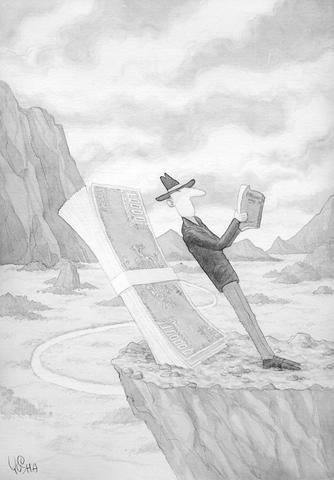
Some EU finance ministers still view the Stability Pact as the "cornerstone" of EMU. Others talk of the importance of obeying the "rules of the game." Still others say that while it is clearly essential to restore economic growth, the recovery must occur "within the spirit of the Pact."
From the American side of the Atlantic, all of these rationales seem utterly bizarre.
The last time an American government tried to ensure a balanced budget in the face of a recession was over seventy years ago, during the presidency of Herbert Hoover at the outset of the Great Depression. Since then the broad consensus in the US has been that cyclical economic distress requires the use of budget deficits to ameliorate suffering, stimulate aggregate demand, and hasten recovery.
Economists call these cyclical fiscal boosts "automatic stabilizers." When private incomes fall, so do public revenues. The reduction in tax collection can increase disposable income. But, more importantly, when private incomes fall, government social-welfare expenditures rise, sparking a recovery in demand, output, investment, and employment. The fall in taxes and the rise in spending do widen the budget deficit, but in a healthy and useful way.
On the American side of the Atlantic, the usefulness of these automatic fiscal stabilizers is unchallenged. On the contrary, whenever recession threatens, political debate revolves around whether they need to be reinforced by additional stimulus via discretionary fiscal policy. No one considers how to put further downward pressure on the economy by raising tax rates and cutting back on spending programs. Neither Democrats nor Republicans have an interest in choking off economic activity. This is not a partisan issue.
Nor is it even a fiscal discipline issue. Whenever proposals have surfaced for some sort of balanced-budget amendment to the US Constitution, proponents have typically included exemptions not just for war, but also for recessions.
We know the origins of the Stability and Growth Pact. Northern European countries -- particularly Germany and the Netherlands -- prided themselves on traditionally maintaining moderate debt-to-GDP ratios and relatively low interest rates. These countries saw that Southern European countries -- Italy and Greece were the biggest worries -- traditionally had high debt-to-GDP ratios and relatively high nominal interest rates because of their perceived tolerance of inflation.
The Northern European countries feared that deficit spending by the South might ultimately create pressure for partial monetization of their debt through inflation of the euro -- or, more precisely, their leaders feared that investors, fearing the same thing, would demand higher interest rates. The Stability and Growth Pact was intended to keep the public debts of southern Europe low, and thus keep interest rates low by reassuring investors that national debts would never be allowed to rise high enough to generate serious inflationary pressures.
But if you look at the euro zone's economic problems today, the danger of high long-term nominal interest rates does not even rank among investors' top 10 concerns. At the very least, investors clearly do not fear that high debt will lead governments to stoke inflation by printing more money. The EU's problems are stagnant output, high structural unemployment, weak productivity growth, the wasteful and unfair Common Agricultural Policy (CAP), and the forthcoming structural adjustments from the expansion of the EU itself.
From one perspective, it is good that the euro zone's finance ministers are eager to keep their national debts low in the long term: it is a sign that the victories over inflation won in the 1970s will not be casually thrown away.
But it is dangerous to become obsessed with the past. There is no more certain route to economic disaster than to put on historical blinders. As Herbert Hoover could attest, when we see only the economic policy problems of a generation ago, we risk missing the hazards that lie directly in front of our eyes.
J. Bradford DeLong is professor of economics at the University of California at Berkeley and a former assistant US treasury secretary. Copyright: Project Syndicate
When Chinese President Xi Jinping (習近平) sits down with US President Donald Trump in Beijing on Thursday next week, Xi is unlikely to demand a dramatic public betrayal of Taiwan. He does not need to. Beijing’s preferred victory is smaller, quieter and in some ways far more dangerous: a subtle shift in American wording that appears technical, but carries major strategic meaning. The ask is simple: replace the longstanding US formulation that Washington “does not support Taiwan independence” with a harder one — that Washington “opposes” Taiwan independence. One word changes; a deterrence structure built over decades begins to shift.
The cancelation this week of President William Lai’s (賴清德) state visit to Eswatini, after the Seychelles, Madagascar and Mauritius revoked overflight permits under Chinese pressure, is one more measure of Taiwan’s shrinking executive diplomatic space. Another channel that deserves attention keeps growing while the first contracts. For several years now, Taipei has been one of Europe’s busiest legislative destinations. Where presidents and foreign ministers cannot land, parliamentarians do — and they do it in rising numbers. The Italian parliament opened the year with its largest bipartisan delegation to Taiwan to date: six Italian deputies and one senator, drawn from six
Recently, Taipei’s streets have been plagued by the bizarre sight of rats running rampant and the city government’s countermeasures have devolved into an anti-intellectual farce. The Taipei Parks and Street Lights Office has attempted to eradicate rats by filling their burrows with polyurethane foam, seeming to believe that rats could not simply dig another path out. Meanwhile, as the nation’s capital slowly deteriorates into a rat hive, the Taipei Department of Environmental Protection has proudly pointed to the increase in the number of poisoned rats reported in February and March as a sign of success. When confronted with public concerns over young
Taipei is facing a severe rat infestation, and the city government is reportedly considering large-scale use of rodenticides as its primary control measure. However, this move could trigger an ecological disaster, including mass deaths of birds of prey. In the past, black kites, relatives of eagles, took more than three decades to return to the skies above the Taipei Basin. Taiwan’s black kite population was nearly wiped out by the combined effects of habitat destruction, pesticides and rodenticides. By 1992, fewer than 200 black kites remained on the island. Fortunately, thanks to more than 30 years of collective effort to preserve their remaining


 RSS
RSS